Key Points
- Mohammed Fahir Amaaz, 21, was jailed for three-and-a-half years after being convicted over a violent incident at Manchester Airport.
- The case involved assaults on two female police officers, PC Lydia Ward and PC Ellie Cook.
- PC Lydia Ward suffered a broken nose during the attack.
- The incident began in Terminal 2 and unfolded after police were called to deal with a disturbance.
- The court heard that the assault happened in front of families and children.
- The sentencing took place at Liverpool Crown Court.
- A separate assault on a civilian in the airport café was part of the wider incident.
- The case attracted attention because footage circulated widely and the officers spoke publicly about the impact.
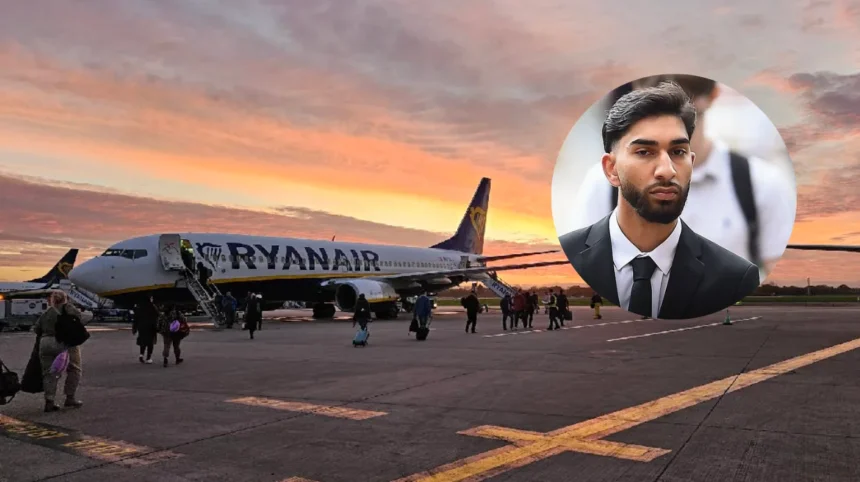
Manchester (Manchester Mirror) June 27, 2026 – Mohammed Fahir Amaaz has been jailed for three-and-a-half years after being found guilty of assaulting two female police officers during a violent incident at Manchester Airport.
The case centred on disorder at Terminal 2 on 23 July 2024, when police were called after a disturbance involving a passenger in the airport’s Starbucks café. Officers moved in to arrest him, and the situation escalated into a physical confrontation. During the incident, PC Lydia Ward was punched in the face and suffered a broken nose, while PC Ellie Cook was also assaulted.
The sentencing followed proceedings at Liverpool Crown Court, where the judge considered the seriousness of the violence and the effect on the officers involved. The court heard that the assault took place in a busy public area and was witnessed by families and children. Prosecutors said CCTV and witness evidence helped establish what happened during the encounter.
The victim impact statement from PC Lydia Ward added a personal dimension to the case. She described the attack as cowardly and said the experience had been difficult to process. Her account also highlighted the pressure officers can face after high-profile incidents that attract public comment and online reaction.
What was the background to the case?
The case began with a disturbance inside Manchester Airport that led police to intervene. According to the reporting on the case, Amaaz had already been involved in an earlier confrontation with a member of the public before officers attempted to arrest him. That arrest attempt then turned into the assault that led to the prison sentence.
The wider court process included evidence from CCTV, witness accounts and the officers’ own testimony. The prosecution argued that the violence was unprovoked and serious enough to justify a custodial sentence. The court accepted the central findings and imposed imprisonment rather than a community penalty.
The case also drew attention because it involved officers being attacked while performing their duties in a crowded transport hub. Violence against emergency workers often receives strong public scrutiny, and this incident became part of a wider debate about respect for police officers and the risks they face in public-facing roles.
Why does this case matter?
This case matters because it shows how quickly an airport disturbance can become a serious criminal matter. A public setting, a busy terminal and the presence of officers responding to an arrest created a situation that escalated in front of bystanders.
It also matters because the victim officers were women, and the attack prompted discussion about abuse directed at frontline police staff. The courtroom comments and victim statements showed the personal impact that such incidents can have long after the physical injuries have healed.
The sentence is likely to be seen as a warning that assaults on police officers, especially in public and during operational duties, will be treated as serious offences. It also reinforces the role of video evidence and witness accounts in modern criminal cases.
Background of the development
The Manchester Airport case developed from an incident in July 2024 and moved through investigation, trial and sentencing over the following months. The prosecution relied on CCTV footage, witness statements and evidence from the officers involved. The court process eventually led to conviction and a custodial sentence for Amaaz.
The incident received wider attention because footage of the altercation circulated online and the case became a subject of public discussion. The involvement of two female officers, the location at one of the UK’s busiest airports and the visible injuries sustained during the incident all contributed to the level of coverage.
The sentencing marked the final stage of the main case reported in the media. It closed a legal process that had already drawn interest because of the public nature of the assault and the serious consequences for the officers involved.
Prediction
For police officers, this case may strengthen calls for clearer protection and quicker support when arrests turn violent in public spaces. It may also encourage more attention to how officers are trained to deal with fast-moving confrontations in crowded places.
For airport passengers, the case is likely to reinforce the idea that airport security and police presence are essential parts of maintaining order in busy terminals. It may also make the public more aware of how quickly routine intervention can become a serious criminal incident.
For the wider audience, the sentence may be viewed as part of a broader message that assaults on emergency workers carry real prison consequences. The case is likely to remain relevant in discussions about public conduct, violence against police and accountability in crowded transport settings.