Key Points
- Live Facial Recognition (LFR) technology was used by Greater Manchester Police at the Caribbean Carnival at Manchester, which was held on 8–9 August 2026.
- Over two days, the carnival had tens of thousands of people and was held without any major disturbances according to the police.
- Live Facial Recognition raised 34 alerts throughout the weekend; of which 11 led to arrests for offenses such as breaking the sexual harm prevention order, fraud, not turning up in court, and theft.
- Out of the remaining 23 alerts, 11 were related to registered sex offenders, whose conditions were verified, and 5 were known for carrying knives.
- A lost child was found through LFR technology, and no misidentification was reported by the police in this operation.
- Since October 2025, over 80 LFR operations have been undertaken by GMP with 850,000 faces being scanned in which one false alert, 359 alerts, 101 arrests, and 53 charges were reported.
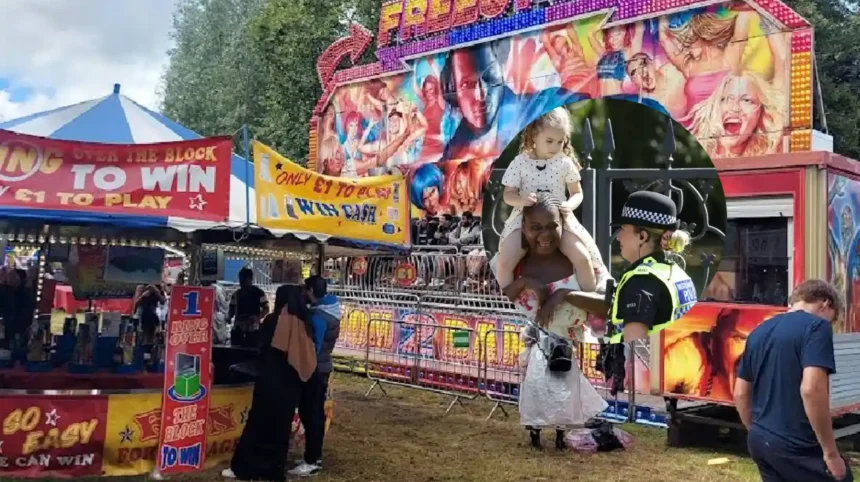
Manchester Police (Manchester Mirror) August 10, 2026 – Manchester’s Caribbean Carnival concluded on Sunday evening with no significant public order incidents, according to Greater Manchester Police (GMP), which attributed part of the operation’s success to the use of Live Facial Recognition (LFR) technology. As reported by Nathan Marsh of Hits Radio, GMP confirmed that officers deployed LFR vans across the event site in Moss Side and Alexandra Park over the two-day celebration, which drew tens of thousands of visitors for the parade, live music and community activities.
The force said the technology produced 34 alerts across Saturday and Sunday, with 11 leading to arrests on charges including breach of a sexual harm prevention order, fraud, failing to appear at court, and theft. The remaining 23 alerts led to officers checking 11 registered sex offenders against their licence conditions and engaging five individuals known to regularly carry knives, while a missing child was also identified with LFR assistance. GMP stated there were no misidentifications during the scans carried out over the weekend.
Assistant Chief Constable Rick Jackson, who served as Gold Commander for the carnival, described the event as “a fantastic success from a policing perspective” and praised LFR as
“a great tool in identifying everything from wanted criminals to missing people, doing so accurately and without any misidentifications”.
He added that officers were present throughout to explain how the system works and to answer public questions.
How does Live Facial Recognition work at public events?
Live Facial Recognition operates by capturing video footage from cameras mounted on GMP vehicles, then using specialist software to create a biometric map—essentially a mathematical representation—of each face detected within a defined zone. This biometric is compared in real time against a bespoke police watchlist comprising individuals wanted by the courts, suspects in criminal investigations, and vulnerable missing persons.
If the system flags a potential match, an alert is sent to an engagement team of officers on the ground, who then verify the identity before taking any policing action. According to GMP, if no match is found the biometric data is deleted immediately, while CCTV footage is retained for 31 days for complaints or evidential purposes. For the carnival operation, all images were deleted within 24 hours, the force said.
Detective Chief Superintendent Neil Jones, GMP’s Live Facial Recognition Lead, previously told ITV News Granada that the public had “absolutely nothing to worry about because the software automatically deletes any images, and there is no retained record that you might get with other CCTV systems”. He stressed that LFR only alerts officers if a person’s image has been uploaded to a police watchlist.
What were the operational results and official statements?
GMP’s post-event statement confirmed 34 LFR alerts, 11 arrests and the identification of a missing child, with no misidentifications recorded during the carnival deployment. Assistant Chief Constable Rick Jackson said: “The overwhelming majority of people enjoyed themselves sensibly and safely… LFR has been a great tool in identifying everything from wanted criminals to missing people, doing so accurately and without any misidentifications”.
In broader operational terms, GMP reported that since LFR was introduced in October 2025 there have been more than 80 deployments across Greater Manchester, resulting in 850,000 faces scanned, 359 alerts, 101 arrests and 53 subsequent charges, including two sex offenders brought before the courts and jailed. The force noted only one false alert in that period—a white female at the Manchester Marathon.
Independent testing by the National Physical Laboratory, cited by GMP, indicates no bias towards different ethnicities and a false alert rate of approximately 1 in 6,000. Officers were on hand throughout the carnival to explain the technology and respond to queries from attendees, the force added.
What legal and privacy safeguards are in place?
GMP states that LFR watchlists are created before each deployment and include individuals wanted by police and courts, as well as vulnerable missing persons who may pose a risk of harm to themselves or others. The system uses NEC’s NeoFace facial recognition technology, and biometric data is deleted instantly when no match is found.
CCTV footage is retained for 31 days to allow for complaints or evidential use, while LFR images are deleted within 24 hours after an operation, according to GMP guidance. The force has previously faced scrutiny over surveillance practices, including a six-month trial at the Trafford Centre in 2018 that was halted after intervention by the Surveillance Camera Commissioner.
National oversight bodies and parliamentary committees have recorded LFR deployments by multiple UK forces, including the Metropolitan Police, South Wales Police, Leicester Police and Humberside Police, at events ranging from sports matches to Notting Hill Carnival. GMP emphasises that LFR is used for targeted, intelligence-led policing rather than mass surveillance.
Background of the particular development
The deployment of Live Facial Recognition at Manchester’s Caribbean Carnival follows GMP’s rollout of two Home Office-supplied LFR vans from October 2025, intended for use at major events and in high-footfall areas across the North West. Early deployments included town centres such as Sale and Piccadilly Gardens, as well as large-scale events like the Brit Awards, MOBO Awards, football matches and the Manchester Marathon.
GMP’s use of biometric surveillance at public gatherings builds on earlier UK trials, including Automatic Facial Recognition at Notting Hill Carnival and the Champions League final in Cardiff, as well as the force’s own six-month Trafford Centre pilot in 2018. The 2026 carnival marked another high-profile community event where LFR was integrated into a broader security plan involving event organisers, Manchester City Council and on-the-ground officer engagement.
Prediction: How this development can affect carnival-goers and local communities
The continued use of Live Facial Recognition at events such as Manchester’s Caribbean Carnival is likely to shape public expectations around privacy, transparency and perceived safety. For regular attendees, the presence of LFR may increase confidence that serious offenders can be identified quickly, while also raising questions about data handling, consent and the normalisation of biometric scanning in public spaces.
If GMP maintains its current safeguards—such as clear watchlist criteria, immediate deletion of non-matching biometrics, and on-site officer explanations—the technology could become a standard feature of major event security without significantly deterring participation. However, sustained community engagement and independent oversight will be crucial to maintaining trust, particularly among communities with historical sensitivities to surveillance.
For organisers and local authorities, the operational data—34 alerts, 11 arrests, zero misidentifications—may encourage wider adoption of LFR at other cultural festivals and high-attendance gatherings. The key variable will be whether future deployments replicate the carnival’s reported accuracy and transparency, or whether technical errors, perceived overreach or legal challenges alter the trajectory of public acceptance.