Key Points
- Manchester’s most important building competition is approaching its nomination deadline, with submissions closing at the end of Sunday 9 August 2026.
- Place North West is asking readers to identify the Manchester building that has contributed most to the city’s progress during the past 100 years.
- Eligible buildings must be located within Manchester proper and must have been completed during the last century.
- Economic, cultural, architectural and civic importance may all be considered.
- Manchester Cathedral, Chetham’s Library and Manchester Town Hall are excluded because they were completed more than 100 years ago.
- A shortlist will be prepared after nominations close.
- Public voting is scheduled to open on 12 August and close on 26 August.
- Place North West plans to publish its final report on 2 September.
- Early nominations include Beetham Tower, the CIS Building, Manchester Central Library, the Daily Express Building, Urbis, the Arndale Centre, Aviva Studios and the National Graphene Institute.
- Other suggested buildings include Granada House, the Bridgewater Hall, the Civil Justice Centre, One Piccadilly Gardens and the Royal Exchange Theatre.
Manchester (Manchester Mirror) August 7, 2026 — Nominations for Manchester’s most important building are approaching their deadline, with only three days remaining for members of the public to put forward a building they believe has helped advance the city during the past century.
- Key Points
- Why are nominations closing soon?
- What buildings have been nominated?
- Could Beetham Tower be the leading contender?
- What other buildings could influence the result?
- When will the shortlist and vote be announced?
- What does the debate reveal about Manchester?
- Background: How has Manchester’s skyline changed?
- Prediction: What could the result mean for Manchester readers?
The competition is asking readers to identify one building that has made the strongest contribution to Manchester’s economic, cultural, architectural or civic development. Place North West has encouraged people to explain why their chosen building matters rather than simply submit a name.
Why are nominations closing soon?
The deadline for entries is the end of Sunday 9 August. Suggestions can be submitted by email to the address listed by Place North West, using the subject line “Most Important Building”, or by leaving a nomination in the comments section of the publication’s article.
Entrants are expected to provide a reason for their choice. The competition is not presented as a conventional architectural award focused only on appearance or design quality. Instead, the central issue is which building has made the greatest contribution to Manchester’s development.
Buildings can be considered important for several reasons. They may have created jobs, attracted investment, supported cultural activity, improved public services, influenced the city’s skyline or helped establish Manchester’s reputation beyond the region.
The competition is limited to buildings within Manchester proper. Buildings located in nearby areas such as Salford and Trafford are not eligible for this particular exercise, even if they have strong connections with Manchester’s economy, culture or identity.
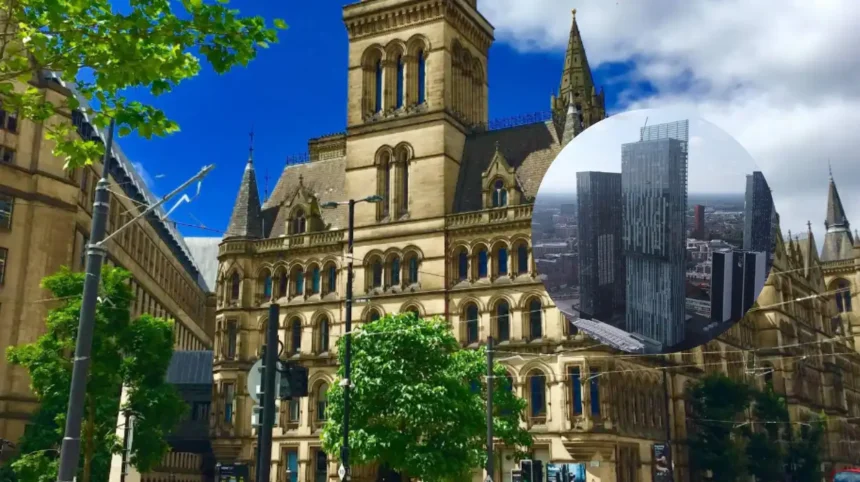
Place North West has also imposed a 100-year limit. Buildings such as Manchester Cathedral, Chetham’s Library and Manchester Town Hall are outside the competition because they pre-date the period under consideration.
The restriction allows the debate to focus on Manchester’s more recent development and on the buildings that have influenced the city during the last century.
What buildings have been nominated?
The nominations listed by Place North West cover a wide range of building types and periods. They include commercial towers, cultural venues, public buildings, research facilities, shopping centres, theatres, offices and major redevelopment schemes.
The buildings named so far include:
- Arndale Centre.
- Aviva Studios.
- Beetham Tower.
- Bridgewater Hall.
- CIS Building.
- City Tower.
- Civil Justice Centre.
- Daily Express Building.
- Gateway House.
- Granada House.
- Hollings Building, commonly known as the Toast Rack.
- Manchester Central Library.
- Manchester Town Hall Extension.
- National Graphene Institute.
- No. 1 Deansgate.
- No. 1 St Michael’s.
- No. 1 Spinningfields.
- One Piccadilly Gardens.
- Piccadilly Hotel.
- Renold Building.
- Royal Exchange Theatre.
- South Tower, Deansgate Square.
- Sunlight House.
- Urbis.
The list demonstrates how difficult it may be to select only one winner. Some buildings are connected with Manchester’s commercial and industrial history, while others represent the city’s transformation into a centre for culture, research, education, professional services and high-density residential development.
The Daily Express Building on Great Ancoats Street has been put forward as an important reminder of Manchester’s publishing heritage. The building has also been refurbished and adapted for modern commercial use.
City Tower, together with the former Piccadilly Plaza buildings, represents another part of the city’s post-war development. The structure overlooking Piccadilly Gardens remains a recognisable part of Manchester’s skyline and continues to provide office space.
Could Beetham Tower be the leading contender?
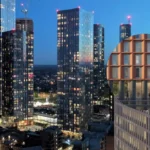
Beetham Tower is one of the most prominent early nominations because of its role in Manchester’s modern skyscraper era. The tower was completed at a time when regional cities were using high-rise developments to demonstrate confidence and an international outlook.
Many proposed skyscraper schemes elsewhere did not proceed, but Beetham Tower was completed and became a highly visible symbol of Manchester’s ambitions. Its presence also formed part of the later expansion of the Great Jackson Street area, where further residential developments were constructed.
Several readers supported Beetham Tower in their comments. Some described it as a catalyst for the modern skyline, while others argued that it helped present Manchester as a dynamic and forward-looking city.
The building remains controversial in architectural terms. Some residents and commentators regard it as a strong addition to the skyline, while others have criticised its design and prominence. That disagreement is part of the wider question facing voters: should importance be judged by visual impact, architectural quality, economic influence or public opinion?
What other buildings could influence the result?
The City of Manchester Stadium, now widely known as the Etihad Stadium, has been included in the discussion because of its connection with the 2002 Commonwealth Games and the subsequent development of the Eastlands area.
The stadium’s main stand was central to the Commonwealth Games, while its later association with Manchester City helped increase the importance of the area as a sports and entertainment destination.
One Piccadilly Gardens has also been nominated despite controversy surrounding its appearance and its relationship with the public space around Piccadilly Gardens.
The building has been linked to efforts to attract the Bank of New York to Manchester in 2005. Its availability reportedly helped secure the occupier, which later expanded to Spinningfields and subsequently agreed to occupy significant space at Noma.
That argument presents One Piccadilly Gardens as an example of a building whose importance may be based less on architectural popularity and more on its role in attracting major corporate activity.
Other nominations highlight Manchester’s cultural life. The Bridgewater Hall, Aviva Studios, the Royal Exchange Theatre and Urbis represent different forms of cultural infrastructure. Manchester Central Library and the Town Hall Extension raise questions about the role of civic buildings, while the National Graphene Institute and the Renold Building point towards research, education and technological development.
Granada House has also attracted support. Readers have argued that Granada’s television studios helped establish Manchester as a major centre for television production. The studios were associated with programmes that reflected life in the North and helped create a significant creative hub in the city.
The CIS Building has been proposed because it represents Manchester’s post-war expansion and the arrival of a major modern tower on the skyline. Its design and scale made it one of the city’s most recognisable commercial buildings during the second half of the 20th century.
When will the shortlist and vote be announced?
Place North West will examine the nominations after the deadline and assess the strength of the arguments put forward for each building. A shortlist will then be prepared before readers are invited to vote.
Voting is due to begin on 12 August and close on 26 August. The publication has scheduled its final report for 2 September.
The outcome will therefore depend on two stages. The first will involve assessing the nominations and selecting the shortlist. The second will allow the public to choose from the buildings that make the final stage.
A building with strong architectural credentials may not necessarily attract the largest number of votes. A familiar building that is used by thousands of people each day may have a broader public appeal than a specialist research or administrative facility.
What does the debate reveal about Manchester?
Manchester’s architectural history reflects its transition from an industrial economy to a service-based urban economy. The city’s historic buildings were shaped by the wealth generated through manufacturing, trade and commerce.
During the 20th century, the decline of manufacturing changed the demand for offices, shops, housing, cultural venues and transport infrastructure. New buildings were constructed to serve professional services, retail, education, entertainment and research.
The CIS Building and City Tower represent post-war confidence in office towers and Modernist design. The Daily Express Building preserves the memory of Manchester’s importance as a newspaper-production centre, while the Arndale Centre reflects the growth of large-scale enclosed retail.
Buildings such as Beetham Tower, No. 1 Deansgate and Deansgate Square are linked to a later period of high-rise commercial and residential development.
Manchester has also relied heavily on the reuse of existing structures. The former Central Station was converted into an exhibition venue, while the Royal Exchange’s historic trading floor became a theatre. These projects show how older buildings can be adapted to meet modern cultural and commercial needs.
The reader responses to the competition illustrate the different ways in which buildings are valued. Some people favour prominent landmarks, while others prioritise cultural influence, job creation, public use, historic significance or economic impact.
Background: How has Manchester’s skyline changed?
Manchester’s modern skyline has developed through several phases. Post-war office towers introduced a new scale of commercial architecture, while retail developments changed the pattern of city-centre shopping.
Later regeneration projects brought new offices, cultural venues, hotels, research facilities and residential towers. The changing skyline reflects the city’s efforts to adapt after the decline of traditional manufacturing.
Some buildings have become symbols of Manchester because of their height or distinctive appearance. Others are important because of what takes place inside them, including theatre, broadcasting, scientific research, education and public administration.
The competition’s 100-year rule excludes many of Manchester’s best-known historic landmarks, but it also encourages attention to buildings that are sometimes overlooked. It asks residents to consider not only which structures are beautiful or famous, but which ones have changed the city’s direction.
Prediction: What could the result mean for Manchester readers?
The competition is likely to encourage residents, architecture enthusiasts, businesses and visitors to reconsider buildings that are often treated as ordinary parts of the city centre.
The nomination process gives readers an opportunity to argue for buildings based on economic contribution, cultural influence, public use, design quality or their role in changing Manchester’s identity.
The final vote may show which kinds of importance matter most to the public. A highly visible landmark such as Beetham Tower or the Daily Express Building could perform strongly because of its recognisable appearance, while a research, education or civic building may depend on voters recognising its less visible long-term contribution.
The shortlist and result could also shape future discussions about Manchester’s planning priorities. A victory for a cultural venue, public building or research facility would highlight the importance of those forms of development. A win for a commercial tower or shopping centre would underline the value many readers place on investment, employment, regeneration and everyday city-centre use.
The result cannot establish objectively which building has made the greatest contribution to Manchester. It can, however, provide a public record of how the city’s buildings are valued in 2026. The final report is expected on 2 September.