Dunham Massey is a historic estate and civil parish located within the Metropolitan Borough of Trafford in Greater Manchester. Positioned near the historic boundary of Cheshire and the town of Altrincham, it encompasses a 300 acre medieval deer park and historic hall.
- How did the ownership of Dunham Massey evolve through British history?
- What architectural features define Dunham Massey Hall and its historic structures?
- What rare artifacts are preserved within the Dunham Massey museum collections?
- How is the ancient deer park and woodland ecology managed at the estate?
- What role did Dunham Massey play during the First World War?
- What are the primary seasonal attractions within the formal estate gardens?
- What are the modern socio-economic impacts and conservation challenges of the estate?
- FAQs About Dunham Massey
- Is entry to the Dunham Massey parkland free for the general public?
- Can visitors bring domestic dogs into the deer park at Dunham Massey?
- What is the best time of year to view the fallow deer herd?
- How far is the Dunham Massey estate from the center of Altrincham?
- Was Dunham Massey Hall used for military purposes during the Second World War?
The estate lies within a predominantly agricultural landscape bounded by the River Bollin to the south and west, which provides natural irrigation and drainage for the low-lying regional terrain. This positioning places the property exactly 1.5 kilometers west of the village of Bowdon and roughly 14 kilometers southwest of Manchester city center, serving as a critical green lung between urban sprawl and rural fields. Administratively, the territory transitioned into the Metropolitan Borough of Trafford following the implementation of the Local Government Act 1972, though it retains deep cultural roots within the historic county of Cheshire.
The local geology comprises lower keuper marl overlaid by a prominent ridge of glacial sand and gravel that stretches across the parish toward the historic village of Warburton. This specific subterranean composition creates a unique topsoil layout that supports ancient woodland development, specialized agriculture, and stable building foundations across the low ridges. Within the broader parish boundaries, three distinct settlement zones exist, including the picturesque hamlets of Sinderland Green, Dunham Woodhouses, and Dunham Town, which feature traditional architectural styles.
Accessibility to the regional landmark is facilitated by a network of historic access routes, including Charcoal Road to the northeast and Dunham Road to the southeast, which connect the rural parish directly to major regional trunk roads. The site is situated within close proximity to major transport hubs, rendering it highly accessible for regional commuters and international visitors who utilize regional flight hubs for cultural excursions. Visitors traveling from nearby urban zones frequently transit through the neighboring market town of Altrincham to reach the outer park wall, which was constructed between 1748 and 1751 to delineate the estate grounds. The presence of the historic Bridgewater Canal running directly through the northern perimeter further emphasizes the historical role of the parish as a focal point for regional transport, industry, and early commercial trade. This convergence of geographical convenience, water resources, and distinct administrative zoning establishes the estate as a highly valuable cultural asset within the wider northwestern geographic infrastructure.
How did the ownership of Dunham Massey evolve through British history?
The ownership of the estate dates back to the Domesday Book of 1086 under the de Masci family. It subsequently transitioned to the Booth family and the Earls of Stamford before Roger Grey bequeathed it to the National Trust in 1976.
The historical lineage of the estate begins in the eleventh century when the settlement, recorded as Duneham in the Domesday Book, was established as the principal seat for the Barony of de Masci. For thirteen successive generations, men named Hamo de Masci maintained control over the fortified manor, overseeing early land clearance, agricultural expansion, and the initial formal designation of the surrounding deer park in 1362. By 1433, through a series of complex marital alliances and inheritance shifts, ownership of the expansive medieval territory passed to Sir Robert Booth, marking the arrival of a lineage that would govern the land for three centuries. The Booth family systematically dismantled the deteriorating medieval structures, and during the seventeenth century, Sir George Booth constructed a substantial Elizabethan mansion on the existing moated platform. This era was defined by intense political involvement, as the family navigated the English Civil Wars by initially supporting Parliament, though they later opposed the execution of King Charles I in 1649.
Political alignments shifted again in 1659 when the grandson of Sir George, known historically as Young Sir George Booth, orchestrated an unsuccessful royalist uprising termed Booth’s Rebellion to restore the exiled monarchy. Following the eventual Restoration of King Charles II in 1660, George Booth was released from imprisonment in the Tower of London and awarded the aristocratic title of Baron Delamer. The estate achieved its peak architectural and financial stability under George Booth, the 2nd Earl of Warrington, who inherited the property in 1694 and spent several decades planting 31000 trees and clearing family debts. Upon his death in 1758, the estate passed through the marriage of his daughter, Lady Mary Booth, to the Grey family, who held the title of the Earls of Stamford. The final private owner, Roger Grey, the 10th Earl of Stamford, dedicated his entire twentieth-century tenure to restoring the historic collections and protecting the parkland from mid-century industrial development. Recognizing that he was the last surviving member of his ancestral line, the Earl bequeathed the entire 3000 acre agricultural estate to the National Trust in 1976.
What architectural features define Dunham Massey Hall and its historic structures?
The main hall is a Grade I listed building originally constructed in the Elizabethan era and extensively rebuilt in 1723 by architect John Norris. The site features a surrounding moat, an 18th century stable block, and a historic watermill.
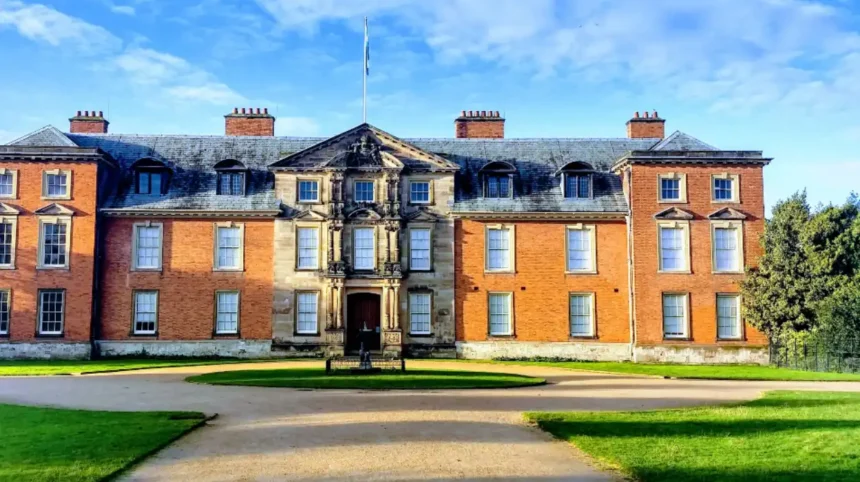
The primary mansion house stands on a historical moated platform toward the northern boundary of the park, showcasing a complex blend of early Georgian design and Edwardian remodeling. Between 1723 and 1740, the master builder John Norris completely transformed the older Elizabethan layout into a symmetrical, clean-lined Georgian palace designed specifically to project the immense wealth of the 2nd Earl of Warrington. The exterior features high-quality Flemish bond brickwork, contrasting stone dressings, and large multi-paned sliding sash windows that look out across the surviving L-shaped arms of the ancient medieval moat.
Further exterior modifications occurred in 1789 when the architect John Hope of Liverpool altered the entrance front, which was subsequently updated again in 1905 by the Edwardian architect J Compton Hall. Compton Hall created a magnificent neo-Caroline facade inspired directly by Sudbury Hall in Derbyshire, characterized by stone carvings, a prominent central pediment, and a grand stone balustrade. The interior layout contains vast formal reception rooms, narrow domestic corridors, and intact Edwardian servant quarters that illustrate the rigid social hierarchies of early twentieth-century country house operations.
Beyond the main residence, the immediate courtyard contains several highly significant ancillary structures that are independently recognized for their outstanding architectural merit and historical integrity. Along the western flank of the spacious forecourt sits a massive carriage house and a symmetrical stable block, both constructed around 1721 and currently designated as Grade I listed buildings. These service buildings feature classical arcades, large timber stable doors, and internal cobbled floors designed to accommodate the heavy transportation needs of an eighteenth-century aristocratic household. To the northeast of the main house stands a beautifully preserved brick orangery dating from the mid-eighteenth century, designed with tall south-facing glass windows to protect delicate citrus plants during frost. The oldest surviving operational structure on the entire estate is the historic watermill, which retains timber machinery components dating back to the 1616 building campaign led by Sir George Booth. A low earthen mound topped with trees situated northwest of the hall likely represents the original motte of the twelfth-century Dunham Castle, providing a stark architectural link to Norman defensive structures.
What rare artifacts are preserved within the Dunham Massey museum collections?
The interior holds a collection of 42245 objects including fine Huguenot silverware crafted by Peter Archambo and Phillip Rollos. The library contains a rare astronomical orrery by Thomas Wright and the earliest known woodcarving by master sculptor Grinling Gibbons.
The interior spaces of the mansion function as a fully accredited museum, housing a globally significant collection of fine art, bespoke furniture, and decorative items accumulated across five centuries. The crown jewel of this extensive inventory is the unparalleled Huguenot silver collection amassed almost exclusively by George Booth, the 2nd Earl of Warrington, during his long eighteenth-century tenure. This collection includes a massive silver cistern produced in 1741 by the silversmith Phillip Rollos, which was utilized to cool wine bottles during lavish aristocratic banquets. The inventory also boasts an incredibly rare silver egg cup stand crafted by the Huguenot artisan Peter Archambo, recognized by international design historians as one of the earliest surviving examples of its type. Wall surfaces throughout the principal state rooms are covered with masterwork paintings, including family portraits by Michael Dahl and Thomas Patch, alongside classical continental European works. Notable among these fine art pieces is the dramatic seventeenth-century oil painting titled An Allegory with Venus, Mars, Cupid and Time, executed by the Italian master artist Guercino.
The historic library serves as another critical repository of human knowledge and artistic achievement, housing thousands of original leather-bound volumes that reflect the intellectual pursuits of successive generations. Displayed prominently within the library space is a large, highly intricate mechanical astronomical orrery constructed by the royal instrument maker Thomas Wright during the eighteenth century. This brass mechanism accurately simulates the rotational movements of the planets relative to the sun, serving as an exceptional example of early scientific education instrumentation. The library also displays a deeply significant relief carving depicting the Crucifixion, executed in high-relief wood by the celebrated master sculptor Grinling Gibbons. This specific artwork is documented as the earliest known surviving piece by Gibbons, who later achieved international renown for his intricate decorative carvings at Windsor Castle and St Paul’s Cathedral. Additional outstanding items include an authentic seventeenth-century state bed featuring vibrant crimson silk velvet curtains and real ostrich feather plumes that originally belonged to the wealthy Duchess of Somerset.
How is the ancient deer park and woodland ecology managed at the estate?
The 300 acre parkland is designated as a Site of Special Scientific Interest due to its ancient pasture woodland habitat. It supports a herd of roaming fallow deer and over 500 insect species living amidst centuries old oak and beech trees.
The estate parkland covers approximately 100 hectares of protected landscape that has functioned continuously as a managed pasture-woodland habitat since the late Middle Ages. Because of this uninterrupted environmental history, the area has been officially designated as a Site of Special Scientific Interest, making it a critical locality for regional biodiversity. The landscape is populated by a permanent, managed herd of approximately 150 fallow deer, which roam freely across the grasslands, maintaining the open canopy through natural grazing habits. The deer are direct descendants of historic herds recorded on the property as early as 1353, and their ongoing management requires strict monitoring by modern conservationists. The physical perimeter of this wildlife habitat is defined by a continuous brick park wall measuring over three kilometers in length, constructed between 1748 and 1751 to prevent livestock escaping. This wall incorporates historic deer leaps, which are specialized architectural features designed to allow wild deer from the outside to jump into the park while preventing internal animals from exiting.
The botanical framework of the parkland is defined by thousands of mature trees, including ancient oaks, sweet chestnuts, and massive beech trees that date back centuries. During the early decades of the eighteenth century, the 2nd Earl of Warrington enacted a vast landscape scheme that resulted in the planting of 31000 trees arranged in formal avenues. Many of these original trees remain standing in 2026, creating a unique structural layout known as a goose foot design, where multiple tree-lined avenues radiate outward from a central point. The dead and decaying timber within these ancient trees is intentionally left in place by estate rangers to support a highly specialized saproxylic insect community. This environmental practice has allowed more than 500 distinct species of beetle, fly, and true bug to thrive, making the parkland one of the top ecological sites for rare wood-boring insects in the United Kingdom. Furthermore, the estate contains a separate protected nature zone known as Brookheys Covert, which provides an isolated woodland sanctuary for native bird populations and small British mammals.
What role did Dunham Massey play during the First World War?
During the First World War the hall was converted into the Stamford Military Hospital to treat wounded soldiers. Between 1917 and 1919 Penelope Countess of Stamford and Roger Grey operated the facility where 282 soldiers underwent medical convalescence.
Following the outbreak of global conflict in 1914, the traditional functions of the great country house were completely suspended to directly assist the British military medical infrastructure. In 1917, Roger Grey, the 10th Earl of Stamford, was deemed medically unfit for active frontline combat duty due to persistent childhood illnesses, prompting his family to find alternative ways to support the war effort. Working in direct partnership with the British Red Cross, the Earl and his mother, Penelope, Countess of Stamford, transformed the grand Edwardian interior of the hall into a fully functioning auxiliary medical facility named the Stamford Military Hospital. The massive formal reception spaces, including the Great Hall and the primary dining rooms, were stripped of their luxury furnishings and refitted with rows of clinical iron hospital beds. The facility operated continuously from April 1917 until its eventual closure in early 1919, providing specialized post-operative care, medical therapy, and psychological rehabilitation for wounded frontline infantrymen.
Over the course of its twenty-two months of operational service, the auxiliary hospital provided treatment for exactly 282 wounded soldiers returning from the trench systems of the Western Front. The Countess of Stamford assumed the administrative role of hospital commandant, overseeing a dedicated team of professional medical doctors, trained nurses, and local Voluntary Aid Detachment assistants. The daily regime was strictly structured, balancing necessary medical procedures with outdoor recreation, as convalescing soldiers were encouraged to walk through the peaceful formal gardens and deer park to accelerate their recovery. The estate archives preserve extensive documentation from this specific era, including personal letters, official medical charts, and historical photographs showing soldiers dressed in distinctive blue hospital uniforms relaxing on the lawns. This wartime chapter permanently altered the social history of the estate, shifting its public perception from an exclusive aristocratic enclave to a place of sanctuary, medical innovation, and profound civic duty. Modern historical exhibitions within the house frequently recreate these wartime ward layouts, allowing contemporary visitors to comprehend the physical realities of early twentieth-century military medicine.
What are the primary seasonal attractions within the formal estate gardens?
The formal gardens feature a world class Winter Garden and an expansive Rose Garden. Visitors explore these landscapes via accessible pathways that weave past an early Georgian orangery, a historic ha-ha wall, and diverse collections of seasonal flora.
The managed gardens wrap around the south and east sides of the main hall, spanning several acres of meticulously cultivated landscape that offers distinct botanical interest across all four seasons. The most celebrated modern horticultural feature is the expansive Winter Garden, which is widely recognized as the largest of its specific type within the United Kingdom. This specialized garden zone was intentionally designed to peak between November and March, utilizing a dense planting scheme of scented shrubs, winter-flowering bulbs, and trees with highly textured bark.
Visitors walking along the paved, fully accessible garden paths encounter large drifts of white snowdrops, purple irises, and vibrant yellow aconites blooming during the coldest months of the year. The garden also features mature specimens of Himalayan birches, which display bright white peeling bark, alongside clusters of red-stemmed dogwood shrubs that provide striking structural color against the winter landscape. As the seasons transition into late spring and summer, the focus shifts toward the large formal Rose Garden, which displays thousands of classic rose varieties selected for their historical relevance and intense fragrance.

Matthew Harvey
The architectural boundary of the formal garden is defined on its southern edge by an intact stone ha-ha wall, which creates an invisible barrier between the manicured lawns and the adjacent wild deer park. This clever landscape feature prevents the roaming fallow deer from entering the flower beds while ensuring uninterrupted views of the wider parkland from the house windows. The gardens also feature a large lawn area interspersed with ancient trees, including a massive blue Atlas cedar and several mature sweet chestnuts that predate the modern garden layouts.
Water features form another critical component of the garden design, with a clear stream running parallel to the southern boundary and feeding into the wider moat system that envelops the hall. Throughout the year, estate horticulturists introduce seasonal trails and educational events designed to highlight specific plant collections, such as spring bluebells or autumn foliage changes. This careful balance of historical garden architecture, continuous seasonal blooming cycles, and accessible path design ensures that the gardens remain highly attractive to diverse public audiences year round.
What are the modern socio-economic impacts and conservation challenges of the estate?
The estate serves as a premier regional tourism driver attracting hundreds of thousands of annual visitors to the Trafford area. Ongoing operations require substantial financial investments to mitigate structural weathering, manage visitor pressure, and protect native biodiversity.
In the twenty-first century, the property operates as one of the most heavily visited outdoor destinations in Northwest England, generating significant economic activity for local businesses and hospitality providers. The influx of visitors creates a steady demand for local services, supporting employment opportunities in tourism management, ecological conservation, historical preservation, and rural estate crafts within the Trafford borough.
The revenue generated through ticket sales, commercial catering, and retail operations is directly reinvested into the continuous maintenance of the Grade I listed structures and the complex ecological management of the parkland. This economic model demonstrates how historical preservation can function sustainably, transforming an ancestral private estate into a self-funding public asset that enhances regional identity and civic pride. However, high visitor numbers present distinct structural challenges, requiring careful crowd management strategies to prevent soil compaction around the roots of the ancient, protected tree avenues. Conservation rangers regularly implement temporary pathway closures and soil aeration techniques to protect the delicate root systems of centuries-old oaks from long-term foot traffic damage.
Environmental conservation represents another major operational challenge, as modern climate shifts and regional pollution put pressure on the sensitive ecosystems within the Site of Special Scientific Interest. The preservation of the ancient wood-pasture habitat requires constant monitoring of tree health, deadwood retention rates, and the genetic diversity of the free-roaming fallow deer herd. Structural maintenance of the historic buildings is equally demanding, as old brickwork, lead roofing systems, and timber window frames require continuous protection against rainwater penetration and frost weathering.
Specialist stone conservators are regularly employed to repair the historic three-kilometer park wall and the stone bridges crossing the medieval moat using traditional lime mortars. By balancing these intense conservation requirements with public access demands, the management framework ensures that the historical integrity of the estate remains completely uncompromised for future generations. The property stands as a prime example of successful landscape scale heritage management, demonstrating how history, architecture, and ecology can be preserved within a single unified framework.
FAQs About Dunham Massey
Is entry to the Dunham Massey parkland free for the general public?
Access to the deer park and formal gardens requires an admission fee for non-members, while National Trust members receive complimentary entry to all areas of the estate. Visitors who choose to travel to the property solely to use the visitor center, restaurant, or retail shop can access those specific facilities without purchasing a ticket.
Can visitors bring domestic dogs into the deer park at Dunham Massey?
Dogs are permitted within the estate grounds but must be kept on a short, non-extendable lead at all times to protect the roaming fallow deer herd. This strict rule prevents domestic pets from startling the wildlife, ensuring a safe environment for both the animals and other families walking along the pathways.
What is the best time of year to view the fallow deer herd?
The fallow deer herd can be observed roaming across the pasture woodland throughout the entire year due to their permanent residency within the walled boundary. The autumn months offer a unique opportunity to witness the annual deer rutting season, while the early summer period reveals young fawns resting amidst the ferns.
How far is the Dunham Massey estate from the center of Altrincham?
The historic estate is situated approximately 3.2 kilometers west of Altrincham town center, making it highly accessible by car, bicycle, or public bus services. Travelers can easily commute from the Altrincham interchange station using local bus routes that drop passengers off near the main pedestrian entrance gates.
Was Dunham Massey Hall used for military purposes during the Second World War?
Unlike its formal designation as an auxiliary hospital during the First World War, the main hall did not function as a military medical facility during the Second World War. The wider agricultural estate and outbuildings did, however, assist the domestic war effort by increasing local food production and providing timber supplies.