Key Points
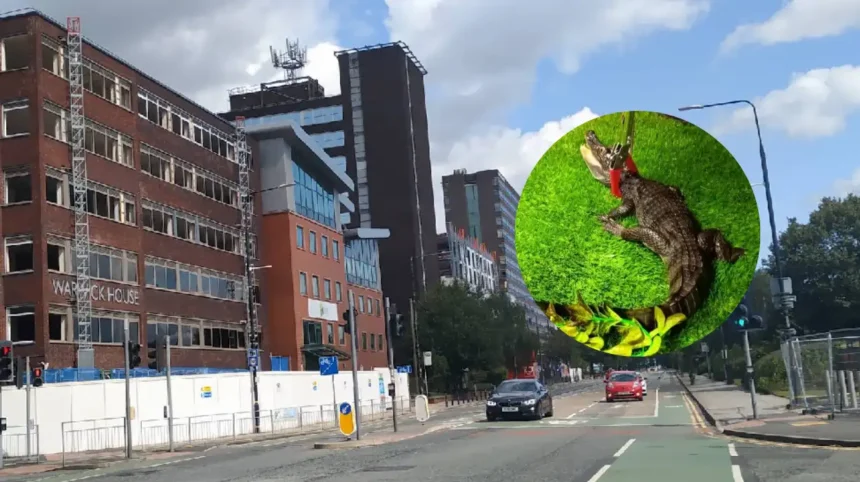
- A spectacled caiman called Lyle was found in a semi-detached house in Hale, Trafford, on Wednesday, September 16, 2026.
- The species is considered a dangerous wild animal according to the Dangerous Wild Animals Act 1976 and it was kept without the appropriate licence.
- Additionally, a python was found at the same address and was assessed under the Animal Welfare Act.
- It was Trafford Council working in collaboration with Greater Manchester Police and RSPCA who carried out an enforcement action through the execution of a warrant at about 11:00 BST.
- Both animals were first looked after by a specialist veterinarian in reptiles before being moved to the right zoo.
- Evie Button, exotic animal expert at the RSPCA, has noted that these species have complex welfare requirements that are hard to provide in domestic environments.
- Keleigh Glenton, councillor, and DeGouveia, GMP Sergeant, have expressed their satisfaction with the cooperation.
Trafford (Manchester Mirror) September 21, 2026 – Authorities have seized a “dangerous” spectacled caiman from a semi-detached home in Hale, Greater Manchester, after reports it was being kept without the required licence. The caiman, named Lyle, was discovered alongside a python during a joint operation led by Trafford Council’s environmental health team, with support from Greater Manchester Police (GMP) and the RSPCA. Both reptiles have since been moved to a specialist zoo following veterinary assessment.
- Key Points
- What Was Seized From The Hale Property And Why Does It Matter?
- How Did The Multi-Agency Operation Unfold?
- What Happened To Lyle The Caiman And The Python?
- What Do Experts Say About Keeping Caimans As Pets?
- What Are The Legal Requirements For Dangerous Wild Animals In The UK?
- What Risks Do Caimans Pose In Residential Settings?
- Background: How Did This Development Come About?
- Prediction: How Could This Affect Residents And Exotic-Pet Owners In Trafford?
What Was Seized From The Hale Property And Why Does It Matter?
The central development concerns the removal of a spectacled caiman a crocodilian species native to Latin America from a residential address in Hale, an affluent suburb in Trafford. As reported by the BBC, the animal is classified as dangerous under the Dangerous Wild Animal Act 1976, meaning private ownership requires a specific licence that was not held in this case. The Manchester Evening News added that the caiman was found inside an enclosure containing water when officers executed a warrant at about 11:00 BST on September 16. A python was also taken from the property for assessment under the Animal Welfare Act, reflecting broader welfare concerns beyond licensing alone.
How Did The Multi-Agency Operation Unfold?
Trafford Council confirmed it led the operation after receiving intelligence that the caiman was being kept without appropriate authorisation. Councillor Keleigh Glenton, the council’s executive member for community safety and civil contingencies, said: “The Council works hard to protect our neighbourhoods from a wide range of potential problems and safety threats. Thanks to the work of our environmental health team and partners, the caiman has been carefully removed.” She stressed that species of this kind “require sensitive, expert handling and proper environments” and that the council “does not hesitate to take decisive action when rules are not adhered to.”
Greater Manchester Police described the incident as an example of effective partnership working. Sergeant DeGouveia, GMP’s wildlife subject matter expert, said:
“The swift and coordinated response from all agencies involved ensured that the animals were safely secured, removed and can now look forward to a brighter future in more suitable accommodation.”
He thanked the Altrincham Neighbourhood Team, the RSPCA and Trafford Council for their professionalism.
What Happened To Lyle The Caiman And The Python?
Following seizure, both reptiles were taken into the care of a local veterinarian specialising in reptiles. According to multiple outlets, they were subsequently transferred to a suitable zoo, with the council confirming the move on September 21. The RSPCA was on hand to advise during the operation, underscoring welfare considerations given the caiman’s physical characteristics: the species can grow beyond two metres in length and possesses sharp teeth and powerful jaws, presenting a biting risk.
What Do Experts Say About Keeping Caimans As Pets?
Evie Button, the RSPCA’s exotic animals expert, warned that such animals have “very specific requirements that are exceedingly challenging to fulfill in a home environment,” adding that their welfare “can be significantly jeopardized when they are kept as pets.” In comments reported by the Manchester Evening News, she said: “We are relieved that both reptiles are now under specialized care, but we are still very concerned that numerous hazardous wild animals are being maintained in private ownership throughout Britain.” The charity reiterated its concern about the number of dangerous wild animals kept privately across the UK, noting the difficulty of meeting their physical, behavioural and environmental needs in domestic settings.
What Are The Legal Requirements For Dangerous Wild Animals In The UK?
Under the Dangerous Wild Animal Act 1976, certain species—including crocodilians such as caimans—may only be kept by individuals holding a Dangerous Wild Animal Licence issued by the local authority. Licensing conditions typically address secure accommodation, public safety and animal welfare standards. Trafford Council’s statement emphasised that owners of such species must hold the appropriate licence and that enforcement action will follow where regulations are breached. The python’s removal under the Animal Welfare Act further highlights that even non-licensed species can be subject to intervention if welfare concerns arise.
What Risks Do Caimans Pose In Residential Settings?
Caimans are large, predatory reptiles capable of exceeding two metres in length, with strong jaws and sharp teeth adapted for catching and subduing prey. In a residential environment, these traits create obvious safety risks, particularly if enclosures are inadequate or if handling is attempted by individuals without specialist training. The Manchester Evening News noted the biting risk explicitly, while the RSPCA’s guidance stresses that meeting welfare needs such as appropriate space, temperature, humidity and diet is exceptionally difficult outside professional facilities.
Background: How Did This Development Come About?
The seizure follows reports to Trafford Council that a crocodilian was being kept at the Hale address without the required licence. Environmental health officers, supported by GMP and the RSPCA, executed a warrant on September 16 after verifying the intelligence. The operation resulted in the discovery of Lyle in a water-filled enclosure and the concurrent recovery of a python. Both animals were assessed by a specialist vet before relocation to a zoo, with authorities citing welfare and public safety as key drivers for intervention.
Prediction: How Could This Affect Residents And Exotic-Pet Owners In Trafford?
This incident is likely to heighten awareness among Trafford residents about the presence of dangerous wild animals in private homes and reinforce expectations that licensing rules will be enforced. For exotic-pet owners, the case signals increased scrutiny of compliance with the Dangerous Wild Animal Act 1976 and the Animal Welfare Act, particularly where large reptiles are concerned. Local authorities may see more tip-offs from neighbours, while councils could prioritise inspections or public guidance on legal requirements. For the wider community, the removal of Lyle and the python to a zoo may reduce immediate safety concerns, but the RSPCA’s warning suggests similar cases could emerge elsewhere unless ownership practices change.