Key Points
- Arrowsmith Management has withdrawn its contentious Apex Tower proposal adjacent to the Britons Protection pub in Manchester city centre.
- The 26-storey residential scheme, designed by Leach Rhodes Walker, would have delivered 72 two-bedroom flats on Albion Street and Great Bridgewater Street.
- Strong opposition emerged from the pub’s landlord, heritage groups, and local residents over concerns about light, trade impact, and the building’s scale next to the Grade II-listed venue.
- The withdrawal follows years of debate since the plans were first lodged in 2021–22 and a period of “radio silence” after submission.
- Place North West first reported the withdrawal on 26 July 2026, confirming the scheme is no longer proceeding in its current form.
Manchester (Manchester Mirror) July 27, 2026 – A controversial 26-storey residential tower scheme next to the historic Britons Protection pub has been pulled by its developer, Arrowsmith Management, ending years of planning uncertainty and local opposition. The withdrawal was confirmed by Place North West on 26 July 2026, with the site on the corner of Albion Street and Great Bridgewater Street now left without an active high-rise proposal in its previously submitted form.
- Key Points
- What happened to the Apex Tower scheme in Manchester?
- Who opposed the tower and what were their concerns?
- What did Arrowsmith and designers say about the plans?
- What is the history of this site and the 2022 planning push?
- Background of the development
- Prediction: how this withdrawal may affect Manchester’s city-centre housing and heritage debate
What happened to the Apex Tower scheme in Manchester?
The Apex Tower project, designed by Manchester-based practice Leach Rhodes Walker, sought to construct a slender 26-storey block containing 72 two-bedroom apartments on a small plot immediately beside the Grade II-listed Britons Protection pub. Arrowsmith Investment, led by Bahraini businessman Mohamed Abbas Haji, had promoted the scheme as a residential-led development that would “enhance and preserve” the 210-year-old pub while adding city-centre housing.
However, the proposal faced sustained criticism from the pub’s landlord, heritage campaigners, and members of the public, who argued the tower’s height and proximity would overshadow the venue, block light to its beer garden, and damage summer trade to the point of threatening closure. As reported by journalists at Place North West and the BBC, the landlord described himself as “dumbfounded” by the scale of the plans and warned of severe economic harm to the historic business.
Following initial consultations in late 2021 and a public drop-in session in November 2021, Arrowsmith indicated it would submit a formal planning application in early 2022. According to Place North West, there was subsequently “radio silence” on the project after the application was lodged, with little public movement until the confirmation of its withdrawal in July 2026.
Who opposed the tower and what were their concerns?
Opposition to Apex Tower centred on its location just feet from the Britons Protection, one of Manchester city centre’s oldest and best-known pubs. The landlord told the BBC that the proposed block would cast significant shadow over the beer garden, undermining a vital revenue stream in warmer months and potentially forcing the pub to close. Heritage-minded critics also raised concerns about the visual impact of a 26-storey structure next to a low-rise, historic building within a sensitive urban conservation context.
As outlined in reporting by the Manchester Evening News, opponents described the tower as a “visually jarring” structure that would dominate and “ruin” the character of the pub and its immediate surroundings. Campaigners drew parallels with earlier high-profile controversies over tall buildings in central Manchester, including the scaled-back St Michael’s scheme associated with Gary Neville, which faced intense scrutiny from Historic England and multiple heritage societies.
Arrowsmith maintained that the design had been carefully evolved to protect the pub’s prominence. In consultation materials, the developer stated that the tower’s lower floors would be stepped back to keep the pub’s traditional brickwork and gable wall largely visible, and that the new entrance would be “glassy and transparent” and set back from the street edges. The firm also proposed a complementary seven-storey office and residential block between the Britons Protection and the adjacent Jury’s Inn hotel, arguing that, taken together, the schemes would create a “well-connected residential-led development”.
Despite these assurances, the strength of local and heritage objections appears to have contributed to the eventual decision to withdraw the scheme, as confirmed by Place North West in its 26 July 2026 report.
What did Arrowsmith and designers say about the plans?
Arrowsmith Investment and its architects, Leach Rhodes Walker, consistently defended the Apex Tower concept as compatible with the historic venue. In public statements cited by the Manchester Evening News and the BBC, the developer said: “At the heart of the design evolution has been the consideration of the Britons Protection and preserving its importance as an historic local landmark and a Grade II listed building.”
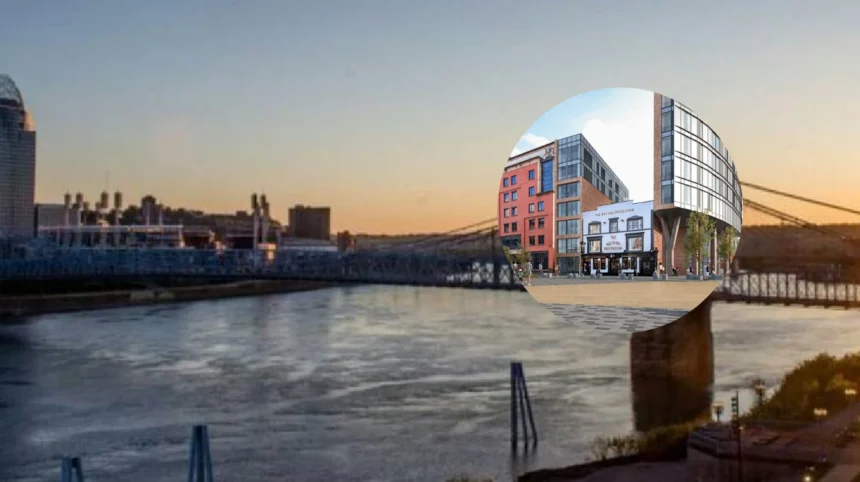
The company added that the taller element on the Albion Street junction was “set back significantly to ensure the Britons Protection will remain a prominent and visually distinct building”. Design visuals and consultation documents showed the tower as a narrow, modern block rising behind and beside the pub, with the lower levels recessed to reduce street-level massing. Arrowsmith also indicated that part of the adjacent seven-storey infill building would be used as its head office, signalling a long-term commitment to the immediate area.
Despite these assurances, the strength of local and heritage objections appears to have contributed to the eventual decision to withdraw the scheme, as confirmed by Place North West in its 26 July 2026 report.
What is the history of this site and the 2022 planning push?
The Britons Protection site has long been a focal point for debates over development pressure in Manchester city centre. In 2021, Arrowsmith unveiled its vision for Apex Tower during a public consultation period, inviting comments before a planned submission to Manchester City Council in early 2022. The proposal included both the 26-storey residential tower and the smaller seven-storey mixed-use block, with the developer seeking to frame the overall project as an enhancement to the public realm at street level.
Coverage at the time by the BBC and the Manchester Evening News highlighted the stark divide between the developer’s narrative and the pub’s fears for its future. The Meteor also reported on broader pressures facing the venue, including a separate Heineken-related takeover issue, which compounded concerns about the pub’s long-term viability in the face of large-scale neighbouring development.
After the formal application was lodged, Place North West noted there was little further public information for several years, describing the situation as “radio silence” until the announcement that the scheme had been pulled.
Background of the development
The Apex Tower proposal emerged against a backdrop of intense scrutiny of tall buildings in central Manchester, following earlier controversies such as Gary Neville’s St Michael’s scheme, which was significantly revised after heritage objections and the withdrawal of Make Architects in 2017. In that context, the Britons Protection case became another test of how high-density residential towers can coexist with protected historic assets in tightly constrained city-centre plots.
Arrowsmith’s plan was one of several high-rise concepts in the wider Manchester pipeline, but its immediate adjacency to a Grade II-listed pub and its potential impact on light and trade made it unusually sensitive. The withdrawal in July 2026, as reported by Place North West, marks the end of this particular iteration of the scheme, though the site remains of interest for future development given its central location.
Prediction: how this withdrawal may affect Manchester’s city-centre housing and heritage debate
The withdrawal of the Apex Tower scheme is likely to reinforce caution among developers and planners when proposing tall residential blocks next to protected heritage assets in Manchester city centre. For housing delivery, the loss of 72 potential two-bedroom flats removes a modest but symbolically important chunk of planned city-centre supply at a time when local authorities are under pressure to meet housing targets.
For the Britons Protection and similar venues, the decision may be seen as a temporary reprieve, reducing the immediate risk of overshadowing and trade loss from a 26-storey neighbour. However, the underlying development pressure on central sites remains, and future proposals potentially at different heights or with altered massing—could re-emerge as the market and planning policy evolve.
For local residents and heritage groups, the outcome may encourage more robust engagement at the earliest consultation stages, using the Apex Tower case as a reference point for what is considered acceptable next to listed buildings. For investors and developers, the episode underlines the commercial and reputational risks of pushing tall schemes into highly sensitive locations without clear, demonstrable design solutions that address light, amenity, and heritage impact from the outset.