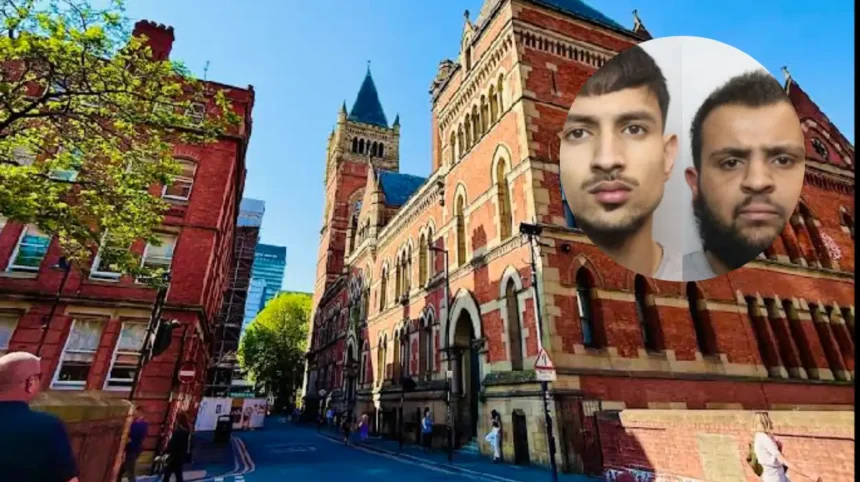
Key Points
- Two men, Uways Hussain and Usmon Mahmood, were jailed after a fatal Manchester crash following extremely dangerous driving.
- The court heard the car was driven at up to 139mph in a 30mph zone while the pair inhaled nitrous oxide and filmed themselves.
- The collision killed 50-year-old Sylvester Abayomi, who was described in court as a man simply on his way to work.
- Hussain received 11 years and eight months in prison after admitting causing death by dangerous driving and related offences.
- Mahmood received 12 years and nine months for aiding and abetting the dangerous driving and uninsured-driving offences.
- Judge Nicholas Dean KC described the conduct as sustained, deliberate, escalating and highly dangerous.
- The court heard the pair discussed fleeing the scene and later reporting the car as stolen.
- The crash happened in the early hours of 9 March at the junction of Green End Road and Kingsway in Manchester.
Manchester Crime(Manchester Mirror)June 01, 2026 – Two men were jailed after a fatal crash in Manchester following what prosecutors and the judge described as an extended episode of extreme and reckless driving. As reported by Susanna Siddell of GB News, the court heard that Uways Hussain, 20, was behind the wheel of a VW Golf GTI and that passenger Usmon Mahmood, 23, was in the front seat when the vehicle was driven at extreme speed in a 30mph area.
The fatal collision happened in the early hours of 9 March at the junction of Green End Road and Kingsway, where the Golf crashed into another vehicle and killed 50-year-old Sylvester Abayomi. According to the court account reported by Susanna Siddell, the men were on their phones, filming videos and inhaling nitrous oxide while driving.
Judge Nicholas Dean KC said the behaviour was “a sustained, deliberate and escalating course of highly dangerous conduct over a prolonged period”, and told the court that the images and phone recordings were “terrifying”. He also said the pair drove at “very nearly 140mph” on roads that were mostly subject to 30mph limits.
How were the defendants sentenced?
Uways Hussain was jailed for 11 years and eight months after admitting causing death by dangerous driving, causing death by driving while uninsured, and failing to provide a specimen. Usmon Mahmood was sentenced to 12 years and nine months for aiding and abetting causing death by dangerous driving and aiding and abetting causing death by driving while uninsured.
The court also heard that Mahmood, who owned the car, was in the front passenger seat and had at times shouted encouragement while Hussain drove. Prosecutor Rachel Shenton said the video and phone evidence showed the pair engaged in dangerous conduct that went far beyond a momentary lapse.
After the collision, Hussain’s Apple Watch automatically called 999 after detecting the crash. The judge heard that the recording after the incident did not show shock or concern for the victim, and instead captured talk of calling an Uber, leaving the scene and reporting the car as stolen.
What was said about the victim?
Denise Doyle, Mr Abayomi’s partner, told the court that he had been “simply on his way to work” and that he should have returned home safely. She said he was left to “die alone” and accused the pair of showing no compassion or humanity.
Mr Abayomi was 50 years old. The court account did not indicate that he had any role in causing the collision; he was the person killed when the Golf struck another vehicle.
Why is this case significant?
The case stands out because the sentencing judge and police described the driving as among the most extreme examples they had encountered. The combination of excessive speed, nitrous oxide use, phone filming and efforts to leave the scene gave the case a wider public safety significance beyond the single crash.
The case also shows how digital evidence can shape modern road traffic prosecutions. In this instance, the recordings on the defendants’ phones and the vehicle’s speed helped establish the scale and duration of the dangerous behaviour.
Background of the development
This case follows a March fatal collision in Manchester that became a criminal prosecution focused on dangerous driving, intoxication and vehicle ownership responsibility. The sentencing on 29 May 2026 ended a court process in which Hussain admitted the principal driving offences and Mahmood accepted his role as passenger and accomplice.
Greater Manchester Police and prosecutors treated the case as a high-risk example of street racing-style behaviour, where speed, peer encouragement and recorded evidence combined to strengthen the case against both men. The court’s findings also reflected the role of mobile phones, wearable technology and video clips in reconstructing what happened before and after the crash.
Prediction
For road users in Manchester and similar urban areas, this case is likely to reinforce the deterrent message that extreme speeding, drug use and filming dangerous driving can lead to very long prison sentences. It may also encourage greater attention from police and prosecutors to passenger involvement, because the court punished not only the driver but also the person who encouraged and enabled the conduct.
For the public, the development may increase awareness of how quickly reckless driving can turn into a fatal case, especially where speed limits are ignored in built-up streets. For families affected by road deaths, the sentencing may be seen as a sign that courts are treating these offences with greater severity when there is clear evidence of deliberate risk-taking.