Key Points
- Three men have been jailed in connection with conspiracy to use a drone to smuggle illegal goods, including drugs, mobile phones, chargers, and SIM cards, into HMP Manchester (Strangeways).
- Nazar Al-Bakili, aged 35, was jailed for two years and ten months.
- Duane Anderson, aged 37, was jailed for three years and nine months.
- Jake Anderson, aged 25, was jailed for a year consecutive to an existing sentence.
- The relevant incident took place on 6 February 2025 when a drone was seen being flown from a nearby car park. The investigations then resulted in arresting Al-Bakili and Duane Anderson in a Nissan Micra. A drone and a package with Class A and Class B drugs, mobile phones, chargers, and SIM cards were seized.
- The case was brought forward through the joint efforts of the North West Regional Organised Crime Unit (NWROCU), Greater Manchester Police, and His Majesty’s Prison and Probation Service (HMPPS). The accused pled guilty at Manchester Crown Court, and the case was heard on 12 November 2026.
- The Detective Chief Inspector Dan Clegg stated that using drones for contraband delivery means that the organised crime can continue from the prison grounds and causes danger to both employees and prisoners.
Manchester Crime (Manchester Mirror) November 14, 2026 — Three men have been jailed after police said they used a drone in an attempt to smuggle cannabis, cocaine, mobile phones, chargers and SIM cards into HMP Manchester, the prison widely known as Strangeways.
As reported by the Manchester Evening News, the case concerned an operation on 6 February 2025, when officers spotted a drone in the sky that appeared to have been launched from a nearby car park. The North West Regional Organised Crime Unit said officers attended the area and found a Nissan Micra parked between two large vans.
A man was seen holding a drone controller. According to the NWROCU, when officers approached, he threw the controller away and tried to run. He was detained and identified as Nazar Al-Bakili, 35.
Another man, who was sitting in the driver’s seat of the Nissan, was also detained. He was identified as Duane Anderson, 37.
Officers later found the drone with a package attached. The package contained Class A and Class B drugs, mobile phones with accessories, and SIM cards.
Who was involved in the drone plot?
The investigation identified a third participant: Jake Anderson, 25, Duane Anderson’s brother. The NWROCU said Duane Anderson’s mobile phone was seized after his arrest and examined.
Messages recovered from the device showed communication with a contact about the supply of drugs. One message read: “SLAB OF POLLEN FOR JAKE PLZ”.
According to the NWROCU, further examination established that “Jake” was Jake Anderson, Duane Anderson’s brother, and that he had been part of the conspiracy.
The three men were prosecuted after a joint investigation by the NWROCU, Greater Manchester Police and HMPPS into drone flights carrying contraband into HMP Manchester.
What were the sentences?
The sentences were imposed following a hearing at Manchester Crown Court. The NWROCU said the three men were sentenced on Thursday, 12 November 2026.
| Defendant | Age | Sentence | Offences |
|---|---|---|---|
| Nazar Al-Bakili | 35 | Two years and 10 months | Conspiracy to convey List A articles into prison, namely cannabis and cocaine; conspiracy to convey List B articles into prison, namely two mobile phones, chargers and two SIM cards; possession with intent to supply Class A and Class B drugs |
| Duane Anderson | 37 | Three years and nine months | Conspiracy to convey List A articles into prison, namely cannabis and cocaine; conspiracy to convey List B articles into prison, namely two mobile phones, chargers and two SIM cards; possession with intent to supply Class A and Class B drugs |
| Jake Anderson | 25 | One year | Conspiracy to convey List A articles into prison |
Al-Bakili, of Barlow Road, Dukinfield, pleaded guilty to the charges against him. Duane Anderson, of Manchester Road, Worsley, also pleaded guilty.
Jake Anderson, also of Manchester Road, Worsley, pleaded guilty to conspiracy to convey List A articles into prison. His one-year sentence will run consecutively to the sentence he is currently serving.
What did police find on the drone?
The recovered drone was found a short time after the arrests. The NWROCU said the package attached to it contained Class A and Class B drugs.
It also contained two mobile phones, chargers and two SIM cards. These items were described in court proceedings as List B articles, while the cannabis and cocaine were described as List A articles.
The presence of phones and SIM cards is significant because such devices can allow prisoners to maintain unmonitored contact with people outside prison. The NWROCU said such deliveries can enable organised criminals to continue offending from behind bars.
What did the police say?
After the hearing, Detective Chief Inspector Dan Clegg, from the NWROCU, said the sentencing demonstrated the force’s determination to target people who seek to undermine the safety and security of prisons for criminal gain.
As reported by the Manchester Evening News, Clegg said: “The use of drones to deliver drugs, mobile phones and other prohibited items into prisons is a significant threat, enabling organised criminals to continue offending from behind bars and placing both prison staff and inmates at risk.”
He added: “Thanks to the strong partnership between the NWROCU, Greater Manchester Police and HMPPS, those responsible have been identified, prosecuted and brought before the courts. We will continue to target anyone involved in this type of criminality.”
How was the operation carried out?
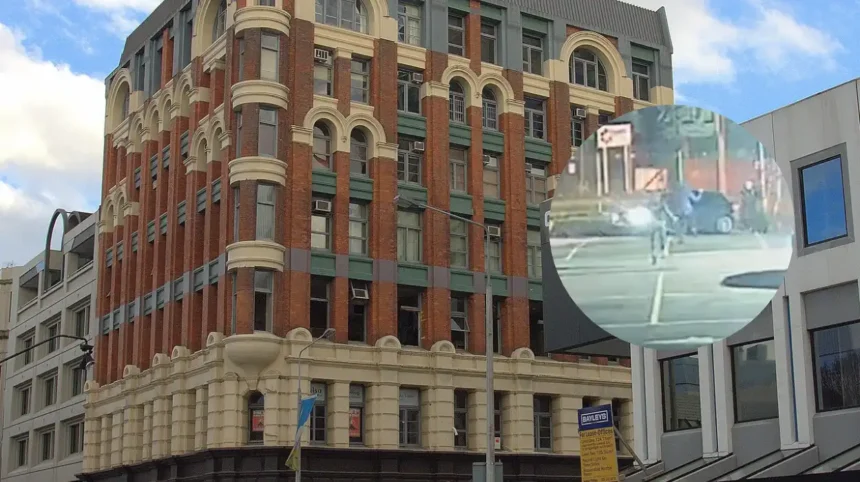
The NWROCU released footage of the moment officers intervened. The video showed a man getting out of a Nissan Micra in a dimly lit car park and placing an item on the ground.
From a distance, the item appeared to be a small device. It then flew into the sky, alerting authorities at nearby Strangeways prison.
Within seconds of the drone taking off, officers descended on the car park. Al-Bakili, who had been operating the drone, threw away the controller and attempted to run. He was caught and handcuffed shortly afterwards.
Duane Anderson was detained in the driver’s seat of the Micra. The subsequent examination of his phone provided evidence that led investigators to Jake Anderson.
Why does drone smuggling matter?
Drone deliveries into prisons have become a recognised method for attempting to introduce prohibited items without physical contact at the prison perimeter. In this case, authorities said the attempted delivery involved drugs as well as communications equipment.
The NWROCU described the use of drones as a significant threat because it can support continued criminal activity from within prison. It also said such activity places prison staff and inmates at risk.
The case followed a coordinated response involving three organisations: the regional organised crime unit, the local police force and the prison service. Their investigation focused on contraband drone flights into HMP Manchester.
What happens next?
The three men have been sentenced, and the NWROCU said it will continue to target anyone involved in this type of criminality. No further defendants were named in the published reporting or the unit’s statement.
The sentencing marks the conclusion of the prosecution arising from the February 2025 incident. The evidence cited publicly included the drone and package recovered by officers, the arrests at the car park, and messages recovered from Duane Anderson’s mobile phone.
Background of the development
HMP Manchester, commonly referred to as Strangeways, is a prison in Manchester. The case concerned an alleged attempt to deliver contraband into the jail by drone from a nearby car park.
The investigation was conducted jointly by the North West Regional Organised Crime Unit, Greater Manchester Police and HMPPS. It focused on drone flights intended to carry prohibited items into the prison.
The defendants were charged with conspiring to convey prohibited articles into prison. The items identified in the case included cannabis, cocaine, mobile phones, chargers and SIM cards.
Prediction: How this affects prison security
For prison staff, inmates and nearby residents, the case is likely to reinforce attention on drone-related security around HMP Manchester. The recovery of the drone, drugs and communications equipment shows how authorities are treating aerial deliveries as a direct threat to prison safety.
For people connected to the prison system, the sentences may increase awareness that drone smuggling can lead to substantial custodial penalties. The involvement of police, the regional organised crime unit and HMPPS also indicates that future attempts may face rapid detection and coordinated enforcement.
For the wider Manchester community, the development highlights the continuing use of technology in organised crime. The case may prompt further investment in detection, monitoring and preventive measures around prison perimeters, particularly where car parks and open spaces are close enough to allow drone launches.