Key Points
- It has been 20 years since Officer Michael Briggs was killed while investigating a call for a domestic disturbance in Manchester, New Hampshire, on October 16, 2006.
- Officer Michael Briggs died the next day when he was just 35 years old and a husband and father of two children who was also a veteran of the US Marine Corps.
- In 2008, Michael Addison was found guilty of capital murder and got the death penalty for the murder of Michael Briggs.
- The state legislature of New Hampshire repealed the death penalty in 2019, but the law did not affect Addison’s case because he was already convicted before that.
- The petition by Michael Addison for the review of his death sentence was dismissed by the New Hampshire Supreme Court on October 6, 2026.
- The city officials and former officials of Manchester have talked about Michael Briggs being a good officer, and his death had affected the police department and his family.
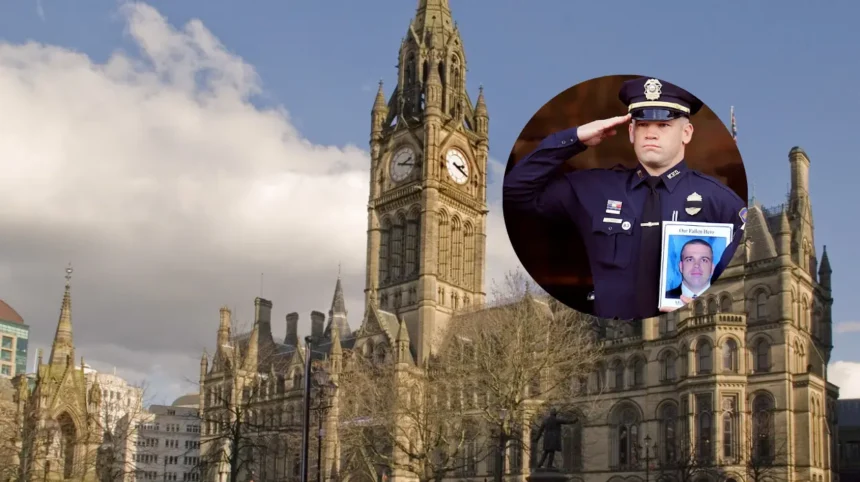
Manchester Police (Manchester Mirror) October 17, 2026 — Manchester police officers, city leaders and state officials have marked two decades since Officer Michael Briggs was fatally shot while responding to a reported domestic disturbance, in a case that remains central to New Hampshire’s debate over capital punishment.
- Key Points
- Who Was Officer Michael Briggs?
- What Happened During the 2006 Shooting?
- What Has Happened to Michael Addison?
- How Have Officials Remembered Briggs?
- What Did State Leaders Say?
- What Does the Case Mean for New Hampshire?
- Background of the Development
- Prediction: How May This Development Affect Manchester Residents?
The Manchester Police Department commemorated the anniversary on Friday, 16 October 2026, 20 years after Briggs was shot at about 2:45 a.m. in an alleyway while investigating a domestic-incident call involving a reported gunshot. As reported by WMUR, Briggs approached two people during the response; one was Michael Addison.
According to Manchester Police Chief Peter Marr, as quoted by WMUR, Briggs told Addison to stop. “And (Addison) waited until he got close to him and spun on him and shot him,” Marr said. Briggs died the next day.
Who Was Officer Michael Briggs?
Briggs was 35 years old, a military veteran and a married father of two when he was killed. He had served five years with the Manchester Police Department and had previously worked in corrections at Valley Street.
In the New Hampshire Union Leader’s anniversary report, Marr recalled Briggs as a colleague who could be relied upon in difficult situations. “Mike was one of those guys you were absolutely certain if you were on a bad call or in a bad fight, he’s one of the guys you want showing up,”
Marr said.
Marr said Briggs commanded respect partly because of his prior work at Valley Street corrections.
“No drama, always did his job – he was just a good guy, a good family guy,”
Marr told the Union Leader.
What Happened During the 2006 Shooting?
Briggs was responding to a domestic disturbance when he encountered Addison. The Boston Globe reported that Briggs was shot in an alleyway after approaching the scene of a reported gunshot.
As reported by WMUR, Addison was walking away when Briggs ordered him to stop, then turned and shot the officer before Briggs had the opportunity to draw his weapon.
Addison fled after the shooting and was arrested hours later at his grandmother’s home in Dorchester, Massachusetts, according to The Boston Globe.
What Has Happened to Michael Addison?
Addison was convicted of capital murder in 2008 and sentenced to death for Briggs’s killing. He remains New Hampshire’s only death-row inmate.
New Hampshire abolished capital punishment in 2019, but the legislation applied prospectively, meaning it did not remove Addison’s previously imposed death sentence.
On 6 October 2026, the New Hampshire Supreme Court dismissed Addison’s petition seeking a further review of his sentence. As reported by New Hampshire Public Radio, the court said lawmakers had not authorised further review of death-penalty cases.
The Union Leader reported that the court found state law permits only one proportionality review under the direct-appeal process and does not allow defendants to seek additional reviews years later. The court also noted that the 2019 repeal expressly applied only to people convicted of capital murder after the law took effect.
Addison’s lawyers had argued that upholding the death sentence conflicted with the state’s current values, WMUR reported. The justices said the law ending the death penalty specified that it applied only to sentences handed down after its passage.
How Have Officials Remembered Briggs?
Current and former Manchester officials described the anniversary as a moment to reflect on Briggs’s service and the continuing effect of his death.
Marr told the Union Leader that he had a private opportunity to see Briggs before he died. “It was devastating not just for the members of the Manchester Police Department, it was devastating for the city,” Marr said.
Marr also recalled seeing Briggs’s children’s jackets placed on him in hospital to keep him warm. “Mike signed up for this, but the family didn’t,” he said.
Former Manchester Police Chief Nick Aldenberg said Briggs’s parents carried a lasting burden. “His dad passed away a few years ago,” Aldenberg told the Union Leader. “Every time I saw his dad, you could see the pain on his face.”
Alderman Dan O’Neil recalled waking to news of the shooting and later bringing doughnuts to the police station.
“I remember going out, getting in the car, and saying – I don’t know if it was right or wrong – I said, ‘Oh, I’ll bring donuts down to the police station,’”
O’Neil told the Union Leader.
What Did State Leaders Say?
Governor Kelly Ayotte, who was New Hampshire attorney general at the time of Addison’s prosecution, said she believed Addison should be held responsible “to the fullest extent of the law.”
“We want to make sure that criminals in our state understand that if you take the life of a police officer, you’re going to face the ultimate consequence,” Ayotte told the Union Leader. She said the case affected her view of law enforcement because it showed the dangers officers face and the impact on their families.
Attorney General John Formella said Briggs’s legacy was “ultimately about more than the circumstances of his death.”
“It is about his service, his sacrifice, and the responsibility we all share to remember those who have given everything to keep their fellow Granite Staters safe,” Formella said, according to the Union Leader.
Formella added that Briggs’s death remained a reminder of the risks taken by law-enforcement officers. “New Hampshire is proud to be the safest state in the nation, but safety can never be taken for granted,” he said.
What Does the Case Mean for New Hampshire?
The anniversary comes shortly after the state Supreme Court’s refusal to revisit Addison’s sentence, leaving him as the only person on death row in New Hampshire and, according to The Boston Globe, the only person remaining on death row in New England.
The court’s October ruling does not itself schedule an execution. Courthouse News reported that Addison was awaiting a ruling in another appeal before the Merrimack County Superior Court that could halt his execution.
The case continues to illustrate the legal distinction between repealing a punishment and eliminating sentences already imposed. New Hampshire lawmakers preserved Addison’s sentence when they abolished capital punishment in 2019, and the Supreme Court has now rejected his latest attempt to obtain further review.
Background of the Development
Michael Briggs was shot on 16 October 2006 while responding to a domestic-disturbance call in Manchester. He died the following day, and Addison was arrested later that day in Massachusetts after fleeing the scene.
Addison was convicted of capital murder in 2008 and sentenced to death. New Hampshire’s Supreme Court reaffirmed in 2015 that his punishment was “neither excessive nor disproportionate,” according to The Boston Globe.
The state repealed the death penalty in 2019, but the law included a carve-out preserving sentences imposed before the repeal. Addison, now 46, has therefore remained on death row despite the statewide abolition of capital punishment for future cases.
Prediction: How May This Development Affect Manchester Residents?
For Manchester residents, the anniversary and the recent court ruling are likely to keep attention on officer safety, public memorials and the long-term consequences of violent crime. The police department’s commemoration indicates that Briggs’s killing remains part of the city’s institutional memory, particularly within the force and among officers who knew him.
For families of law-enforcement officers, the case may reinforce awareness of the risks associated with police work and the effect that a line-of-duty death can have beyond the officer’s own career. Marr’s comments about Briggs’s family reflect that concern, noting that officers accept occupational risks while their relatives do not choose them.
For New Hampshire residents following the justice system, Addison’s continued presence on death row may sustain public discussion about whether a pre-repeal death sentence should remain enforceable after the state abolished capital punishment. The Supreme Court’s decision suggests that, under current state law, further review of his sentence is not authorised, although separate proceedings may still affect the eventual outcome.