The 1960s transformed Manchester through radical urban slum clearances, massive economic shifting from textile manufacturing to tertiary services, expanding pop music venue ecosystems, and major infrastructural developments like the Mancunian Way construction.
- How Did Deindustrialization Reshape the Economy of Manchester in the 1960s?
- How Did Urban Renewal Programs Rebuild Manchester in the 1960s?
- What Major Civil Engineering Projects Were Built in Manchester in the 1960s?
- How Did the Music and Nightlife Scene Evolve in Manchester in the 1960s?
- What Role Did Granada Television Play in Manchester in the 1960s?
- How Did Higher Education and Research Expand in Manchester in the 1960s?
- How Did Football Culture Define Manchester in the 1960s?
- How Did Demographics and Immigration Shift in Manchester in the 1960s?
- Frequently Asked Questions
- What was the biggest economic shift in Manchester during the 1960s?
- Why were so many terraced houses demolished in Manchester in the 1960s?
- What made Manchester’s 1960s music scene distinct from London?
- How did television production impact Manchester’s economy in the 1960s?
- What major infrastructure opened in Manchester during the 1960s?
The decade of the 1960s represented a pivotal structural turning point for Manchester. The municipality shifted away from its nineteenth-century industrial identity as the world center of cotton manufacturing. Economic decline forced the local government and private sectors to diversify into tertiary services, broadcasting, and higher education. Urban planners initiated large-scale slum clearance programs that flattened Victorian terrace housing to construct system-built tower blocks and modern estates. Transport infrastructure underwent modernizing overhauls, exemplified by the opening of the Mancunian Way highway. Meanwhile, a vibrant youth culture transformed the local music scene through venue expansions and pop recording successes.
How Did Deindustrialization Reshape the Economy of Manchester in the 1960s?
Deindustrialization reshaped the economy of Manchester in the 1960s by forcing the closure of traditional textile mills, reducing industrial manufacturing employment, accelerating heavy engineering losses, and driving a major economic transition toward service sector, financial, and broadcasting industries.
The economic foundation of Manchester experienced fundamental structural decline throughout the 1960s. For over a century, the local economy relied on cotton textile production, heavy engineering, and port logistics tied to the Manchester Ship Canal. Foreign competition, outdated manufacturing infrastructure, and shifting global trade routes caused widespread factory closures across the region. Thousands of manufacturing positions vanished during this ten-year span.
The municipality addressed these industrial losses by incentivizing tertiary sector investments. Commercial banking, corporate administration, insurance, and professional services expanded inside the city center. Media production emerged as a critical new economic driver, anchored by Granada Television. Higher education institutions, including the Victoria University of Manchester and the Manchester College of Science and Technology, expanded their physical campuses and employment capacity.
How Did Urban Renewal Programs Rebuild Manchester in the 1960s?
Urban renewal programs rebuilt Manchester in the 1960s by demolishing tens of thousands of Victorian slum terraces, clearing industrial land, constructing high-density system-built housing estates, and rehousing over 100,000 residents into suburban developments like Hattersley.
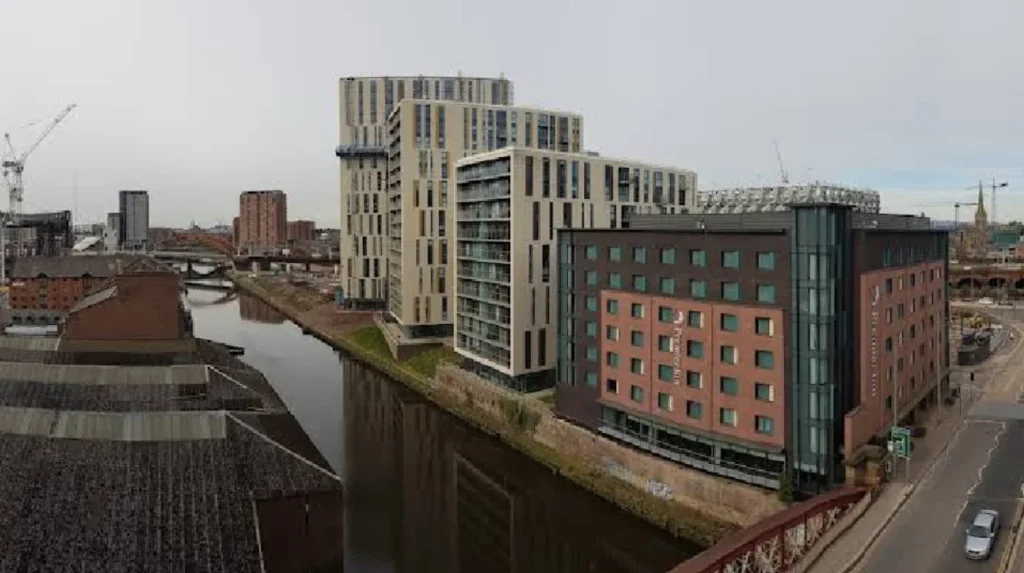
Urban planners in Manchester executed one of the most aggressive slum clearance initiatives in Western Europe during the 1960s. Large sections of nineteenth-century worker housing in districts like Hulme, Ancoats, Moss Side, and Collyhurst were declared unfit for human habitation under public health mandates. The local authority demolished entire street networks of damp, overcrowded back-to-back terraced houses.
The housing department replaced traditional neighborhoods with modernist high-density public housing schemes. The most notable development was the Hulme Crescents project, designed in the late 1960s using prefabricated deck-access concrete systems. Concurrently, the municipal corporation constructed overspill estates outside the city boundaries, such as Hattersley and Gamesley, transferring tens of thousands of working-class families away from the urban core.
What Major Civil Engineering Projects Were Built in Manchester in the 1960s?
Major civil engineering projects built in Manchester in the 1960s included the elevated Mancunian Way highway, the Piccadilly Plaza complex, new high-rise office towers, and modernized railway electrification connecting London Euston to Manchester Piccadilly station.
Civic infrastructure in Manchester underwent rapid modernization to accommodate growing automotive traffic and commercial expansion. The centerpiece project was the Mancunian Way, an elevated 2-kilometer concrete highway constructed between 1965 and 1967. Designed to route cross-city traffic away from the downtown core, the structure received the Institution of Civil Engineers Award for structural engineering design excellence.
Vertical development transformed the urban sky view. The Co-operative Insurance Society (CIS) Tower was completed in 1962, holding the title of the tallest building in the United Kingdom for several years at 387 feet. Piccadilly Plaza was built between 1959 and 1965, incorporating the Sunley House tower block, hotel facilities, and retail spaces directly adjacent to Piccadilly Gardens.
How Did the Music and Nightlife Scene Evolve in Manchester in the 1960s?
The music and nightlife scene evolved in Manchester in the 1960s through the proliferation of beat clubs, jazz cellars, cabaret venues, and the rise of globally successful pop acts like Herman’s Hermits and The Hollies.
Youth culture flourished across Manchester throughout the 1960s, establishing a dense network of music venues that supported the Beat Boom movement. Venues such as The Oasis Club on Lloyd Street, The Twisted Wheel on Brazennose Street, and The Cavern on Charlotte Street provided live performance spaces for emerging local pop bands, American blues artists, and early soul musicians.
Local bands achieved substantial commercial chart success on both domestic and international fronts. The Hollies scored consecutive hit singles throughout the decade, while Herman’s Hermits achieved massive commercial popularity in the United States during the British Invasion. The Twisted Wheel club later relocated to Whitworth Street in 1965, becoming the acknowledged birthplace and focal point of the All-Nighter Northern Soul subculture.
What Role Did Granada Television Play in Manchester in the 1960s?
Granada Television played a central role in Manchester in the 1960s by producing groundbreaking television programs, broadcasting Coronation Street, advancing investigative journalism, and establishing the city as the primary commercial broadcasting hub outside of London.
Granada Television, headquartered at Quay Street in Manchester, became a dominant cultural and economic force during the 1960s. On December 9, 1960, the network broadcast the first episode of Coronation Street, a dramatic series set in a fictional working-class Salford street. The show became the most-watched program on British television, depicting Northern working-class culture to national audiences.
Granada Television expanded its investigative current affairs programming during this period. The flagship current affairs series World in Action launched in 1963, pioneering hard-hitting investigative documentary techniques. Granada also broadcast live music acts, providing early television exposure for groups including The Beatles, which cemented Manchester as a rival media hub to London.
How Did Higher Education and Research Expand in Manchester in the 1960s?
Higher education and research expanded in Manchester in the 1960s through campus building expansions, the rapid development of computer science at the Victoria University, and the growth of the Manchester College of Science and Technology.
The academic footprint of Manchester expanded significantly during the post-war higher education boom of the 1960s. The Victoria University of Manchester added new departmental buildings along Oxford Road, creating a centralized academic corridor. The Manchester College of Science and Technology gained independent university status as UMIST in 1966, focusing on industrial engineering, chemistry, and technical training.
In computing science, Manchester retained its global research prominence. In 1962, the Victoria University of Manchester officially commissioned the Atlas computer in collaboration with Ferranti. At its activation, the Atlas was considered one of the world’s most powerful supercomputers, pioneering early concepts of virtual memory, paging, and multiprogramming operating systems.
How Did Football Culture Define Manchester in the 1960s?
Football culture defined Manchester in the 1960s through the competitive success of Manchester United and Manchester City, culminating in European Cup victory, First Division titles, and domestic FA Cup triumphs.
Professional association football reached unprecedented competitive heights in Manchester during the 1960s, capturing global athletic attention. Under the management of Matt Busby, Manchester United rebuilt its team following the 1958 Munich air disaster. Anchored by players George Best, Bobby Charlton, and Denis Law, Manchester United won the FA Cup in 1963, First Division titles in 1965 and 1967, and became the first English club to win the European Cup in 1968.
Concurrently, Manchester City experienced a revival under the managerial partnership of Joe Mercer and Malcolm Allison. After winning promotion to the First Division in 1966, Manchester City won the League Championship title in 1968, beating Manchester United on the final day of the season. Manchester City followed this success by winning the FA Cup in 1969 at Wembley Stadium.
How Did Demographics and Immigration Shift in Manchester in the 1960s?
Demographics and immigration shifted in Manchester in the 1960s through the arrival of Commonwealth immigrants from the Caribbean and South Asia, reshaping suburban communities, cultural diversity, and local labor markets.
The demographic composition of Manchester diversified rapidly throughout the 1960s due to post-war labor migration patterns. Citizens from Commonwealth nations in the Caribbean, Pakistan, India, and Bangladesh settled in inner-city residential districts. Neighborhoods such as Moss Side, Longsight, and Cheetham Hill developed distinct multicultural communities, establishing local businesses, religious centers, and specialized commercial markets.
These demographic shifts altered the cultural and social fabric of the city. Immigrant populations filled critical labor shortages in public transport services, the National Health Service, and remaining manufacturing facilities. Concurrently, the overall population count within the central administrative boundary declined as families relocated outward to suburban housing developments across Greater Manchester.
Frequently Asked Questions
What was the biggest economic shift in Manchester during the 1960s?
The primary economic shift was the rapid decline of traditional cotton textile manufacturing and heavy engineering, which was replaced by growth in tertiary services, media broadcasting, commercial finance, and higher education institutions.
Why were so many terraced houses demolished in Manchester in the 1960s?
The city council executed aggressive slum clearance policies to eradicate Victorian-era back-to-back terraced housing deemed unsanitary, replacing them with modern high-density concrete housing estates like the Hulme Crescents and suburban overspill developments.
What made Manchester’s 1960s music scene distinct from London?
Manchester offered a dense, accessible network of beat clubs and soul venues like The Twisted Wheel and The Oasis Club, breeding internationally successful pop acts like The Hollies and laying the groundwork for the Northern Soul movement.
How did television production impact Manchester’s economy in the 1960s?
Granada Television established Quay Street Studios as the major commercial broadcasting hub outside London, producing national television hits like Coronation Street and World in Action, which created skilled employment and media infrastructure.
What major infrastructure opened in Manchester during the 1960s?
The most prominent infrastructure projects were the elevated Mancunian Way highway completed in 1967, the CIS Tower completed in 1962, the Piccadilly Plaza complex, and the electrification of the main railway line to London Euston.