Key Points
- A music event was held on 29 May 2026 at Projekts MCR’s skatepark situated below Mancunian Way in Manchester.
- While the event had been estimated to cater to roughly 1,000 people, it turned out that over 2,000 tickets had been issued, reported Greater Manchester Police.
- GMP claimed that the music event was “poorly planned, poorly supervised and unsafe” with people climbing over fences to enter the event site.
- The music was paused, and the police were called in an attempt to manage the chaos.
- The organisers stated that the promoter broke their contract by selling too many tickets and they had to stop the event after one hour.
- At the Manchester licensing committee meeting, GMP and the council’s licensing and out-of-hours team opposed some of the proposed amendments to Projekts MCR’s license.
Manchester (Manchester Mirror) September 02, 2026 – A music event at a Manchester skatepark has been branded unsafe after it descended into chaos, with crowd control breaking down and attendees climbing perimeter fences to get in. Greater Manchester Police (GMP) told a licensing hearing that the event was “inadequately planned, poorly supervised, and unsafe” for participants after more than 2,000 tickets were issued for a gathering assessed for about 1,000 people. The council’s licensing and out-of-hours team also recorded multiple noise complaints linked to the event, which took place on 29 May beneath the Mancunian Way.
How did the event descend into chaos?
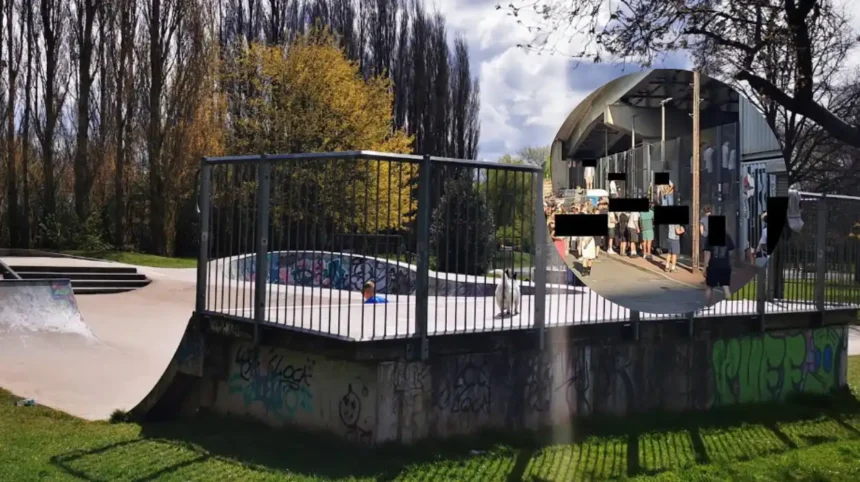
According to details presented at a Manchester licensing meeting on Tuesday, 1 September 2026, the situation deteriorated quickly once numbers swelled beyond capacity. As reported by Manchester Evening News, GMP said in a statement on the council’s website: “The event issued 2,000 tickets for a gathering that had been assessed and organised for approximately 1,000 individuals. The decision to issue excess tickets was deliberate on the part of both the venue management and the promoters.” The force added: “The evident dangers associated with this decision would be apparent to any reasonable person and swiftly proved to be perilous, with individuals without tickets scaling the perimeter fences to gain access.” Council report images showed attendees attempting to climb over fences to enter the site. As conditions worsened on the night, organisers chose to stop the music and alert police “in an effort to restore order”.
What have police and the council said about safety?
GMP’s assessment, as quoted in the council’s published statement, was that the event was unsafe from the outset due to the deliberate overselling of tickets. The council’s licensing and out-of-hours team highlighted the volume of noise complaints as part of the broader picture of disorder and disruption caused by the event. Both GMP and the licensing team used the hearing to set out their concerns about how the event was planned and supervised, and how those failures translated into on-the-ground risks for attendees and local residents.
What did Projekts MCR say about the incident?
John Haines from Projekts MCR told the licensing hearing that the “vast majority” of events at the venue are “secure and well-organised”. He said: “We strive to be good neighbours within our community; we do not cease operations at the skatepark lightly.” Addressing the May event specifically, Mr Haines stated:
“The promoter violated our agreement by issuing 2,000 and 2, tickets for the planned event. Once this issue became clear, I believe the management team at Projekts acted swiftly and responsibly. We terminated the event within an hour, kept thorough incident records, maintained constant communication with the security team, and coordinated with GMP and the licensing and out-of-hours team throughout the event and afterward.”
His comments sought to separate the venue’s usual operating standards from the actions of the external promoter on the night.
What licence changes were proposed and decided?
During the licensing session, Projekts MCR put forward several amendments to its premises licence that it said would help it run secure events. GMP argued that some of the suggested changes would effectively “weaken” existing licensing protections, and both the police and the council’s licensing and out-of-hours team opposed those proposals. One specific request that was refused was to reduce the advance notice period required for events organised by an external promoter from 28 days to 14 days for gatherings of more than 500 attendees. Despite that refusal, several other requests from Projekts MCR were approved, including the removal of what the venue described as redundant conditions.
Background to the development
The hearing forms part of Manchester’s ongoing oversight of live music and nightlife events at the Projekts MCR skatepark site beneath the Mancunian Way, a location that has hosted a range of promoted nights over recent years. The May 2026 incident came after the venue and an external promoter agreed an event plan assessed for around 1,000 people, but tickets were then sold well beyond that figure, leading to overcrowding, fence-scaling and a breakdown in supervision. The licensing process is being used to review how such events are notified, supervised and controlled, with particular attention on notice periods for external promoters and the conditions attached to the premises licence.
Prediction: how this could affect Manchester eventgoers and residents
If licensing authorities maintain a strict stance on notice periods and capacity enforcement, future events at the skatepark are likely to see tighter controls on ticket numbers, stronger promoter vetting and more robust on-site security plans. For Manchester eventgoers, that could mean fewer last-minute large-scale nights but potentially safer, better-managed gatherings with clearer entry procedures and reduced risk of overcrowding. For local residents, stricter enforcement and retained notice periods may translate into fewer unexpected noise disturbances and a more predictable pattern of late-night activity around the Mancunian Way corridor. For promoters and venues, the outcome signals that breaching capacity assessments or attempting to shorten statutory notice windows is likely to be challenged, which could raise compliance costs but also clarify expectations around safe event delivery.