Key Points
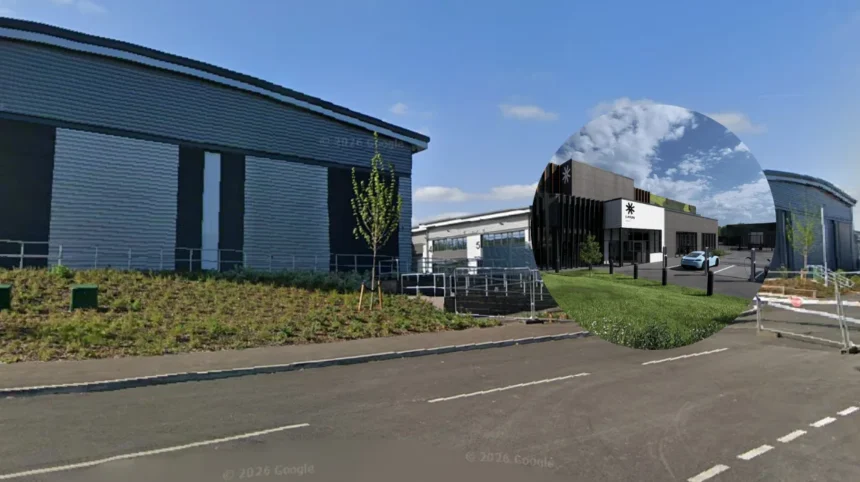
- A planning application has been lodged by Latos Data Centres with Manchester City Council seeking permission for an 28,000 sq ft “neural edge” data centre on a site off Bower Street in Newton Heath. The development is scheduled for completion by 2030.
- The dual building project will make use of a three-acre brownfield site adjacent to the Lowry Park industrial area and is intended to provide capacity in support of AI computing needs.
- The proposed facility is a “neural edge data centre”, according to Latos. This data centre will be quicker than cloud facilities and bring AI closer to the end-user.
- According to Andrew Collin, Managing Director of Latos Data Centres, Manchester is a “leading digital city”. This planning application will enable the growth of Manchester’s digital landscape.
- Create Architecture has been selected as the lead designer, while Euan Kellie Property Solutions is the planning consultant. A number of specialist consultants have been appointed including E3P, Sol, Merebrook Consulting, CW Studio, GIA, Civic, RWO, SK Transport and Counter Context.
- Further details of the planning application can be accessed on the Manchester City Council Planning Portal using reference PLA-2026-001350.
- Latos is building a £100m “neural edge” data centre in Tees Valley
Manchester (Manchester Mirror) August 20, 2026 — Latos Data Centres has lodged plans with Manchester City Council for a 28,000 sq ft “neural edge” data centre on a three‑acre brownfield site off Bower Street in Newton Heath, with the aim of completing construction by 2030. The two‑building development, close to the Lowry Park industrial zone, is intended to cater for the rising popularity of artificial intelligence by locating powerful computing capacity nearer to end users in the city region.
- Key Points
- How does the Newton Heath scheme fit into Latos’s wider UK pipeline?
- What is a “neural edge” data centre and how is it different from hyperscale sites?
- Where exactly is the Newton Heath site and what is the planning reference?
- How does this proposal sit within Greater Manchester’s data centre expansion?
- What have local voices and experts said about data centre growth in the region?
- Background: how did the Newton Heath data centre proposal develop?
- Prediction: how could this development affect businesses, residents and the local economy?
As reported by Dan Whelan of Place North West, Latos has said previously that neural edge data centres are faster than traditional cloud computing facilities and can bring “powerful AI computing closer to end users”. Neural edge facilities sit on the smaller end of the data centre spectrum, with hyperscale centres serving large users such as Microsoft representing the largest tier.
Andrew Collin, managing director at Latos Data Centres, said:
“We are pleased to have submitted our planning application to Manchester City Council. Manchester is a leading digital city, and this proposal supports its continued growth by providing the cutting‑edge digital infrastructure Manchester needs.”
He added:
“Our ambition is to deliver a high‑quality, sustainable data centre designed to meet rigorous environmental and safety standards. We are committed to being a responsible neighbour and will continue to engage with the community and the Council throughout the planning process and beyond.”
Create Architecture is leading on design and Euan Kellie Property Solutions is the planning consultant. E3P, Sol, Merebrook Consulting, CW Studio, GIA, Civic, RWO, SK Transport, and Counter Context are also advising, according to the Place North West report. Members of the public can review the application by searching reference number PLA‑2026‑001350 on Manchester City Council’s planning portal.
How does the Newton Heath scheme fit into Latos’s wider UK pipeline?
Latos is also behind proposals for a smaller, £100m data centre currently under construction in Tees Valley, which the company has described as the UK’s first “neural edge” AI data centre. Last September, approval was secured for the Stockton scheme at Preston Farm Industrial Estate, and the company says the project is now on track after initial delays linked to lead times.
As reported by Insider Media, Latos chief executive Peter Wilcock said: “Timescale wise, we are hoping that we will have it ready to service in 12 months… We’re on track and we’re up and running.” Wilcock noted the importance of securing land and power connections quickly, and said the company looks for locations with around 350,000 homes nearby because it believes AI will become more of a consumer product over time.
The Stockton facility is intended to bring AI power closer to businesses and communities, cutting processing times from seconds to milliseconds compared with traditional cloud data centres, according to Insider Media. Wilcock added: “The scheme becomes a flagship and draws in interest. It opens up opportunities for tech businesses, start‑ups and universities.”
What is a “neural edge” data centre and how is it different from hyperscale sites?
Neural edge data centres are positioned as smaller, locally sited facilities that reduce latency by processing data nearer to where it is generated and used. Latos has said such centres are faster than traditional cloud computing facilities and can bring “powerful AI computing closer to end users”.
By contrast, hyperscale data centres are very large facilities designed to serve major cloud providers and enterprise users at scale, with Microsoft cited as an example of a large user in reporting by Place North West. The distinction matters for AI workloads that require rapid response times, such as real‑time inference, edge analytics and applications where milliseconds of delay can affect performance.
Where exactly is the Newton Heath site and what is the planning reference?
The proposed development would be constructed on a three‑acre brownfield site off Bower Street in Newton Heath, close to the Lowry Park industrial zone, according to Place North West. Stockport Nub News, reporting on wider data centre growth in Greater Manchester, described the Latos site as being on the corner of Bower Street and Ten Acres Lane, next to the Rochdale Canal and a short distance from Manchester city centre.
To learn more about the Newton Heath proposal, search for reference number PLA‑2026‑001350 on Manchester City Council’s planning portal, as stated in the Place North West article.
How does this proposal sit within Greater Manchester’s data centre expansion?
Greater Manchester is experiencing a period of data centre expansion, with new buildings planned around the region, including the Latos scheme in Newton Heath and a £350m Kao Data facility in Reddish, Stockport, as reported by Stockport Nub News. The Reddish project, approved in March 2024, will deliver northern England’s biggest data centre at 25,900 sq m on Kenwood Road, with power delivery to the site scheduled for completion by September 2027, according to the same report.
As reported by Alasdair Perry of Stockport Nub News, Greater Manchester mayor Andy Burnham visited the Kao Data site in 2024 and said:
“We’ve been the fastest growing digital and tech hub in Europe in recent years, but if we want that to continue we need to see the emergence of facilities like this.” He added: “It will particularly support the development of our AI cluster… There’s an opportunity right now for Greater Manchester to become the first big mover in this space in the north of England.”
Councillors in Salford also approved plans for a £250m investment for a new data centre near the Salford Community Stadium in Eccles in 2025, with planning lead Mike McCusker describing the building as “crucial for our economy and generating the growth we need”, according to Stockport Nub News.
What have local voices and experts said about data centre growth in the region?
While councils have been supportive, some residents and local representatives have raised concerns about noise, energy use and water consumption. As reported by Alasdair Perry of Stockport Nub News, Reddish councillor James Frizzell of the Green Party said:
“We weren’t particularly happy with first of all its location, and its energy credentials, using diesel generators as a back up, there’s no real plan to reuse the heat that it generates, there’s concerns about the amount of water that it uses.”
He added:
“It’s not going to create that many jobs either and they’re not necessarily going to be local jobs, from memory it’s about 40 jobs.”
Dr Yawei Zhao, a lecturer at the University of Manchester in human geography, told the Local Democracy Reporting Service via Stockport Nub News: “It’s really hard to say whether building more data centres will be good or bad for Greater Manchester.” She noted:
“Building more data centres is certainly aligned with the Greater Manchester digital strategy… The current proposals for data centres under construction, they might address the gap in terms of replacing older facilities.”
But she cautioned:
“On the basis of the evidence I’m aware of the environmental impact and waste pollution, and also whether data centres are resource intensive and use a lot of energy and water, considering all this possible impact, it’s really hard to say.”
Kao Data responded to local concerns by stating its Reddish facility will use closed loop liquid cooling technology and that the cooling system “will not affect anyone’s water pressure at all”, according to Stockport Nub News. The company also said the site will use less water over its 20‑year lifetime than one family of four uses in a year.
Background: how did the Newton Heath data centre proposal develop?
The Newton Heath proposal emerges from Latos’s broader strategy to deliver “neural edge” infrastructure across the UK, beginning with its Stockton scheme that secured approval last September and is now under construction. The company has emphasised the need for locations where land and power connections can be secured quickly, and where planning processes are supportive, as outlined by chief executive Peter Wilcock in Insider Media.
In Manchester, the choice of a brownfield site off Bower Street aligns with regional efforts to repurpose former industrial land for high‑value digital uses, while positioning the city to capture AI‑driven demand. The application, submitted in August 2026 and recorded under reference PLA‑2026‑001350, follows a pattern of recent data centre consents across Greater Manchester, including the Kao Data project in Reddish and the Salford scheme near Eccles.
Prediction: how could this development affect businesses, residents and the local economy?
If approved and built to the 2030 target, the Newton Heath facility could affect several audiences in distinct ways. For technology businesses and AI start‑ups in Greater Manchester, a local neural edge site may reduce latency and improve performance for real‑time applications, potentially making the region more attractive for firms that rely on fast inference and edge processing. For the construction sector and specialist supply chain, the project could generate short‑term activity during the build phase, with a smaller number of permanent operational roles once the site is live, consistent with job profiles described for other regional data centres.
For nearby residents, the main impacts are likely to centre on construction traffic, noise during the build, and long‑term questions about energy and water use, themes already raised in relation to the Reddish scheme. If Latos delivers on its stated commitment to rigorous environmental and safety standards and ongoing community engagement, as set out by Andrew Collin, the project may mitigate some concerns, though scrutiny over sustainability and resource use is likely to persist. For local authorities, the development could support digital strategy objectives and economic growth narratives, while requiring careful planning oversight to balance infrastructure needs with neighbourhood impacts.