Key Points
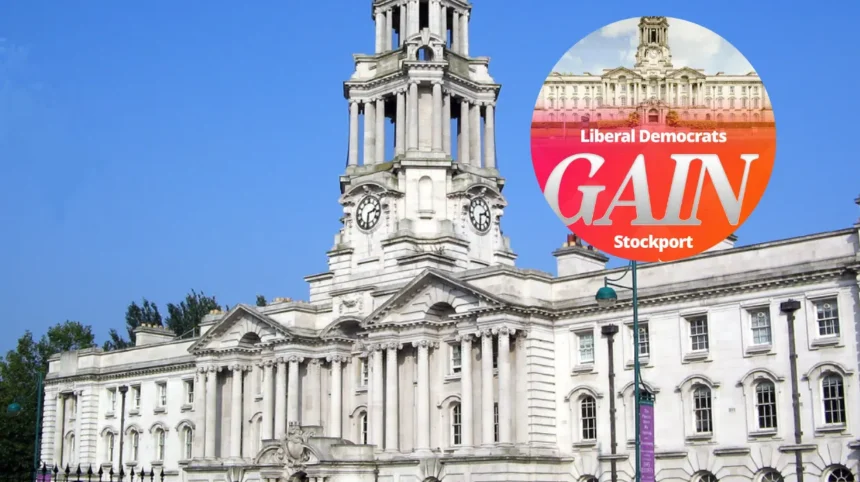
- The Liberal Democrats won overall control of Stockport Council in the 2026 local elections.
- They secured 33 of the 63 seats, giving them a working majority and ending 15 years of no overall control.
- The party gained three seats from Labour, including Davenport and Cale Green, Marple South and High Lane, and Offerton.
- Labour lost five of the seven seats it was defending and fell to 14 councillors.
- Reform UK won its first two seats on Stockport Council, including Brinnington and Stockport Central by 59 votes.
- Turnout across Stockport was 44%.
Stockport(Manchester Mirror)May 09, 2026 – The Liberal Democrats have taken control of Stockport Council after the 2026 local elections, bringing an end to a 15-year period in which no single party held a majority.
As reported by the reporting from ITV Granada and Marketing Stockport, the Lib Dems reached 33 councillors on the 63-seat authority, crossing the 32-seat threshold needed for control. That result marks the first time since 2011 that any party has held a majority on the council.
The party’s gains came mainly at Labour’s expense, with Labour losing five of the seven seats it was defending and dropping to 14 councillors. The Green Party also made a gain in Reddish North and now has four councillors, while Reform UK won two seats for the first time in the borough.
How was the majority won?
The key shift came from the Liberal Democrats adding three seats in wards that had been held by Labour. Those gains were in Davenport and Cale Green, Marple South and High Lane, and Offerton. ITV Granada reported that the party moved from 30 seats into a working majority with 33 councillors.
The council’s own results page confirms the ward winners across Stockport and shows turnout at 44%. In Brinnington and Stockport Central, Reform UK won by a margin of just 59 votes, the closest result in the borough.
What did the numbers show?
Marketing Stockport’s results summary shows the post-election council makeup as Liberal Democrats 33, Labour 14, Independents 9, Greens 4, Reform UK 2, and Conservatives 1. Place North West also reported that the borough moved out of no overall control for the first time in 15 years.
That shift matters because Stockport had become one of the most closely watched councils in Greater Manchester, with control often dependent on small changes in seat totals. Before the vote, the Liberal Democrats were already the largest group and were close to overall authority.
Why does this matter locally?
Stockport Council decisions affect local services, planning, housing, waste, roads, and spending priorities. The move from no overall control to a Lib Dem majority gives the party greater freedom to implement its programme without needing cross-party support on every major decision.
For residents, this can mean clearer accountability because one party now carries responsibility for council policy and outcomes. It may also reduce the uncertainty that often comes with minority or deadlocked control, where decisions can depend on informal agreements between parties.
What is the wider political context?
The result follows a campaign in which the Liberal Democrats had identified Stockport as a top target. BBC reporting in April noted that the council was the party’s only area of authority in Greater Manchester before the election and that just a small number of gains could deliver overall control.
The outcome also sits within a broader night of local election changes across Greater Manchester, where Reform UK made notable gains and Labour suffered losses in several areas. In Stockport, however, the clearest headline was the Liberal Democrats converting a long-standing position of influence into formal control.
What did the sources say?
ITV Granada said Stockport Council would be led by a majority party for the first time in 15 years after the Liberal Democrats achieved one of their top targets. Marketing Stockport said the result was the first majority on the council since 2011.
The council’s official results page provides the ward-level winners and records turnout at 44%. BBC News later described the result as the Liberal Democrats taking control of Stockport for the first time.
Background?
Stockport had been under no overall control since 2011, meaning no single party had enough councillors to run the council alone. Over that period, the Liberal Democrats came closest to a majority and were already running the authority in a minority position before the 2026 vote.
The 2026 election changed that balance by giving the party a decisive buffer above the control line. Labour’s losses, along with smaller gains for the Greens and Reform UK, helped reshape the council chamber and end the deadlock.
Prediction?
For Stockport residents, the most immediate effect is likely to be a more stable council leadership and a clearer line of responsibility for decisions. A majority administration may be able to move faster on local priorities such as planning, transport, housing, and service delivery.
For opposition parties, the result means they may have less leverage over council policy than during the years of no overall control. For voters, the next test will be whether the new majority translates into visible changes in day-to-day services and local decision-making over the coming year.