Key Points
- Major tram disruption has started across Greater Manchester as part of a £150m Metrolink upgrade.
- Tracks are being replaced between Trafford Bar, Cornbrook and Deansgate-Castlefield from 13 July to 2 August.
- No trams will run on the Eccles, Trafford Centre and Altrincham lines during the works.
- East Didsbury and Manchester Airport services will terminate at Firswood.
- Rochdale line trams will terminate at Exchange Square.
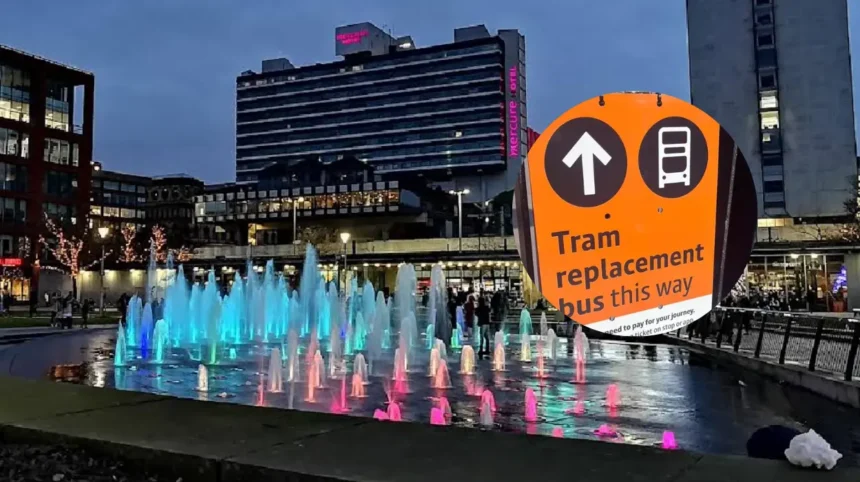
- Replacement buses are in operation while sections of the route are closed off.
- TfGM says more work will also take place at Eccles and in the city centre near Piccadilly Gardens to reduce the need for future disruption.
- A special event bus service will run for The Hundred at Old Trafford Cricket Ground on 26 and 31 July.
- Metrolink network director Ian Davies said the work is taking place on one of the busiest stretches of tram track in the country.
- Davies said some sections are more than 30 years old and that the upgrades should improve reliability and reduce journey times.
Manchester Live Traffic & Travel (Manchester Mirror) July 13, 2026 – Greater Manchester is facing three weeks of major tram disruption after Transport for Greater Manchester began a large-scale upgrade programme on 13 July, with services on three lines suspended and several others cut back while track replacement work takes place. The work is centred on the busy stretch between Trafford Bar, Cornbrook and Deansgate-Castlefield, where engineers are replacing worn track as part of Metrolink’s £150m improvement plan.
As reported by Transport for Greater Manchester, the shutdown will run until 2 August and will affect some of the network’s most heavily used routes, including the Eccles, Trafford Centre and Altrincham lines, which will not have trams running during the closure. Services on the East Didsbury and Manchester Airport lines will end at Firswood, while Rochdale line trams will stop at Exchange Square.
Replacement buses have been introduced to carry passengers through the affected areas while the work is under way. TfGM has also said parts of the route have been blocked off to support the upgrade work and to allow engineers to complete the programme safely and efficiently.
Why is the upgrade being carried out?
According to Ian Davies, Metrolink’s network director, the stretch at Trafford Bar and Deansgate-Castlefield is one of the busiest tram corridors in the country, with some sections now more than 30 years old. He said the network carries 40-tonne trams every 30 seconds at peak times, which has led to significant wear and tear on the track.
Davies said the upgrade is necessary because that level of pressure on the system takes its toll and makes renewal essential. He added that the works are intended to improve reliability and help reduce journey times for passengers once the project is complete. He also acknowledged the inconvenience for customers, saying TfGM understands the disruption and will do what it can to keep people moving during the closure.
The wider improvement plan is part of Metrolink’s £150m upgrade programme, which TfGM says is designed to strengthen the network and reduce the likelihood of further disruption in future. That includes additional work at Eccles and in the city centre near Piccadilly Gardens during the closure period.
How are passengers being affected?
Passengers using the suspended lines are being advised to rely on replacement buses, temporary route changes and revised terminating points while the work continues. The disruption is likely to affect regular commuters, leisure travellers and anyone using the network to reach central Manchester or the south and west of the city region.
The temporary arrangements also come at a busy time for the city’s transport network because of major summer events, including The Hundred at Old Trafford Cricket Ground. TfGM said a special event bus service will be in place on 26 July and 31 July to help spectators travel to and from the ground while the tram closures remain in effect.
For passengers, the main practical impact is likely to be longer journeys, more changes and reduced direct access on several key routes. TfGM’s message is that the disruption is temporary, but necessary to improve the long-term condition of the network.
What did TfGM say?
Ian Davies said the work is being carried out on one of the most heavily used sections of tram track in the UK. He said some of the infrastructure has been in service for more than three decades and that ongoing heavy use means the system now needs major renewal.
He also said the aim is not just to repair the track but to make the service better for users in the longer term. According to Davies, the upgrades should support more reliable tram operations and quicker journeys once the work is finished.
Davies apologised for the inconvenience, saying the authority knows the disruption will be annoying for passengers. He added that TfGM will try to keep people moving while the essential work is completed.
How long will the closure last?
The current works began on 13 July and are scheduled to continue until 2 August. That gives the upgrade programme a three-week window to replace the affected sections of track and carry out related work across the network.
During that period, passengers will have to use altered tram services or replacement buses depending on their route. The affected area includes a key part of the network linking south Manchester, the city centre and the western routes into Trafford and Salford.
Because the closure covers several important corridors, the impact is likely to be felt across a broad range of journeys rather than just one part of the system. TfGM has indicated that the works are being timed and managed to limit the need for repeated closures later on.
Background of this development
Metrolink is Manchester’s tram network and has been expanded over many years to serve the wider city region. As the network has matured, some of its busiest sections have reached an age where replacement is becoming necessary rather than optional.
The current work reflects a wider pattern seen in transport systems built for heavy daily use: track, signals and associated infrastructure need renewal after long periods of service. TfGM has framed the project as a long-term investment intended to support reliability, capacity and passenger comfort rather than a short-term fix.
The decision to carry out the work during summer also suggests an effort to balance engineering needs with passenger demand, even though the closure still causes significant disruption. The inclusion of special services for The Hundred shows how transport planners are also trying to manage event travel alongside routine journeys.
What could this mean for passengers?
For regular commuters, the most immediate effect is likely to be longer travel times and the need to plan around replacement buses or short-turned tram services. People who normally rely on direct services into the city centre or across Trafford may have to allow extra time and check service changes before travelling.
For businesses and event visitors, the disruption could affect punctuality and footfall in areas served by the suspended routes, particularly around central Manchester and Old Trafford. Over time, however, TfGM says the upgrades should improve the network’s reliability, which may reduce delays and make services more dependable once the works are complete.
The wider significance is that passengers may see short-term inconvenience now in exchange for fewer faults and better performance later. That trade-off is often central to major transport maintenance, especially on heavily used urban networks.