Key Points
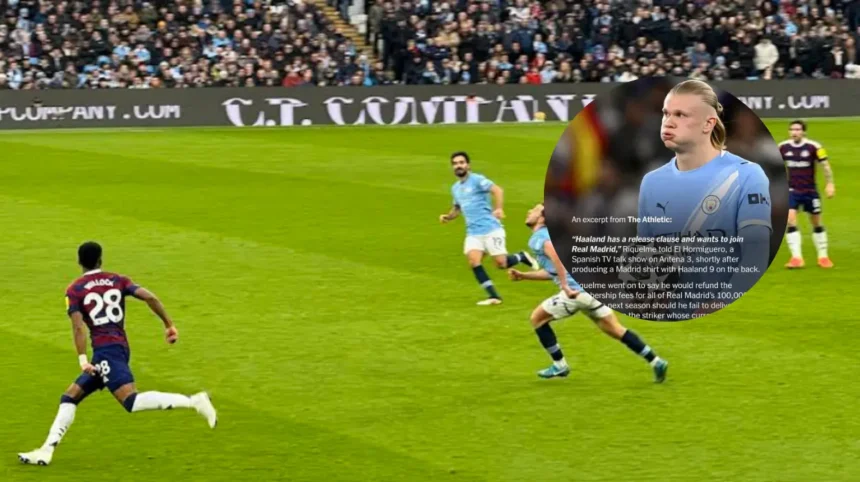
- Man City are considering legal action after Real Madrid presidential candidate Enrique Riquelme claimed he would sign Erling Haaland if elected.
- City said reports from Spain about Haaland’s future are false and insisted there is no contractual route for such a move.
- The club said it was also considering legal action over the use of their player’s image in connection with the claim.
- Riquelme’s comments were linked to a public shirt stunt involving a Real Madrid shirt with Haaland’s name and number nine on it.
- Separate reporting has said City remain confident Haaland will stay at the Etihad and are treating any summer move as highly unlikely.
- Haaland signed a long-term contract earlier in 2026, which City view as a major statement about his future.
Manchester City FC(Manchester Mirror)June 03, 2026-Manchester City are considering legal action after Enrique Riquelme, a Real Madrid presidential candidate, said he would sign Erling Haaland if elected. As reported by the relevant outlets, City rejected the claim and said there is “no chance” of the striker leaving for Real Madrid.
The club’s position is that the Spanish reports about Haaland’s future are false and that there is no contractual clause that would allow the transfer to happen in the way suggested. City also said they were looking at legal steps because their player’s image was used in the context of the claim.
What did City say?
Manchester City’s response was firm and direct. The club said: “The reports originating from Spain concerning Erling Haaland’s future are false. There is no possibility of this occurring, and no contractual provision exists to facilitate it.”
City also addressed the shirt stunt linked to Riquelme, saying they were considering legal action over the use of Haaland’s image. That statement has become central to the story because it moves the issue beyond a transfer rumour and into a potential legal dispute.
Who is Enrique Riquelme?
Enrique Riquelme is a Real Madrid presidential hopeful whose comments about Haaland triggered City’s reaction. According to the reports, he raised the prospect of bringing the forward to the Bernabéu if he wins the election.
His public appearance with a Real Madrid shirt carrying Haaland’s name and number nine added to the controversy. City appear to have viewed that as a step too far, especially given the sensitivity around player image rights and transfer speculation.
Why Haaland matters
Erling Haaland remains one of the most valuable players in world football, so any suggestion of a move to Real Madrid draws major attention. Separate reporting has said City are adamant he will not leave this summer and that the club view his long-term deal as a strong commitment to their future.
That wider context matters because it shows City are not reacting only to one statement, but to a recurring pattern of transfer noise involving one of their most important players. The club has repeatedly tried to shut down speculation around his contract and future.
What is the wider context?
There has been long-running discussion about Haaland’s future, but recent reporting has suggested City believe he is settled and not seeking an exit. One report said Haaland’s new contract, signed in January, runs until 2034 and was seen internally as a major statement.
Earlier reporting also noted that Haaland said City’s financial issues had no influence on his decision to extend his deal, which reinforced the idea that he had chosen to stay despite outside noise. That makes the current dispute less about an actual move and more about the boundaries of public claims involving a player already under contract.
Background of the development
This development sits inside the broader tension between transfer speculation, club image rights, and presidential campaign rhetoric at elite football clubs. In this case, a high-profile Real Madrid election claim about signing Haaland collided with City’s insistence that the story is baseless.
The issue also reflects how modern football disputes can quickly become legal or quasi-legal, especially when a player’s image is used for publicity. City’s response suggests they wanted not just to deny the transfer claim, but to discourage similar public use of their player’s name and likeness.
What happens next?
At this stage, the immediate next step depends on whether Manchester City choose to formally pursue legal action. The available reporting shows the club has only said it is “considering” that route, so no case has yet been confirmed.
Real Madrid’s election campaign context may also shape how the story develops, especially if further public comments are made. If that happens, City may feel pressure to respond again, particularly if Haaland’s image or contract situation is referenced in future statements.
Prediction
For the football audience, this development is likely to keep Haaland in the transfer conversation even if a move remains highly unlikely. That means more speculation, more denials, and continued media focus on whether Real Madrid will keep trying to associate themselves with the striker.
For Manchester City supporters, the most likely short-term effect is frustration rather than concern, because current reporting points to Haaland staying at the club. For readers following Spanish football politics, the issue may also become a test of how far candidates can go in using star-player claims during election campaigns.