Key Points
- Manchester United enlisted data specialists to prove Liverpool striker Alexander Isak could not have reached the ball during their Premier League fixture at Anfield on Sunday, November 22, 2026.
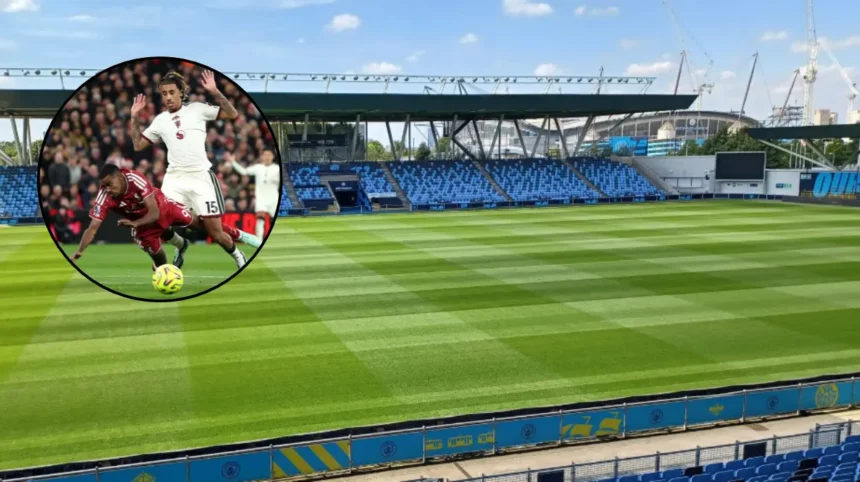
- Defender Leny Yoro was shown a straight red card by referee Sam Barrott in the eighth minute for allegedly denying an obvious goalscoring opportunity, a decision upheld by Video Assistant Referee (VAR) John Brooks.
- United submitted three high-resolution video clips from multiple angles at real-time and slow-motion speeds, alongside technical data claiming Isak would have remained at least 1.8 metres short of the ball.
- A three-person independent Football Association (FA) regulatory commission unanimously overturned the dismissal on Tuesday, removing Yoro’s one-match suspension and ruling that Barrott had committed an obvious error.
- The written reasons published by the FA revealed that while the panel viewed United’s proprietary data with caution, they agreed Isak’s heavy touch had ceded control of the ball to United goalkeeper Senne Lammens.
- Referees’ chief Howard Webb and the Premier League’s Key Match Incidents (KMI) Panel reportedly maintained contrasting views, backing the original on-field decision and the VAR’s refusal to intervene.
Manchester (Manchester Mirror) November 27, 2026 – Manchester United successfully overturned defender Leny Yoro’s red card by submitting technical data analysis and multi-angle video footage to an independent Football Association (FA) panel, proving that Liverpool forward Alexander Isak would have fallen at least 1.8 metres short of reaching the ball.
- Key Points
- What Evidence Did Manchester United Present to the Independent Panel?
- How Did the Football Association Panel Respond to the Data Analysis?
- Why Did Officiating Bodies Disagree Over the Anfield Incident?
- Background of the Development
- Prediction: How Will This Development Affect Premier League Clubs and Officials?
The incident occurred just eight minutes into Manchester United’s 4-0 Premier League defeat against Liverpool at Anfield on Sunday, November 22, 2026. Referee Sam Barrott dismissed the young French centre-back for a challenge on Isak as the Swedish striker raced towards the penalty area, determining that the foul met the criteria for denying an obvious goalscoring opportunity (DOGSO). Video Assistant Referee (VAR) John Brooks, supported by assistant VAR Paul Howard, reviewed the collision and upheld Barrott’s on-field call, concluding that no clear and obvious error had occurred.
Following the match, Manchester United lodged an official claim for wrongful dismissal with the FA. On Tuesday, November 24, the governing body confirmed that the appeal had been successful, rescinding Yoro’s automatic one-match suspension and clearing him to feature in upcoming domestic fixtures.
What Evidence Did Manchester United Present to the Independent Panel?
To persuade the regulatory commission to overturn the dismissal, Manchester United’s management and legal team compiled a comprehensive evidentiary dossier. According to the written reasons published by the FA on Thursday, November 26, the Old Trafford club submitted a formal letter outlining in detail why the dismissal of Yoro for denying an obvious goalscoring opportunity was wrongful.
Alongside the written submission, United provided the panel with three high-resolution video clips capturing the collision between Yoro and Isak from various camera angles and distances.
These clips were presented at both real-time and slow-motion speeds to illustrate the trajectory of the ball and the positioning of the covering defenders and goalkeeper.
Furthermore, United included comparative video footage from a previous Premier League fixture involving Brighton & Hove Albion and Sunderland, where defender Pascal Struijk had a red card rescinded under similar circumstances, using the case as a regulatory precedent.
As reported by Kaveh Solhekol of Sky Sports News, United’s technical analysis claimed that Isak was “at best 1.8m short of reaching the ball” had Yoro not made the challenge.
By deploying internal data specialists to calculate player speeds, ball deceleration, and spatial distances, the club sought to demonstrate mathematically that the Swedish forward had no realistic prospect of regaining possession before United goalkeeper Senne Lammens gathered the ball.
How Did the Football Association Panel Respond to the Data Analysis?
The appeal was adjudicated by a three-person independent regulatory commission chaired by Stuart Ripley, a former Premier League winger, alongside former First Division goalkeeper Mick Kearns and former striker Tony Agana. The panel received guidance on the Laws of the Game from former top-flight referee Eddie Wolstenholme.
While the commission ultimately ruled in Manchester United’s favour, the published written reasons clarified how the panel weighed the club’s proprietary tracking data. In the official FA documentation, the commission stated that it
“had no way of testing the validity of this analysis undertaken by the club and as such the evidence was viewed with caution and allocated weight accordingly.”
Despite treating the 1.8-metre calculation with caution, the panel concluded from the visual evidence that Barrott had made an erroneous judgement. In their official written reasons, the three-person panel stated:
“The commission members were unanimous that, taking the foul committed by LY [Yoro] out of the scenario, AI [Isak] would not have had an obvious goalscoring opportunity.”
Elaborating on the specific mechanics of the attacking phase, the commission noted:
“Despite the fact that AI had reached the ball initially, his touch was heavy to the extent that he had in fact lost control of the ball; that control had, in effect, passed to the advancing MUFC goalkeeper who, in the view of the commission, would have reached the ball first. To the mind of the commission, the referee had made an ‘obvious error’ in deciding that AI [Isak] would have had an obvious goalscoring opportunity.”
Why Did Officiating Bodies Disagree Over the Anfield Incident?
The FA commission’s verdict highlighted a sharp division between the independent disciplinary panel and football’s officiating authorities regarding the threshold for VAR intervention and red-card offences. Immediately following the match at Anfield, Manchester United manager Mauricio Pochettino expressed his frustration with the dismissal. As reported by All Football, citing original coverage from the Liverpool Echo, Pochettino stated: “Never is a foul.”
Conversely, former Premier League referee Dermot Gallagher defended the on-field officiating during a broadcast assessment. Speaking on Sky Sports, Gallagher stated:
“If you look at it from the referee’s angle. Is it a foul? That’s the first step. Yeah. Is he in possession of the ball? From that angle, yes. I think most people would’ve expected a red card.”
Audio recordings from the match officials, which were reviewed during the post-match assessment, revealed that VAR John Brooks determined Isak was “likely” to get on the end of the ball ahead of goalkeeper Senne Lammens, a view shared by assistant VAR Paul Howard. Referees’ chief Howard Webb also backed the officials’ process, stating that the on-field decision was “certainly not clearly wrong.”
Additionally, as reported by the Gazette Herald, citing findings from the Daily Mail, the Premier League’s five-person Key Match Incidents (KMI) Panel—comprising three former players and coaches, one Premier League representative, and one representative from Professional Game Match Officials Limited (PGMOL)—supported Barrott’s decision to dismiss Yoro and agreed that Brooks was correct not to recommend an on-field review. PGMOL declined to comment on the KMI Panel’s reported stance or the FA commission’s written reasons.
Explore More Manchester Sports News
Toni Jimenez Key to Senne Lammens Recovery at Manchester United 2026
Maxi Araújo Open to €50m Manchester United Transfer in Manchester 2026
Background of the Development
The dispute stems from Manchester United’s visit to Anfield on November 22, 2026, during the 2026–27 Premier League campaign. Just eight minutes into the contest, Liverpool launched a direct attack that sent Alexander Isak through on goal, leading to the tangle with Leny Yoro near the edge of the penalty area. Following Yoro’s dismissal, Liverpool midfielder Dominik Szoboszlai converted the resulting free-kick, setting the tone for a dominant 4-0 victory for the hosts.
Under International Football Association Board (IFAB) Laws of the Game, a player who denies the opposing team a goal or an obvious goalscoring opportunity by an offence punishable by a free-kick must be sent off. When evaluating DOGSO incidents, referees are instructed to consider four specific criteria: the distance between the offence and the goal, the general direction of the play, the likelihood of keeping or gaining control of the ball, and the location and number of defenders.
The central point of contention in Yoro’s case revolved entirely around the third criterion—whether Isak’s final touch had knocked the ball too far ahead of him, thereby eliminating the likelihood of him maintaining control.
Prediction: How Will This Development Affect Premier League Clubs and Officials?
The successful overturning of Leny Yoro’s red card carries immediate operational consequences for Manchester United and broader procedural implications for Premier League clubs and match officials. For Manchester United manager Mauricio Pochettino and his squad, the rescission of the one-match ban restores a starting centre-back ahead of their Premier League fixture against Brentford on Saturday, November 28, 2026, providing defensive stability following a week marked by domestic and European officiating frustrations.
For Premier League clubs and their internal analytics departments, the written reasons establish a clear evidentiary benchmark for future disciplinary appeals. While clubs will likely continue to deploy tracking specialists and biomechanical analysts to quantify player distances and ball trajectories, the FA commission’s explicit warning that unverified club data is “viewed with caution” signals that mathematical models alone cannot win an appeal. Clubs will need to pair proprietary data with clear, multi-angle broadcast footage and established disciplinary precedents to persuade independent panels.
For match officials and PGMOL, the divergence between the FA regulatory commission and the KMI Panel underscores ongoing friction in how the “likelihood of gaining control” criterion is interpreted in real time versus retrospective review.
Referees and VARs may face heightened scrutiny when adjudicating high-speed footraces involving advancing goalkeepers, as independent panels demonstrate a willingness to label split-second on-field DOGSO calls as obvious errors when slow-motion replays indicate an attacker’s heavy touch has ceded possession.