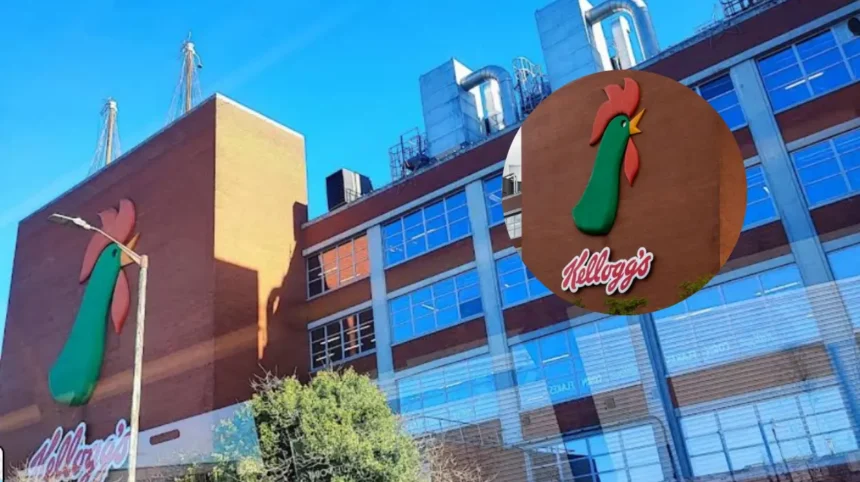
Key Points
- Production from the Kellogg’s Trafford Park factory in Greater Manchester has ceased after nearly 90 years of production
- This closure has resulted in the loss of about 360 jobs
- This site, constructed in 1938, used to be among the biggest cereal factories in Europe
- Production will be relocated to the Kellanova factory in Wrexham, northern Wales
- The decision by Kellanova was made in 2024 for unprofitable investment costs required for maintaining the Trafford Park site
- This site will be operational until the end of 2026
- According to Kellanova, the company will cooperate with local stakeholders in celebrating the history of the site
- Kellanova still employs more than 500 employees in the North West region of Media City and St Helens
Trafford (Manchester Mirror) September 03, 2026 – Production at the historic Kellogg’s Trafford Park factory has officially come to an end, marking the closure of one of Europe’s largest cereal manufacturing sites after nearly nine decades of operation. The shutdown has resulted in the loss of approximately 360 jobs, bringing an end to an era for the facility that once produced one million boxes of breakfast cereal daily.
- Key Points
- Why Is Kellogg’s Closing Its Trafford Park Factory?
- Where Is Kellogg’s Moving Production To?
- What Products Were Made at Trafford Park?
- What Will Happen to the Trafford Park Site?
- Background of the Kellogg’s Trafford Park Factory Closure
- Prediction: How This Development May Affect Workers and the Local Community
Why Is Kellogg’s Closing Its Trafford Park Factory?
The decision to cease production at the Trafford Park site was announced in 2024 by Kellanova, the company that owns Kellogg’s. According to reports, Kellanova stated that the investment required to maintain the factory was not financially viable. The company explained that half of the space in the Trafford Park building was unused and that redeveloping the site would have been too costly.
As reported by the BBC, a company spokesperson said in 2024 that the factory’s layout, which made sense in the 1930s when it was built, had become outdated. The facility was designed with food travelling up and down six floors in what the company described as a legacy manufacturing process.
The announcement came after three months of talks between Kellanova, union representatives, and employee representatives. The retail union Usdaw was approached for comment regarding the closure but had not provided a statement at the time of reporting.
Where Is Kellogg’s Moving Production To?
Production from the Trafford Park factory is being transferred to Kellanova’s existing site in Wrexham, north Wales. The company confirmed that operations across production and packing at Trafford Park came to an end during the final week of August 2026.
Marking the conclusion of production, a company spokesperson said:
“A significant milestone was reached this week, as operations across production and packing came to an end.”
The spokesperson added that their priority through the transition has been to “support colleagues and the wider community through this period of change”.
What Products Were Made at Trafford Park?
The Trafford Park factory, which was built in 1938, once produced one million boxes of breakfast cereal a day. Among the iconic products manufactured at the site were Corn Flakes, Rice Krispies, and Coco Pops.bbc+1
Kellogg’s is an American company that was founded in Michigan in 1906. The company began exporting to the United Kingdom in 1922, with the Trafford Park facility opening 16 years later.
What Will Happen to the Trafford Park Site?
The Trafford Park site will remain open until the end of 2026, according to Kellanova. The company has stated that it will work with local partners to recognise and celebrate the site’s legacy. Kellanova also said it would continue to mark special milestones in the months ahead.
A spokesperson for the owners said:
“We thank everyone who has worked there, as well as the suppliers, partners and local community who have worked alongside us.”
Despite the closure of the Trafford Park factory, Kellanova maintains a significant presence in the North West of England. The firm continues to have around 500 jobs remaining at its UK head office at Media City in Salford and at a distribution centre in St Helens.
Background of the Kellogg’s Trafford Park Factory Closure
The Trafford Park factory was established in 1938 during a period of industrial expansion in Greater Manchester. At the time of its construction, it was one of the largest cereal factories in Europe. The facility operated continuously for 88 years, becoming a landmark employer in the Trafford Park industrial estate.
Kellanova, which was formed following the split of Kellogg Company in 2023, owns the Kellogg’s breakfast cereal business. The decision to move production to Wrexham was part of a broader restructuring of the company’s UK manufacturing operations. The Wrexham site has been undergoing investment to accommodate the additional production capacity from Trafford Park.
The closure follows a trend of manufacturing consolidation in the UK food industry, with companies seeking to reduce costs by operating fewer, more modern facilities. The Trafford Park building’s multi-floor layout, typical of 1930s industrial architecture, had become increasingly inefficient compared to modern single-level manufacturing plants.
Prediction: How This Development May Affect Workers and the Local Community
The closure of Kellogg’s Trafford Park factory is likely to have significant implications for the affected workers and the wider Trafford Park community. The 360 job losses represent a substantial blow to local employment, particularly for workers with long tenure at the facility who may face challenges in finding equivalent positions in the area.
Workers who have been employed at the factory for decades may struggle to transfer their specialised manufacturing skills to other sectors. While Kellanova has stated its commitment to supporting colleagues through the transition, the availability of comparable roles in the immediate area remains uncertain. Some workers may need to consider commuting to the Wrexham site or seeking employment in different industries altogether.
The local economy around Trafford Park may experience a ripple effect from the closure. Suppliers, contractors, and service providers who depended on the factory’s operations could see reduced business. However, the continued presence of Kellanova’s 500 jobs at Media City and St Helens may provide some employment opportunities for displaced workers willing to relocate within the region.
The redevelopment potential of the Trafford Park site remains unclear. While Kellanova has indicated that half the space was unused, the building’s historic status and industrial designation may limit immediate conversion options. Local authorities may seek to attract new employers to the site, though the specialised nature of the facility could pose challenges for repurposing.
For the broader UK cereal manufacturing sector, the closure signals continued consolidation towards fewer, larger production facilities. This trend may lead to increased efficiency for companies but could also concentrate employment in fewer locations, potentially creating regional disparities in food manufacturing jobs.
The move to Wrexham may strengthen the food manufacturing cluster in north Wales, potentially attracting additional investment to the area. However, the loss of such a historic facility in Greater Manchester marks the end of an important chapter in the region’s industrial heritage.