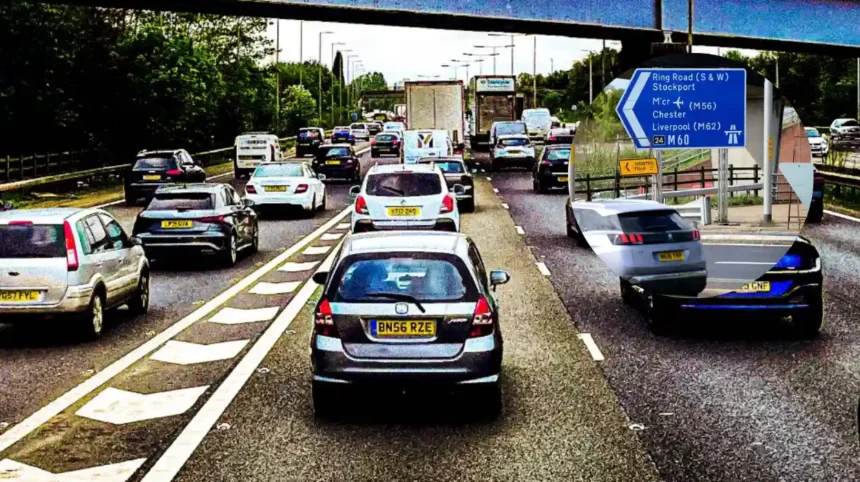
Key Points
- Part of the anticlockwise M60 between junctions 23 (Ashton‑under‑Lyne) and 24 (Denton) will fully close for two consecutive nights on Friday 10 July and Saturday 11 July 2026, according to National Highways.
- After the first full closure, the motorway will reopen on Saturday 11 July but with one lane closed until 9pm.
- The anticlockwise carriageway will then close again from 9pm Saturday 11 July until 6am Monday 13 July 2026.
- On the following weekend (17–20 July 2026), the clockwise carriageway between the same junctions will face similar full closures and lane restrictions.
- The work includes resurfacing both carriageways, replacing traffic sensors, bridge joints and road markings, and is described as “essential improvements” by National Highways.
- Most of the work will take place overnight to minimise disruption, with lane closures or full carriageway closures used as needed.
- An additional short closure of the anticlockwise M60 is scheduled from midnight to 6am Monday 6 July 2026.
- National Highways stated drainage works on the stretch had finished in May 2026 and the current phase is now underway.
- Drivers are advised to plan alternative routes, especially for evening and overnight travel between Ashton‑under‑Lyne, Audenshaw and Denton.
- Local commuters, freight operators and event traffic in Tameside and Greater Manchester will be the most affected by the closures.
Tameside (Manchester Mirror) July 03, 2026 – Part of the M60 motorway will shut in Tameside on two consecutive weekends as essential improvements are carried out between junctions 23 at Ashton‑under‑Lyne and 24 at Denton, National Highways has confirmed. The agency is partway through a series of drainage and carriageway repairs on this section, which began in January 2026, and the latest phase involves resurfacing both the anticlockwise and clockwise carriageways along with work to traffic sensors, bridge joints and road markings.
- Key Points
- How Will the M60 Closures Be Structured Over the Two Weekends?
- What Work Is Being Done and How Long Has the Project Been Running?
- Who Is Most Affected by the M60 Tameside Closures?
- Why Are Overnight Closures Being Used Instead of Rolling Lane Restrictions?
- What Alternative Routes and Practical Advice Are Available for Drivers?
- What Happens If Drivers Ignore Closure Notices or Try to Use Closed Sections?
- Background of the M60 Tameside Improvement Programme
- How Will These Developments Affect Local Drivers, Commuters and Businesses?
As reported in a National Highways website post, a spokesperson said:
“We’ll work on the M60 in both directions between junctions 23 and 24 near Audenshaw, Manchester. Drainage works finished in May 2026 and we’re now starting the next stage.”
The statement went on to explain that the work “includes resurfacing both carriageways and replacing traffic sensors, bridge joints and road markings. Most of this work will take place overnight, as lane closures or full carriageway closures are required to complete the work”.
How Will the M60 Closures Be Structured Over the Two Weekends?
The first set of closures focuses on the anticlockwise carriageway. National Highways says the anticlockwise M60 will fully close from 9pm on Friday, 10 July, until 6am on Saturday, 11 July 2026. The motorway will then reopen, but with one lane closed throughout Saturday until 9pm. This means drivers will face a complete shutdown during the night, followed by reduced capacity during the day.
The M60 will then fully close again anticlockwise between junctions 23 and 24 from 9pm on Saturday, 11 July, until 6am on Monday, 13 July 2026. On the following weekend, works will focus on the clockwise carriageway, with further closures in place. The clockwise side will be fully closed between junctions 23 and 24 from 9am on Friday, 17 July, until 6am on Saturday, 18 July. As in the previous weekend, the motorway will reopen on the Saturday morning, with one lane remaining shut until 9pm.
From 9pm on Saturday, 18 July, the clockwise side will close fully again until 6am on Monday, 20 July 2026. Additionally, the anticlockwise carriageway will also be closed from midnight until 6am on Monday morning, 6 July 2026, as part of earlier preparatory work. These staggered closures aim to allow continuous overnight progress while limiting the total time roads are unavailable to traffic.
What Work Is Being Done and How Long Has the Project Been Running?
National Highways has described the activity as part of a wider repair programme on the M60 between junctions 23 and 24. The agency says drainage works on this stretch were completed in May 2026, and the current phase is now underway. The work includes:
- Resurfacing both the anticlockwise and clockwise carriageways.
- Replacing traffic sensors that monitor flow and speed.
- Repairing or renewing bridge joints to maintain structural integrity.
- Updating road markings to improve lane definition and safety.
The broader project began in January 2026, with drainage and initial carriageway repairs already carried out. The current closures are necessary to complete the resurfacing and associated infrastructure upgrades, which are critical for long‑term reliability and safety on a key section of the M60 ring road around Manchester.
Who Is Most Affected by the M60 Tameside Closures?
The M60 is a major orbital route around Manchester, linking towns and cities across Greater Manchester and beyond. The closure of a section between Ashton‑under‑Lyne and Denton will particularly affect:
- Commuters travelling between Tameside, Stockport, Oldham and central Manchester, especially during evening and overnight hours.
- Freight and logistics operators using the M60 to access distribution centres in the north‑west.
- Local residents in Audenshaw, Denton and Ashton‑under‑Lyne who rely on the motorway for regional travel.
- Event traffic attending concerts, sports matches or other gatherings in the area, where alternative routes may add significant travel time.
National Highways has advised drivers to plan ahead, consider alternative routes and allow extra time for journeys. For some users, routes via the A580 East Lancashire Road, A57 or local A‑roads may be more appropriate during closure periods, though these can also experience increased congestion.
Why Are Overnight Closures Being Used Instead of Rolling Lane Restrictions?
According to National Highways, most of the work will take place overnight because lane closures or full carriageway closures are needed to complete the task safely and efficiently. Overnight work reduces the impact on peak‑hour traffic and allows larger equipment to operate without constant interruption from high traffic volumes. This approach is common on major motorway projects where continuous resurfacing and structural work must be carried out quickly to minimise overall disruption.
Full closures, rather than partial lane restrictions, are used when:
- The work requires uninterrupted access across the entire carriageway.
- Safety zones must be large enough to protect workers and equipment.
- The nature of the work (for example, joint replacement or sensor installation) cannot be safely done with live traffic nearby.
By concentrating closures to night hours and limiting them to specific weekends, National Highways aims to balance the need for progress with the need to keep the M60 as open as possible for daytime traffic.
What Alternative Routes and Practical Advice Are Available for Drivers?
While official alternative route guidance will be published by National Highways and local traffic authorities, general advice for drivers includes:
- Checking National Highways’ website and local traffic news before travelling, especially for updates on the status of closures.
- Using navigation apps that incorporate real‑time closure data to avoid impacted sections.
- Considering travel outside of closure windows if possible, particularly for essential journeys.
- Allowing extra time for journeys, as congestion is likely on surrounding roads during and after closures.
For local residents and businesses, the impact may be more significant if the closures coincide with delivery times, shift changes or event schedules. Planning journeys in advance and sharing this information with staff, customers or passengers can help reduce delays and frustration.
What Happens If Drivers Ignore Closure Notices or Try to Use Closed Sections?
Motorway closures are enforced to protect both road users and workers. If drivers attempt to use a closed section, they may face:
- Physical barriers or signage preventing entry.
- Direction by police or traffic officers to alternative routes.
- Potential fines or penalties if the closure is treated as a statutory restriction.
National Highways and local authorities will work closely with police to manage traffic and ensure compliance. Ignoring closure notices can also increase the risk of accidents, particularly in overnight conditions where visibility is limited and work zones are active.
Background of the M60 Tameside Improvement Programme
The M60 improvement programme between junctions 23 and 24 is part of a longer‑term strategy to maintain and upgrade the motorway network around Manchester. Drainage works on this section, which were completed in May 2026, addressed issues such as water accumulation and surface wear that can contribute to potholes and reduced safety. The current phase, involving resurfacing and infrastructure replacement, follows on from those initial repairs and is intended to extend the lifespan of the carriageway and improve overall road performance.
The project started in January 2026, with National Highways carrying out a series of targeted interventions to stabilise the road structure and prepare for more extensive resurfacing. The choice to work in stages over multiple weekends allows the agency to complete significant work without closing the entire M60 for an extended period, which would have far‑greater economic and social impacts on the region.
How Will These Developments Affect Local Drivers, Commuters and Businesses?
This development can affect the particular audience in several measurable ways. Commuters and local drivers in Tameside and surrounding areas will face disrupted travel patterns, particularly during evening and overnight hours when the motorway is fully closed. Journeys that normally take 15–20 minutes on the M60 could be extended by 30 minutes or more if alternative routes are congested or less direct. This may lead to increased stress, delayed arrivals at work or appointments, and higher fuel consumption due to longer travel distances.
Freight operators and businesses relying on timely deliveries through the M60 corridor may experience delays in dispatch and receipt of goods, potentially affecting supply chains and customer service levels. Companies with shift work or late‑night operations may need to adjust logistics schedules or reroute vehicles, which can increase operational costs. Local residents may also notice increased traffic on nearby A‑roads and residential streets, which could affect noise levels and local congestion patterns. Over the longer term, once the improvements are completed, road safety and reliability on this section of the M60 should improve, which may benefit all users by reducing the risk of accidents and breakdowns and providing a more consistent driving experience.