Key Points
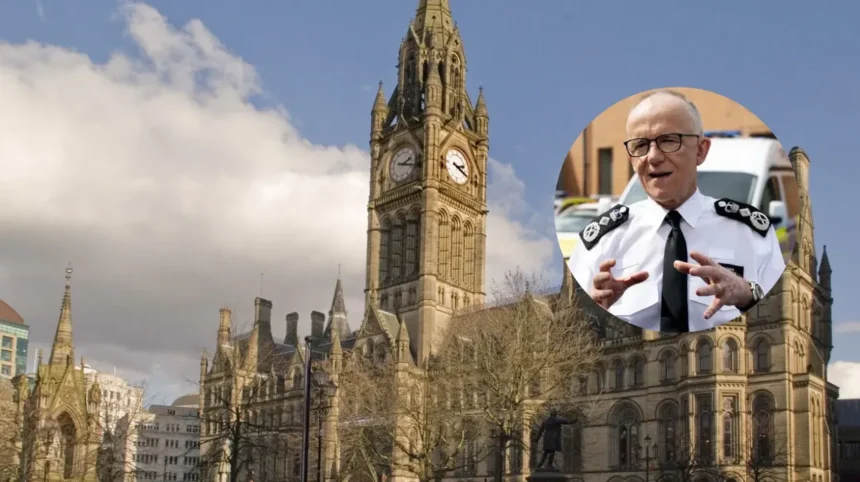
- Commissioner of the Metropolitan Police Sir Mark Rowley made significant policing reform suggestions during his speech in Manchester.
- According to the Met, public confidence has fallen by 9% while the number of favorable results nationally has become almost half of the number of the same parameter 12 years ago.
- Sir Mark has suggested scrapping the 43 police forces of England and Wales in favor of 8-10 regional forces as well as neighborhood and national policing services.
- According to Sir Mark, outdated system, financial problems, and outdated technologies hinder forces in the fight against modern crimes.
- These suggestions are aimed at the future reorganization of the policing rather than existing changes.
- Moreover, according to Sir Mark, regional and national powers should support but not replace neighborhood policing.
Manchester (Manchester Mirror) November 06, 2026 – Commissioner Sir Mark Rowley has called for a major overhaul of policing in England and Wales, warning that falling public confidence and increasingly complex crime require changes to the way forces are organised and supported.
- Key Points
- What Would the Proposed Police Structure Look Like?
- Why Does Sir Mark Believe the Current Model Is Inadequate?
- What Did He Say About Public Confidence?
- How Do Financial Pressures Affect the Reform Argument?
- Which Crime Threats Did Sir Mark Highlight?
- How Would Local Policing Fit Into Larger Forces?
- What Is Known About the Next Steps?
- Background: Why Has Police Restructuring Returned?
- Prediction: How Could Residents and Victims Be Affected?
As reported by About Manchester, Sir Mark used his Manchester speech to call for policing reforms while highlighting declining public confidence. In its published account of the address, the Metropolitan Police said the Commissioner wanted the most significant restructuring of policing in more than half a century.
The Metropolitan Police said positive outcomes nationally were less than half their level 12 years earlier, while public confidence had fallen by 9 per cent. Those figures formed part of Sir Mark’s argument that the present system was not consistently delivering the service communities expected.
His central proposal was to replace the existing 43-force structure with eight to 10 regional forces, supported by local policing commands and a National Police Service. The proposal would substantially change the organisation of policing in England and Wales, but the speech did not itself implement that restructuring.
What Would the Proposed Police Structure Look Like?
According to the Metropolitan Police, Sir Mark proposed a three-tier arrangement combining neighbourhood-level policing, larger regional forces and national capabilities.
Local commands would retain responsibility for serving communities, while regional forces would provide broader operational resources and specialist support. A National Police Service would strengthen the response to threats that extend beyond individual force boundaries.
Sir Mark argued that the existing structure requires separate organisations to maintain overlapping capabilities and administrative arrangements. The Metropolitan Police said removing duplication across 43 forces could release thousands of roles for frontline work.
That claim represents the case advanced for reform, rather than a confirmed staffing outcome. The number of posts that could be redirected, and how any changes would affect individual areas, would depend on the eventual design and implementation of a new system.
Why Does Sir Mark Believe the Current Model Is Inadequate?
In the speech published by the Metropolitan Police, Sir Mark argued that crime increasingly crosses local, regional and international boundaries, while policing remains organised around structures developed for an earlier period.
He identified fraud, cybercrime, online child abuse, organised criminal networks and hostile-state activity as threats requiring capabilities beyond those available within every individual force.
His argument distinguished between the location of a victim and the organisation of the offending behind an incident. A victim may need support from local officers even when the criminal operation targeting them is based elsewhere or operates across several jurisdictions.
According to the Metropolitan Police, Sir Mark said officers’ professionalism could not indefinitely compensate for structural weaknesses. He argued that forces needed better access to specialist resources rather than being expected to maintain every capability independently.
What Did He Say About Public Confidence?
The BBC reported that Sir Mark would highlight both declining police performance and falling confidence. Its report referred to positive outcomes nationally being less than half their level 12 years earlier and public confidence falling by 9 per cent.
In the speech published by the Metropolitan Police, Sir Mark also pointed to reduced public visibility of officers. He said 11 per cent of people reported seeing an officer or Police Community Support Officer on foot patrol each week, compared with 39 per cent in 2011.
These figures were presented as evidence supporting his argument for change. They should not be read as establishing that force size alone caused declining confidence or that mergers would automatically reverse it.
Sir Mark linked the public’s experience of policing to officer visibility, the accessibility of services and the treatment of victims. His proposals therefore placed neighbourhood policing alongside regional and national reform, rather than presenting specialist crime-fighting as a substitute for local contact.
How Do Financial Pressures Affect the Reform Argument?
According to the Metropolitan Police, Sir Mark said policing funding had fallen from approximately 0.9 per cent of GDP to approximately 0.7 per cent since 2010. He described the difference as more than £3 billion in today’s money.
In the published speech, he also cited the use of £276 million from reserves to balance budgets in the previous year and more than £630 million in borrowing for capital programmes.
Sir Mark said officer and staff pay accounted for 77 per cent of expenditure. He argued that financial commitments and ageing infrastructure left limited room for investment in equipment, technology and training.
His case was that changing organisational boundaries without addressing capability and investment would not resolve the underlying challenges. The financial figures were part of his explanation for why forces were struggling to modernise while maintaining day-to-day services.
Which Crime Threats Did Sir Mark Highlight?
According to the Metropolitan Police’s published speech, Sir Mark said fraud represented approximately 45 per cent of Crime Survey offences, with more than four million offences against the public each year.
He also highlighted cybercrime and serious organised crime, arguing that these threats require coordinated investigations and specialist expertise. The speech cited at least 59,000 people involved in serious and organised crime in the UK and an estimated annual economic cost of at least £47 billion.
Online child sexual abuse was another area of concern. Sir Mark referred to more than 92,000 platform referrals relating to child sexual abuse during the previous year and a substantial increase in reports of sexual extortion involving children.
The figures illustrated the range of demands underpinning his reform argument. They were not presented as separate incidents arising from the Manchester speech, but as evidence of the pressures facing policing.
How Would Local Policing Fit Into Larger Forces?
According to the Metropolitan Police, Sir Mark’s proposed regional structure would retain hundreds of local policing commands. His stated aim was to combine local accountability and community contact with access to capabilities that smaller organisations may struggle to provide independently.
Those capabilities could include digital and financial investigation, surveillance and other specialist operational support. Sir Mark argued that local officers should be able to obtain such assistance without unnecessary organisational barriers.
The distinction matters for residents concerned that larger forces could become more distant. The proposal seeks to preserve local delivery, but whether it would do so effectively would depend on decisions about command structures, resources and accountability.
The speech did not establish how every existing force area would be grouped or how individual neighbourhood teams would be staffed under a final arrangement.
What Is Known About the Next Steps?
The Independent reported that Sir Mark would call for the number of forces to fall from 43 to as few as eight. The Metropolitan Police’s description set out a proposed range of eight to 10 regional forces.
In his published speech, Sir Mark referred to the Home Secretary’s reform agenda and an awaited report by Lord Hogan-Howe. He presented his intervention as a contribution to decisions about the future organisation of policing.
The Metropolitan Police said four other chief constables joined the event, which included a panel discussion. Their participation formed part of a wider discussion about the direction of reform.
The speech should therefore be understood as a significant public proposal, not confirmation that the existing force structure has been abolished or that replacement organisations have begun operating.
Background: Why Has Police Restructuring Returned?
In the speech published by the Metropolitan Police, Sir Mark placed his proposals within the history of British policing, referring to the establishment of the Metropolitan Police in 1829 and the consolidation of smaller forces during the 1960s.
He argued that earlier structural changes reflected the demands of their time and that modern threats required a comparable reassessment. The Metropolitan Police described his proposals as the most substantial potential overhaul in more than 50 years.
The present debate centres on how to combine neighbourhood policing with the resources needed to investigate complex, geographically dispersed offending. Sir Mark’s Manchester intervention brought those questions together with concerns about confidence, funding and operational performance.
Prediction: How Could Residents and Victims Be Affected?
If adopted and successfully implemented, the proposed structure could give local investigators more consistent access to regional and national expertise. That could be particularly relevant to victims of fraud, cybercrime and organised offending, whose cases may extend beyond the boundaries of their local force.
For residents, the practical test would be whether changes improve officer visibility, communication, response and investigative support. Larger organisations would not, by themselves, guarantee those outcomes.
There could also be disruption during any transition, depending on how staffing, technology, leadership and accountability arrangements were changed. These are conditional possibilities, not outcomes established by Sir Mark’s speech.
The central question for the public would be whether reform produces a more accessible and effective service while maintaining a clear connection between local communities and the officers responsible for protecting them.