Key Points
- Five individuals have been convicted of operating a county lines drug gang that supplied crack cocaine and heroin throughout Oldham.
- The “Tony” and “Ali” drug lines were active from September 2024 until March 2026, and the group continually changed their contact numbers to stay under the radar.
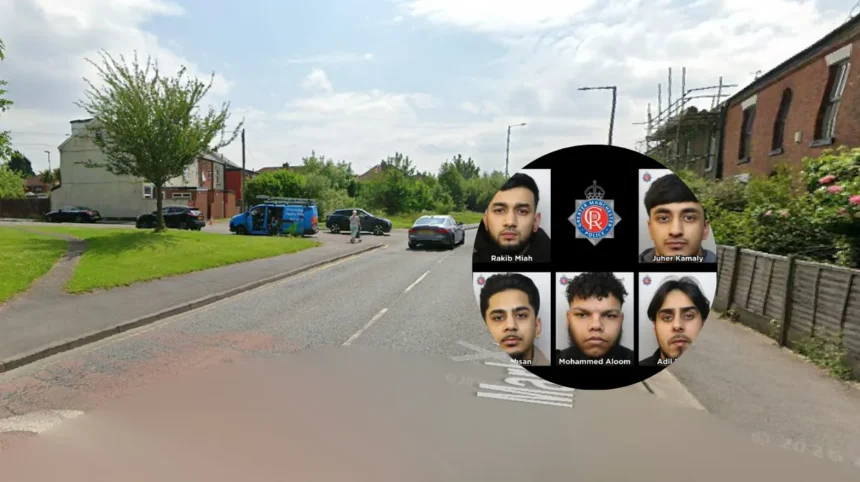
- Rakib Miah and Adil Ahsan have both been given sentences of eight years and three months, while Adil Rehan has been jailed for five years and six months. Mohamed Shaffial Aloom and Juher Kamaly have each been sentenced to four years and six months.
- Sentences totaling over 31 years have been imposed at Bolton Crown Court on 3 September 2026 after the arrests made in March 2026 during County Lines Intensification Week.
- Greater Manchester Police has noted that this crime gang was exploiting vulnerable individuals and instilling violence and fear into communities.
Oldham (Manchester Mirror) September 07, 2026 – Five men who operated a county lines drugs network that flooded Oldham’s streets with crack cocaine and heroin have been locked up after a long-running police investigation. The group, linked to the “Tony” and “Ali” drugs lines, was sentenced at Bolton Crown Court on 3 September 2026, following arrests made during a series of raids in March.
What happened in the Oldham county lines drugs case?
Oldham became the focus of a major Greater Manchester Police (GMP) operation after officers identified a sophisticated drugs supply network active across the town. According to GMP, the group ran dedicated drug lines under the names “Tony” and “Ali”, distributing Class A drugs between September 2024 and March 2026.
As reported by the Manchester Evening News, investigators said the network frequently changed its drug line phone numbers while keeping the same customer base, operational patterns and distribution routes in an effort to avoid detection. Analysis of mobile phones, telecommunications data and digital downloads allowed officers to map out the hierarchy and daily running of the operation.
Who were the five men sentenced?
All five defendants were found guilty of conspiracy to supply Class A drugs. The Oldham Times reported the following sentences handed down at Bolton Crown Court:
- Rakib Miah, 24, of Davies Street, Oldham – eight years and three months.
- Adil Ahsan, 24, of Eden Street, Oldham – eight years and three months.
- Adil Rehan, 24, of Redgrave Street, Oldham – five years and six months.
- Mohamed Shaffial Aloom, 24, of Mitchell Street, Oldham – four years and six months.
- Juher Kamaly, 24, of Broadway, Chadderton, Oldham – four years and six months.
The combined total of the sentences exceeds 31 years in prison.
How were the men caught?
The arrests took place on 4 March 2026 during County Lines Intensification Week, a coordinated GMP crackdown on organised drugs networks. Officers executed multiple warrants across Oldham as part of the operation, which targeted active county lines and those at risk of exploitation.
According to the Manchester Evening News, one of the suspects, Adil Ahsan, attempted to evade arrest by fleeing through the rear of a property but was quickly located and detained with assistance from GMP’s Drone Unit. A business premises linked to Ahsan was also searched, where officers recovered a phone connected to the active “Ali” drugs line along with significant quantities of heroin and cocaine packaged for street supply.
During the wider operation, GMP said it recovered dedicated drugs line handsets, large amounts of Class A drugs, cash and messages detailing the day-to-day running of the network.
What did police say about the network?
Detective Constable Bennett, from GMP’s County Lines Team within the serious and organised crime unit, described the group as a dangerous network that operated across Oldham for more than a year.
“These sentences have removed a dangerous county lines network that operated across Oldham for more than a year, supplying significant quantities of crack cocaine and heroin into our communities,”
he said, as quoted by the Oldham Times.
DC Bennett added:
“Behind every drugs line are real victims. County lines networks thrive on the exploitation of vulnerable adults and children, drawing people into criminality, fuelling addiction and bringing violence and fear into our neighbourhoods.”
He said the investigation revealed a clear hierarchy, with those at the top directing others to distribute drugs on the streets while profiting from the harm caused to the community.
The officer also highlighted the role of public intelligence.
“The information we receive from members of the public is vital in helping us tackle this type of offending. Community intelligence helps us build a clearer picture of organised crime groups operating in our neighbourhoods and enables us to take action against those responsible,”
DC Bennett said, according to the Oldham Times.
What was County Lines Intensification Week?
The arrests formed part of County Lines Intensification Week in March 2026, during which GMP targeted organised criminals, shut down drugs lines and sought to protect people at risk of exploitation. During that week, officers executed 30 warrants, made 40 arrests and closed 20 active drugs lines, including the “Tony” and “Ali” lines, the Oldham Times reported.
GMP said the operation was designed to disrupt the supply of Class A drugs, reduce associated violence and safeguard vulnerable individuals who are often coerced into county lines activity.
Background of the development
County lines is a term used by UK police to describe the practice of drug dealers moving substances from one area to another, often across local authority or police force boundaries, using dedicated mobile phone lines. The model typically involves a hierarchy in which senior figures control supply while using runners, sometimes including children and vulnerable adults, to distribute drugs at street level.
The “Tony” and “Ali” lines in Oldham fit this pattern, with GMP describing a structured operation that used multiple handsets and regularly updated contact details to stay ahead of enforcement efforts. Investigations into such networks commonly rely on telecommunications data, financial records and surveillance to identify those at the top of the chain.
Oldham has been the subject of repeated police action against drugs supply in recent years, with multiple gangs and organised groups targeted through coordinated operations. The latest sentencing follows other high-profile cases in Greater Manchester involving large-scale cocaine and heroin supply, as covered by regional media including ITV News Granada and the Manchester Evening News.
Prediction: how this development can affect Oldham residents
The removal of the “Tony” and “Ali” drugs lines is likely to have a measurable impact on street-level drug availability in parts of Oldham, at least in the short term. Police and community safety partners often report reductions in visible drug dealing and associated antisocial behaviour following successful county lines disruptions.
For residents, the immediate effect may be fewer open drug transactions in known hotspot areas and a reduction in the intimidation and violence that frequently accompanies county lines activity. Local businesses and community groups in affected neighbourhoods may also see a decrease in incidents linked to drug supply, such as confrontations, loitering and related criminality.
In the longer term, the case could strengthen community confidence in reporting drug activity, particularly after DC Bennett’s emphasis on the importance of public intelligence. If residents perceive that tips lead to tangible outcomes such as arrests and lengthy sentences, they may be more willing to engage with GMP and support services.
However, policing experts caution that dismantling one network does not always eliminate demand. Without sustained enforcement and parallel work on prevention, treatment and support for those at risk of exploitation, there is a possibility that other groups could attempt to fill the gap. Continued multi-agency work, including education, youth support and addiction services, will be key to ensuring that the impact of this sentencing is lasting for Oldham’s communities.