Key Points
- A recent article has questioned Andy Burnham’s “Manchesterism” as homelessness and housing pressure remain major issues in Greater Manchester.
- The report says Manchester still ranks among the areas with the highest homelessness levels in the country, despite years of political promises and housing activity.
- It claims the city has seen a rise in luxury apartment development alongside continuing housing insecurity and waiting-list pressure.
- The piece says Manchester is ranked third in the country for homelessness, behind Birmingham and London, according to Shelter figures cited in the report.
- It also says one in 74 residents in Manchester lacks a permanent home, while Salford’s homelessness rate is higher still.
- The article argues that Burnham’s wider vision of “Manchesterism” is being tested by the scale of the housing crisis.
- The background context includes earlier Greater Manchester policies aimed at reducing rough sleeping and expanding homelessness prevention.
Manchester(Manchester Mirror)May 24, 2026-Manchester has again been drawn into a debate over housing, homelessness and the political brand associated with Andy Burnham, after a report questioned whether his “Manchesterism” has delivered enough for people struggling to find secure accommodation.
The article, published by the Express and attributed to its reporting on the state of the city, says Manchester’s housing pressures remain severe even as the city continues to grow and attract investment.
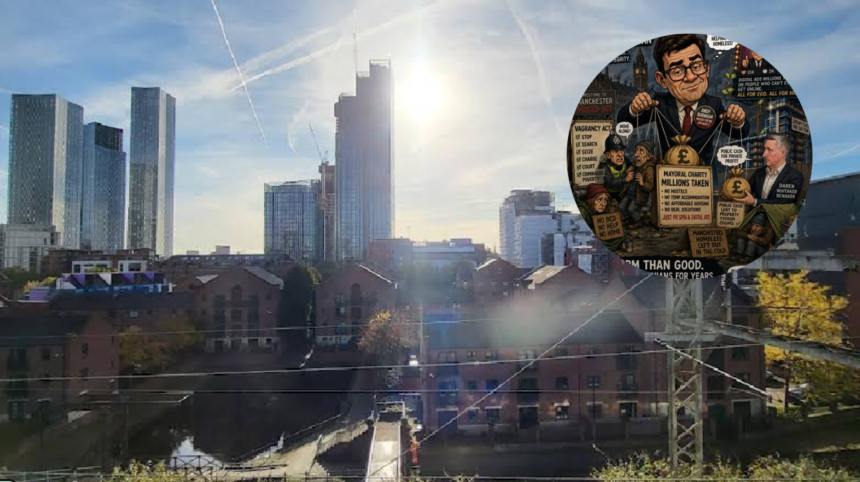
As reported by the Express, the criticism is that Burnham’s political message about fairness, community and opportunity sits uneasily alongside persistent homelessness figures and a growing number of people on housing waiting lists. The report says the city centre has been transformed by new high-rise development, while many residents still face insecurity in the rental and social housing markets. It presents that contrast as the central tension in the story of Manchester’s recent growth.
What the report says
According to the Express report, Manchester is now described as having one of the highest homelessness rates in the country. The article says Shelter figures place Manchester third nationally for homelessness, behind Birmingham and London, and gives a figure of one in 74 residents lacking a permanent home. It also says Salford, close to Manchester city centre, has an even higher rate.
The same report says pressure on social housing remains intense, with around 24 council homes reportedly having been lost over two decades. It also states that by 2024, the number of households on housing waiting lists is projected to have reached about 86,000. The article links these pressures to the wider argument that rising luxury housing has not eased the shortage of affordable homes for lower-income residents.
How Manchester changed
Manchester’s recent transformation is part of why the debate has become politically sensitive. The Express article says the city centre is now dominated by glass towers and upscale flats, reflecting a broader urban boom. But it argues that this expansion has not translated into enough relief for people in unstable housing situations.
That point matters because Burnham has repeatedly framed Greater Manchester as a model of fairer, locally driven growth. In earlier statements from Greater Manchester Combined Authority, he argued that stronger local powers, better investment in social rent, and a more urgent response from national government were needed to tackle homelessness and housing insecurity. His administration later set out a homelessness prevention strategy that aimed to reduce rough sleeping and address root causes such as insecure housing.
Why the timing matters
The story has resurfaced at a politically sensitive moment because Burnham’s name continues to circulate in broader Labour politics and in discussions about his future role. The Express article frames the housing issue as part of a wider test of his political identity, especially as he positions himself around a post-growth, fairness-led model for the city region. That makes the housing figures not just a local policy issue but also a measure of the credibility of his wider brand.
The timing also matters because the housing debate in Greater Manchester has not gone away despite previous interventions. In 2017 and 2018, Burnham launched homelessness initiatives and publicly set ambitions to end rough sleeping, signalling that the issue had become a core part of his mayoral agenda. The current criticism suggests that opponents believe those promises have not yet been matched by enough visible improvement.
What Burnham said before
Burnham has previously argued that homelessness should be treated as a serious social failure rather than an isolated policy challenge. In 2017, he launched a homelessness fund and pledged part of his salary to support efforts to end rough sleeping across Greater Manchester. Later, he urged national politicians to treat housing as a human right and give local authorities more freedom to intervene in housing markets.
In 2021, Greater Manchester published a draft homelessness prevention strategy that aimed to go beyond emergency responses and deal with the causes of homelessness, including poor-quality and insecure housing. That strategy also promised targeted investment in accommodation for people who had been rough sleeping. These past commitments form the backdrop to the current scrutiny, because the criticism is not only about present-day figures but also about whether the city’s long-running policy direction has worked well enough.
Background of the development
The debate over “Manchesterism” sits inside a longer housing story in Greater Manchester. Burnham has spent years arguing that local control, social rent and prevention-led policy are essential to reducing homelessness and rough sleeping. His mayoralty has included public promises, funding schemes and homelessness strategies that aimed to turn those ideas into action.
At the same time, the wider housing market in Manchester has continued to tighten, with high demand, waiting lists and affordability problems remaining part of the picture. That has created a gap between the city’s political narrative and the lived reality of many residents, which is why the issue keeps returning to the political agenda. The latest reporting shows that housing is still one of the clearest tests of Burnham’s record as mayor and of the broader idea he has attached to Manchester’s future.
Prediction
For residents facing homelessness or insecure housing, the immediate effect of this development is likely to be continued pressure for more social homes, stronger prevention policies and clearer results from local and national government. For Burnham, the issue could shape how voters judge his leadership, because housing is one of the most visible measures of whether his model of urban growth is helping ordinary people.
For people in Greater Manchester more broadly, the debate may push housing further up the political agenda and keep attention on affordability, rough sleeping and social rent. If the criticism grows, it could also intensify demands for a more direct response from local authorities and Westminster on housing supply and homelessness support.