Key Points
- Green Party leader for England and Wales, Zack Polanski, has expressed confidence in the party’s prospects for increasing its council representation across North West England.
- This optimism follows a historic by-election victory in Gorton and Denton, where Green candidate Hannah Spencer secured the seat, marking the party’s first-ever Westminster by-election win.
- In that by-election, Labour was relegated to third place, trailing both the Green Party and Reform UK, signalling a potential shift in traditional voting strongholds.
- The Green Party is actively targeting councils across Greater Manchester, aiming to replace the Labour government’s influence and halt the rise of Reform UK.
- Party officials, including national elections coordinator Faaiz Hasan, are deploying a “Target to Win” strategy to focus resources on competitive areas ahead of the local elections on May 7, 2026.
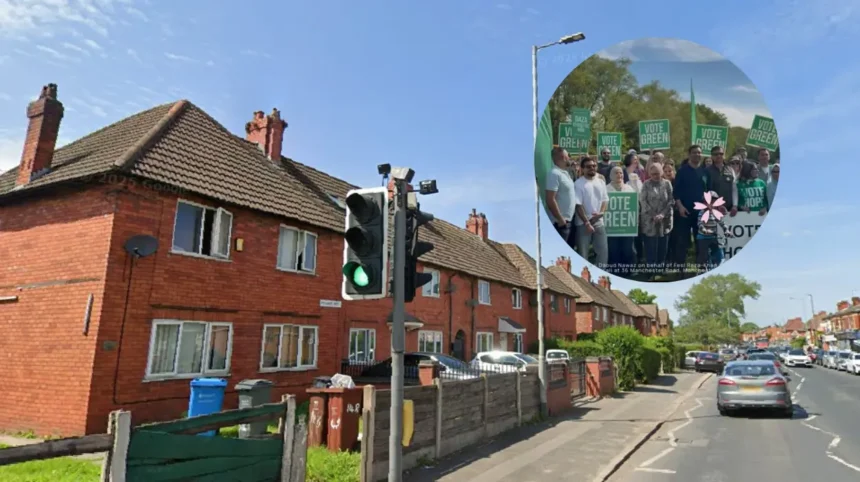
Gorton (Manchester Mirror)April 29, 2026 – As the UK prepares for local elections on 7 May, the Green Party has emerged as a significant political force, voicing strong confidence in its ability to secure a record number of council seats across North West England, particularly in areas traditionally dominated by Labour. Building upon the momentum from its historic by-election victory in Gorton and Denton earlier this year, the party is aggressively campaigning to expand its influence in Greater Manchester and beyond.
As reported by the BBC, Zack Polanski, the leader of the Green Party for England and Wales, stated that he is “feeling confident, not complacent,” regarding the party’s prospects for increasing its representation in councils throughout the north-west of England. During a recent campaign event in Manchester, Polanski was joined by Hannah Spencer MP, whose triumph in the Gorton and Denton by-election has become a cornerstone of the party’s current electoral narrative.
Why is the Gorton and Denton victory significant for the Green Party?
The Gorton and Denton by-election, held in February 2026, represented a major political shift in the region. According to reporting by Al Jazeera, the constituency, which had been a Labour stronghold for nearly a century, saw the Green Party’s Hannah Spencer secure 40.7 per cent of the vote. As noted by the BBC, Labour, which had taken the seat with more than 50 per cent of the vote in the 2024 general election, was relegated to third place, finishing behind both the Green Party and Reform UK.
Spencer, who works as a plumber, commented on the significance of the result, stating: “Life has changed. Instead of working for a nice life, we’re working to line the pockets of billionaires. We are being bled dry”. Polanski highlighted this victory as evidence that there are no longer any “no-go” zones for the Green Party, asserting their ambition to “halt Reform in its tracks and replace the Labour government”.
How does the Green Party plan to win more seats?
The party is implementing a strategic approach to ensure its resources are used effectively. According to materials from the Action Network, the party utilizes a “Target to Win” (TTW) campaign strategy, which allows them to accurately determine which areas to focus on by analysing vote shares in previous elections, the number of electors in a specific area, and the level of work required to secure a victory.
Furthermore, Faaiz Hasan, a national elections coordinator for the Green Party, discussed the party’s broader strategy in an interview cited by Middle East Eye. Hasan emphasized the importance of winning crucial councils and outlined how the party intends to coordinate with independent candidates and navigate the political landscape, including responding to criticisms regarding their campaign methods. The party is also leveraging a surge in membership and favourable polling data to fuel its campaign efforts as the May 7 election date approaches.
What is the background of this political development?
The current push by the Green Party is part of a longer-term effort to transform its grassroots support into tangible political power at the council level. Following the 2024 general election, which saw significant changes in the national political environment, the Green Party identified opportunities to contest seats in diverse regions, including those previously held by the Conservative and Labour parties. The “Target to Win” strategy, which has been in development for several years, focuses on both “Target Divisions,” where the party aims to gain a majority, and “Development Divisions,” where the primary goal is to increase visibility for future electoral cycles. The success in Gorton and Denton has provided the party with a proof-of-concept for this strategy, demonstrating that it can successfully challenge entrenched two-party dominance by appealing to voters disillusioned with the current government.
How will this development affect local voters?
The rise of the Green Party, coupled with the influence of Reform UK, suggests a fragmentation of the traditional two-party system that could lead to more competitive and less predictable local elections for voters in Greater Manchester and across the UK. For the average voter, this development may result in a wider array of policy options being presented on ballots, specifically concerning local services, environmental issues, and economic policy. If the Green Party successfully increases its number of councillors, voters can expect a shift in council priorities towards policies that align with the party’s platform, such as sustainability initiatives and community-focused public services, while also potentially forcing established parties like Labour to revise their own local platforms to remain competitive. As these developments continue, voters in the affected regions will be the ones to decide, through their ballots on May 7, whether this shift towards a more multi-party local government is the direction they wish to take.