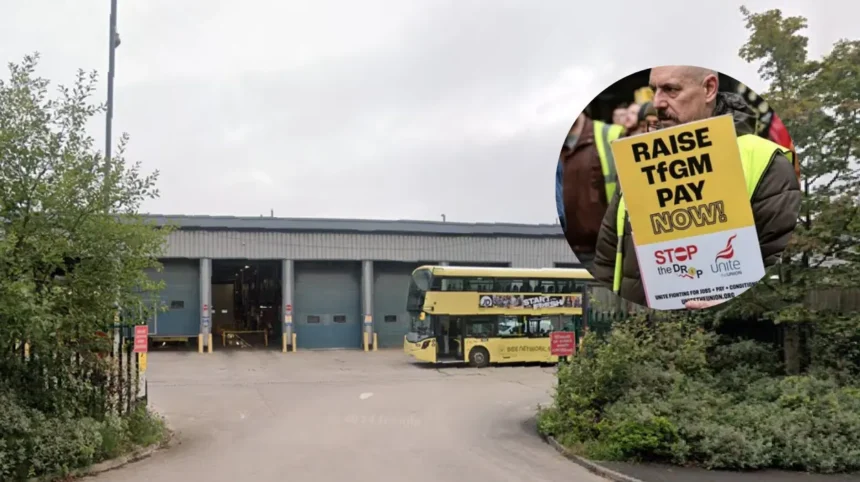
Key Points
- Hundreds of Go North West bus drivers across Greater Manchester have been balloted for strike action over pay disparities with Bee Network colleagues.
- Unite the Union says drivers in Bolton, Denton, Heywood and Wigan are angered by “huge pay disparities” compared with staff working on the Bee Network.
- The ballot follows failed talks between Unite and Go North West, aiming to resolve pay and equality issues.
- Unite describes the dispute as centred on pay parity, terms and conditions, and fairness after local public contracts and Bee Network agreements were introduced.
- The company and union have given statements and indicated that further negotiations may continue while the ballot result is processed.
- The outcome could lead to localised strikes that disrupt bus services across affected towns and potentially wider parts of Greater Manchester.
Manchester(Manchester Mirror) May 2026 — Go North West drivers in Bolton, Denton, Heywood and Wigan were balloted for industrial action after Unite the Union said staff were upset by substantial pay differences compared with colleagues employed on the Bee Network, with ballots launched as talks failed to reach a lasting agreement.
- Key Points
- Why are Go North West drivers being balloted for strikes over pay disparities with Bee Network colleagues?
- Why do drivers say pay parity matters now?
- Why did talks between Unite and Go North West not resolve the dispute?
- Why could ballots lead to local strikes that affect services?
- Why are local communities and commuters closely watching the dispute?
- What exactly did Unite say about the pay differences?
- What has Go North West said in response?
- Who are the principal stakeholders in the dispute?
- What is the Bee Network, and why does it matter here?
- What practical steps will follow the ballot?
- What do drivers say about workplace morale and recruitment?
- Are there wider implications for the region’s transport policies?
- What have local officials said?
- What could be the immediate effect on passengers if strikes occur?
- Which routes and depots are involved?
- How will the dispute be resolved?
- Background of the particular development after the news
- Prediction — how could this development affect drivers, passengers and local services?
Why are Go North West drivers being balloted for strikes over pay disparities with Bee Network colleagues?
As reported by Unite the Union, the ballot stems from what union officials describe as “huge pay disparities” between Go North West drivers and those working for Bee Network services, a difference the union says has left many drivers feeling undervalued and treated unfairly.
Why do drivers say pay parity matters now?
Unite representatives told journalists that the introduction and expansion of Bee Network contracts and local public transport procurement in Greater Manchester have created two different pay regimes within the area’s bus workforce, with drivers on Bee Network agreements receiving higher pay or better terms than long-standing Go North West employees a divergence that the union says is unjust and unsustainable.
Why did talks between Unite and Go North West not resolve the dispute?
Union officials say they engaged in negotiations with the operator but were unable to secure an agreement on pay parity and improvements to terms and conditions to the satisfaction of members, prompting the decision to hold a strike ballot in the affected depots in Bolton, Denton, Heywood and Wigan.
Why could ballots lead to local strikes that affect services?
If the ballots return a majority in favour of industrial action and Unite subsequently calls a strike, drivers at the balloted depots could refuse to work on specified dates, producing cancellations and reduced frequency on routes that start from or rely on those depots; the union has framed the action as a last resort aimed at forcing a negotiated settlement.
Why are local communities and commuters closely watching the dispute?
Commuters and local authorities are attentive because any strike action would hit daily travel for school, work and essential appointments in the towns named by Unite, with potential knock-on effects on congestion and alternative transport arrangements while services are disrupted.
Manchester — Unite the Union announced in May 2026 that it had balloted hundreds of Go North West drivers across Greater Manchester for strike action after what the union described as “huge pay disparities” with colleagues employed on the Bee Network, with ballots taking place in Bolton, Denton, Heywood and Wigan following unsuccessful negotiations with the company.
What exactly did Unite say about the pay differences?
As reported by Unite’s official statement, union officers claimed that drivers working for Go North West were being paid significantly less and operating under less favourable terms than those employed on Bee Network services, and that the disparity had created “real anger” among members who feel their work is being undervalued.
What has Go North West said in response?
Go North West provided a response to the dispute, confirming it had been in discussions with Unite and acknowledging there were differences in pay and conditions across operations, while emphasising its willingness to continue talks to reach a settlement that balances fairness for staff with the sustainability of services; the company also noted that operational and contractual arrangements vary between services and that change requires time and constructive negotiation.
Who are the principal stakeholders in the dispute?
Key stakeholders include the ballot drivers and their families, Unite the Union, which represents the workforce and is organising the ballot and potential action, Go North West as the employer operating local routes, Transport for Greater Manchester as the regional transport authority whose contracts and Bee Network roll-out shape local terms, and passengers who rely on bus services in the affected towns.
What is the Bee Network, and why does it matter here?
The Bee Network is Greater Manchester’s integrated public transport programme, introduced to coordinate services, fares and standards across the city-region; its introduction has included contracts for specific routes that Unite says have created a two-tier workforce, with drivers on Bee Network agreements receiving better pay and conditions than some existing operators’ staff.
What practical steps will follow the ballot?
If the ballot returns a majority for strike action, Unite can call specific strike dates; before that happens both sides usually have the opportunity to return to talks and avert disruption, while legal and procedural steps must be followed for any industrial action to be lawful and organised, with notice periods and further negotiations likely to be part of the immediate timetable.
What do drivers say about workplace morale and recruitment?
Union representatives and drivers have argued that pay disparities undermine morale, make staff retention and recruitment more difficult, and risk driving experienced drivers away from the company or into other roles with better pay, thereby harming the overall resilience of local services.
Are there wider implications for the region’s transport policies?
Analysts and union spokespeople suggest the dispute highlights tensions arising from the transition to the Bee Network and public procurement, pointing to a need for clearer standards on pay and conditions across contracts to prevent fragmentation and inequality among employees delivering publicly funded services.
What have local officials said?
Transport for Greater Manchester and local councillors have previously emphasised the importance of integrated services for passengers, while also acknowledging that complex procurement processes and differing commercial arrangements can create discrepancies in employment terms that need to be managed sensitively; in this instance, officials called for constructive dialogue between the union and operator to protect services.
What could be the immediate effect on passengers if strikes occur?
Strikes would likely cause journey cancellations, reduced frequencies on affected routes and increased pressure on alternative travel modes such as rail, tram, car or taxi, especially during peak times; operators and the union typically issue guidance to passengers ahead of any action to help them plan alternative travel.
Which routes and depots are involved?
Unite specified that drivers at Go North West depots in Bolton, Denton, Heywood and Wigan were included in the ballot, meaning routes operated from those depots are most at risk of disruption if the union moves to strike action following a successful vote.
How will the dispute be resolved?
Resolution normally requires renewed negotiation, possibly mediated by an independent party, and may involve compromises on pay increases, harmonisation of terms or phased approaches to parity; both sides have incentives to reach agreement to avoid service disruption, but each must balance financial constraints and operational viability.
Background of the particular development after the news
Greater Manchester’s Bee Network initiative has been implemented to integrate fares, timetables and standards across the city-region, and its rollout has involved new contracts and procurement approaches that sometimes set different pay and terms for staff working on newly franchised or publicly procured routes. Historically, bus companies operating commercial routes negotiated wages and conditions independently, creating variation across employers; the Bee Network’s arrival has exposed these differences and prompted calls from unions for harmonised pay and protections to ensure fairness for long-serving drivers as well as staff on new contracts.
Prediction — how could this development affect drivers, passengers and local services?
If ballots result in strike action, drivers and their families will face short-term income disruption if strikes are unpaid, while passengers in Bolton, Denton, Heywood and Wigan may experience cancellations and longer journeys, with commuters and vulnerable travellers worst affected; in the medium term, sustained disputes could accelerate negotiations towards pay parity or a negotiated settlement, influence future procurement practices under the Bee Network to include clearer pay standards, and prompt operators and local authorities to prioritise workforce harmonisation to maintain service reliability and public confidence.