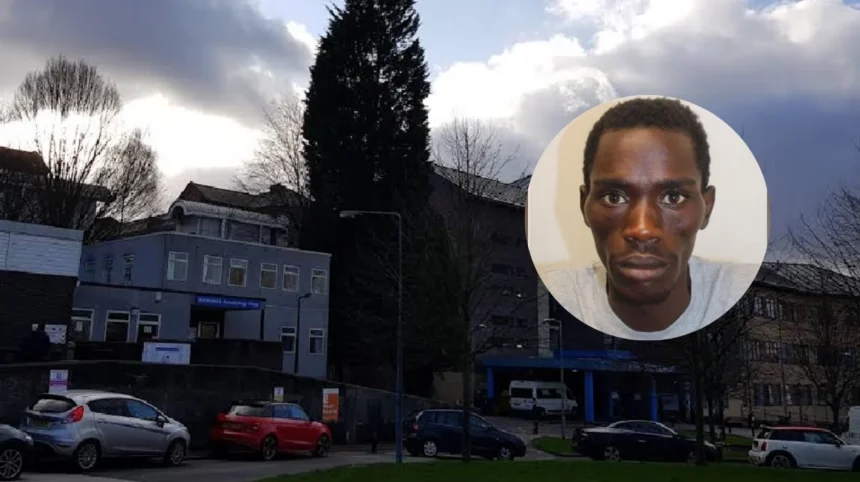
Key Points
- Marwan Jumaa, 20, a Sudanese national serving an indefinite secure hospital sentence, escaped on Tuesday evening, 14 July 2026, during a transfer to North Manchester Hospital for medical treatment.
- He was described by Greater Manchester Police (GMP) as a risk to himself and others, particularly women, following convictions for assaulting two women and a police officer in London last year.
- CCTV showed Jumaa leaving the hospital unaccompanied in a light blue T‑shirt, prompting a public appeal and widespread distribution of his image.
- A multi‑force manhunt followed, with links noted to Bury, Prestwich, Crumpsall, Leeds and London.
- In the early hours of Friday, July 2026, GMP confirmed Jumaa had been arrested by Lancashire Constabulary and was in their custody, to be returned to a secure hospital facility.
Manchester (Manchester Mirror) July 25, 2026 –It has became the focus of an urgent manhunt this week after a high‑risk prisoner absconded during a hospital transfer, before being located and detained in Lancashire following extensive police enquiries.
- Key Points
- Who is Marwan Jumaa and what offences is he serving time for?
- How did the manhunt for Marwan Jumaa unfold across Greater Manchester
- What did police say about the risk posed by the escaped prisoner?
- When and where was Marwan Jumaa recaptured by police?
- What security procedures are being reviewed after the hospital escape?
- Background: How did this development follow earlier convictions and secure hospital orders?
- Prediction: How could this case affect public confidence and hospital transfer policies?
Greater Manchester Police said Marwan Jumaa, 20, escaped after being moved from a secure hospital facility to North Manchester Hospital for medical treatment on the evening of Tuesday, 14 July 2026. He was classed as a danger to the public, especially women, and also at risk to himself, officers said.
As reported by BBC News, GMP warned the public not to approach Jumaa if seen and to call 999 immediately, describing him as having a skinny build, short dark hair, and standing around 5ft 10in. Detectives said he was believed to have links to Bury, Prestwich and Crumpsall in Greater Manchester, as well as Leeds and London.
According to Manchester Evening News, quoted in reporting by the Mirror, CCTV footage showed Jumaa casually walking out of the hospital unaccompanied, wearing a light blue T‑shirt, which was later circulated to assist the search.
In the early hours of Friday, 17 July 2026, GMP confirmed that “following extensive enquiries” Jumaa had been arrested by colleagues at Lancashire Constabulary and was in their custody, with arrangements made to return him to a secure hospital facility.
Who is Marwan Jumaa and what offences is he serving time for?
Marwan Jumaa is a 20‑year‑old Sudanese national currently serving an indefinite secure hospital sentence, court records and police statements indicate.
As reported by GB News, Jumaa was being transported from a secure hospital unit to North Manchester General Hospital for medical treatment when he absconded from custody.
According to coverage by the Mirror, which cited court documents, Jumaa pleaded guilty in January 2026 at Woolwich Crown Court to three offences committed on 17 July 2025 in London: assaulting an emergency worker (a police officer), robbery of a woman, and inflicting grievous bodily harm on a second woman.
The Mirror further noted that Jumaa is “currently serving a custodial sentence for assault” and had been described in police communications as an extreme danger to females.
How did the manhunt for Marwan Jumaa unfold across Greater Manchester
After Jumaa’s escape was confirmed, GMP launched what it described as an urgent operation to locate him, given the assessed risk.
As reported by BBC News, Det Ch Insp Abigail Cronin of GMP said: “We are urging anybody to come forward who may have information about Marwan’s whereabouts,” adding that she recognised the case “may heighten concern within the community” but that officers were “working around the clock to find Marwan and return him to hospital as soon as possible”.
Coverage by GB News and other outlets highlighted that the search covered areas where Jumaa was believed to have connections, including Bury, Prestwich, Crumpsall, and extended to Leeds and London.
Public appeals were issued with a description of Jumaa and a warning not to approach him, with people asked to ring 999 with any sightings or relevant information.
What did police say about the risk posed by the escaped prisoner?
Greater Manchester Police consistently characterised Jumaa as a high‑risk individual during the manhunt.
As reported by BBC News, GMP stated that Jumaa “is classed as a risk to others and himself” and that the public should not approach him under any circumstances.
In statements summarised by ITV News and other broadcasters, officers described him as a “high risk” prisoner who had absconded while being treated at a hospital, reinforcing the seriousness with which the escape was treated.
The Mirror reported that police had labelled Jumaa an extreme danger to females, reflecting the nature of his prior convictions involving assaults on women.
When and where was Marwan Jumaa recaptured by police?
The manhunt concluded in the early hours of Friday, 17 July 2026, when Jumaa was located and detained by another force.
As reported by the Mirror, GMP confirmed:
“Following extensive enquiries, we can confirm that Jumaa has been arrested by our colleagues at Lancashire Constabulary. He is currently in their custody.”
The Manchester Evening News, cited in social media updates, added that Jumaa was arrested overnight by police in Lancashire and returned to custody, with thanks given to members of the public who shared the appeal.
Police indicated that he would be returned to a secure hospital facility following his arrest.
What security procedures are being reviewed after the hospital escape?
The circumstances of the escape have raised questions about hospital transfer protocols for high‑risk patients in secure custody.
Analysis published by MDI noted that the Marwan Jumaa case reveals recurring issues in hospital escapes, pointing to instances where individuals have been able to leave general hospital settings with limited supervision.
While specific internal reviews by GMP or the hospital have not been detailed in the public reports, the incident fits a pattern highlighted by commentators, where general hospital environments present different security challenges compared with secure hospital units.
Background: How did this development follow earlier convictions and secure hospital orders?
Marwan Jumaa’s status as a high‑risk detainee stems from a series of violent offences in London in July 2025, which led to his conviction and subsequent placement in a secure hospital setting under an indefinite order.
Court records referenced by the Mirror show that in January 2026 he pleaded guilty at Woolwich Crown Court to assaulting an emergency worker, robbing a woman, and causing grievous bodily harm to another woman, all on the same day.
Following those convictions, he was placed in a secure hospital facility, from which he was being transferred to North Manchester Hospital for medical treatment when he absconded on 14 July 2026.
The escape triggered a multi‑agency response across Greater Manchester, with public warnings and a coordinated search that ultimately ended with his arrest in Lancashire on 17 July 2026.
Prediction: How could this case affect public confidence and hospital transfer policies?
This development is likely to affect public confidence in secure patient transfers and prompt closer scrutiny of how high‑risk individuals are managed in general hospital settings.
For local communities in Greater Manchester and beyond, the incident may increase awareness of police appeals and safety guidance, while also raising concerns about the frequency of similar escapes.
For policy makers and health authorities, the case could accelerate reviews of escort arrangements, supervision levels, and escalation protocols when secure patients require treatment outside dedicated facilities, potentially leading to tighter controls and revised risk assessments.