Macclesfield FC and FC United of Manchester represent two of the most significant fan-owned and community-rebuilt football clubs in English non-league history. Both institutions arose from structural collapses and supporter protests within the traditional football pyramid.
- How do the financial and operational models of both clubs compare?
- What are the head-to-head competitive statistics and match outcomes?
- How do stadium atmospheres and supporter demographics differ between the venues?
- What is the tactical identity and pitch style of each team?
- What are the long-term regional and strategic impacts on non-league football?
- Frequently Asked Questions
FC United of Manchester was formed in 2005 by Manchester United supporters protesting the leveraged takeover of the club by the Glazer family. These supporters sought to create a fan-owned club free from heavy commercialization, establishing democratically managed operations under the rule of one member, one vote. FC United started at level ten of the English football league system in the North West Counties Football League Division Two, eventually progressing through successive promotions to reach the Northern Premier League Premier Division.
Macclesfield FC was established in 2020 following the winding-up order and financial liquidation of Macclesfield Town Football Club, an entity originally founded in 1874 with a long history in the English Football League. Local businessman Robert Smethurst purchased the club assets and Leasing.com Stadium, appointing former professional player Robbie Savage as director of football. Rebuilt from scratch, Macclesfield FC entered the North West Counties Football League Premier Division for the 2021–2022 season and secured back-to-back promotions to join FC United of Manchester in the Northern Premier League Premier Division by 2023.
How do the financial and operational models of both clubs compare?
FC United of Manchester operates as a strict Community Benefit Society owned entirely by its supporter-members, whereas Macclesfield FC operates as a privately funded limited company focused on sustainable commercial growth and stadium asset utilization.
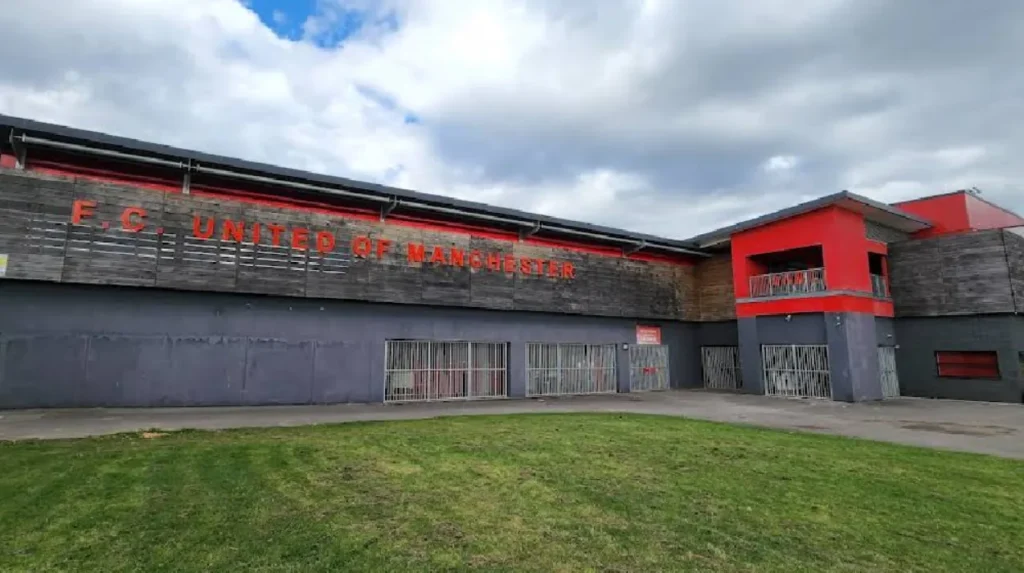
FC United operates under a democratic model where major strategic decisions require member voting. Equity capital cannot be acquired by external private investors, ensuring that institutional governance remains in the hands of the fan base. The club relies primarily on matchday ticket sales, community memberships, and independent local sponsorships. Their home ground, Broadhurst Park in Moston, was opened in 2015 after a successful community share scheme raised over two million pounds in capital.
Macclesfield FC utilizes a hybrid commercial model driven by private ownership and commercial asset management. The owner invested capital into transforming the Leasing.com Stadium into a multi-use sports facility featuring synthetic 4G pitches, hospitality suites, and commercial gym spaces. Revenue generated from pitch rentals and commercial events subsidizes first-team playing budgets, scouting networks, and academy infrastructure. This operational framework allowed Macclesfield FC to scale player recruitment rapidly compared to traditional non-league financial structures.
What are the head-to-head competitive statistics and match outcomes?
Macclesfield FC holds a superior head-to-head record over FC United of Manchester in competitive league and cup fixtures since their initial meeting in 2022.
The inaugural meeting between the rebuilt Macclesfield FC and FC United of Manchester occurred in a pre-season friendly on August 2, 2022, resulting in a 2-2 draw. The first official competitive fixture took place in the Northern Premier League Premier Division on August 26, 2023, where FC United of Manchester secured a 2-1 victory at Broadhurst Park. Subsequent encounters saw Macclesfield FC establish tactical dominance across domestic fixtures.
On March 30, 2024, Macclesfield FC defeated FC United of Manchester 3-1 at the Leasing.com Stadium. During the 2024–2025 Northern Premier League campaign, Macclesfield FC recorded a 2-1 victory away at Broadhurst Park on September 17, 2024, followed by a 2-0 victory at home on January 11, 2025. In a summer fixture on August 1, 2026, Macclesfield FC recorded a 2-0 victory over FC United of Manchester. Out of five competitive league meetings between 2023 and 2025, Macclesfield FC achieved three wins, FC United of Manchester recorded one win, and one match ended in a draw.
How do stadium atmospheres and supporter demographics differ between the venues?
Broadhurst Park offers a traditional, supporter-led terrace atmosphere focused on fan activism, whereas Leasing.com Stadium provides a modernized non-league entertainment venue tailored for broad regional family engagement.
Broadhurst Park holds a capacity of 4,400 spectators with a large covered standing terrace known as the St Mary’s Road End. Supporter atmosphere is characterized by continuous vocal chanting, flag displays, and fan-curated matchday visuals. The supporter culture emphasizes anti-commercialism, community outreach, and active inclusion. Matchday operations rely heavily on volunteer staffing provided by club members and local residents.
The Leasing.com Stadium in Macclesfield holds a capacity of 5,300, featuring a mix of seated stands and covered terracing. The stadium infrastructure includes digital LED perimeter boards, premium hospitality boxes, and an integrated sports bar. Macclesfield FC matchdays attract average attendances exceeding 3,000 spectators in non-league divisions, drawing fans from East Cheshire and South Manchester. The atmosphere combines traditional English non-league enthusiasm with modern event entertainment, music, and corporate hospitality options.
What is the tactical identity and pitch style of each team?
Macclesfield FC emphasizes high-intensity pressing and possession-based attacking football, while FC United of Manchester utilizes a compact, resilient defensive structure designed for rapid transition play.
Macclesfield FC consistently deploys tactical systems built around high territorial possession and wing play. Utilizing the dynamic bounce and uniform surface of their home 4G pitch, Macclesfield focuses on fast ball movement, overlapping fullback runs, and overloads in the final third. Tactical directives emphasize high-volume shot creation and aggressive counter-pressing immediately upon losing possession in the opposition half.
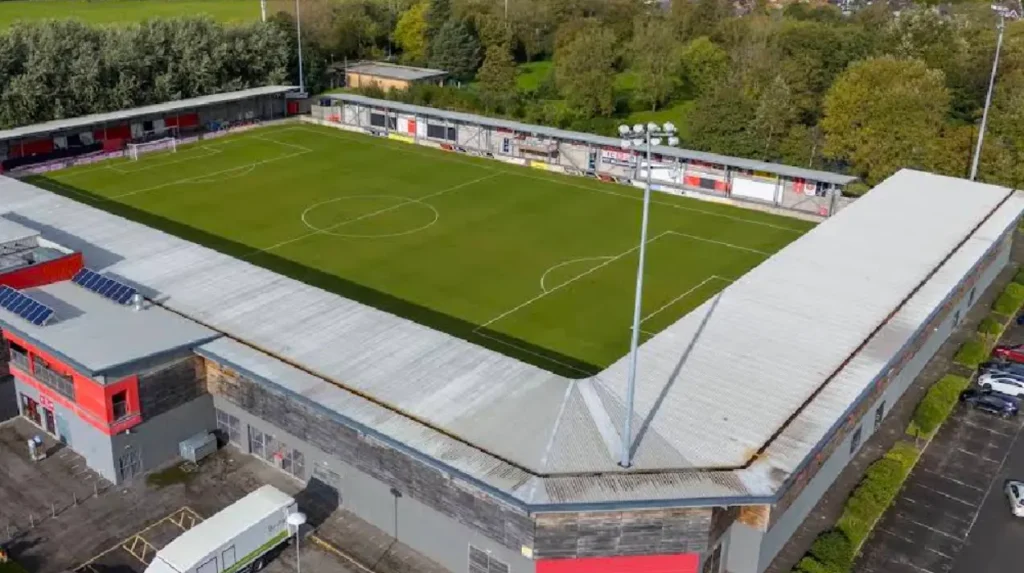
FC United of Manchester structures tactical setups around disciplined defensive compactness and physical duel dominance in central midfield. The team prioritizes direct transitions from defensive turnover into counter-attacking sequences, utilizing fast wingers to exploit spaces behind high opposition defensive lines. On grass surfaces, FC United relies on tactical flexibility, adjusting pitch width based on opposition pressing triggers and set-piece opportunism.
What are the long-term regional and strategic impacts on non-league football?
The competition between Macclesfield FC and FC United of Manchester demonstrates two distinct, viable models for sustaining and modernizing non-league football clubs in North West England.
The North West region contains the highest density of non-league football clubs in England, creating intense competition for supporter loyalty, corporate sponsorship, and youth talent acquisition. The growth of FC United proved that fan ownership can build sustainable stadium infrastructure and support higher-tier non-league competition without reliance on debt or wealthy benefactors. The club serves as a structural blueprint for supporter trusts across the United Kingdom.
Conversely, Macclesfield FC demonstrated how private capital combined with asset diversification can accelerate club recovery following financial liquidation. By turning a stadium facility into an everyday community commercial hub, Macclesfield established a revenue stream independent of matchday turnstile reliance. Both clubs continue to influence non-league governance, demonstrating that sustainable models must prioritize either direct community ownership or multi-use facility monetization to ensure financial stability.
Frequently Asked Questions
What is the main difference between Macclesfield FC and Macclesfield Town?
Macclesfield Town was the original club founded in 1874 that went into financial liquidation in 2020. Macclesfield FC is a new entity formed in 2020 by Robert Smethurst, which purchased the original stadium and assets to start playing in the non-league pyramid from 2021 onwards.
What division do Macclesfield FC and FC United of Manchester play in?
Both clubs have competed in the Northern Premier League Premier Division, which sits at step 3 of the National League System and step 7 of the overall English football league pyramid, though Macclesfield has targeted promotion to the National League North.
Does FC United of Manchester own their home stadium?
Yes, FC United of Manchester plays at Broadhurst Park in Moston, Manchester. The stadium opened in 2015 and was built using a combination of fan-backed community share schemes, grants, and fundraising efforts.
How many fans attend Macclesfield FC matches on average?
Macclesfield FC averages between 3,000 and 4,000 fans per home match at the Leasing.com Stadium, making them one of the highest-attended clubs in non-league football across North West England.