


Manchester’s Clean Air Plan represents a pivotal effort to combat air pollution, focusing on sustainable measures that benefit residents long-term. This investment-driven strategy prioritizes cleaner transport without charging drivers, ensuring compliance with legal air quality standards by 2026.
History of Air Pollution in Manchester
Manchester has long grappled with air quality challenges rooted in its industrial heritage. During the 19th century, the city earned the grim nickname “Cottonopolis” due to its textile mills, which spewed smoke and soot into the sky, blanketing streets in smog. This era saw frequent “pea-souper” fogs, exacerbated by coal burning in homes and factories, leading to thousands of respiratory illnesses annually.
The Clean Air Act of 1956 marked a turning point for the UK, prompted by the deadly 1952 Great Smog of London, but Manchester’s issues persisted into the late 20th century. By the 1990s, vehicle emissions emerged as the primary pollutant, with nitrogen dioxide (NO2) from diesel engines surpassing industrial sources. Official monitoring stations in the city center consistently recorded exceedances of the EU limit of 40 micrograms per cubic meter, prompting legal action from ClientEarth in 2015, which forced local authorities to act.
Today, while overall emissions have declined due to cleaner fuels and regulations, hotspots along Oxford Street and the A665 remain problematic. Historical data from government archives shows a 30% drop in particulate matter (PM2.5 and PM10) since 2010, yet NO2 levels linger above targets, affecting vulnerable groups like children and the elderly.
Air Pollution Sources
Air pollution in Manchester stems mainly from transport, which accounts for over 80% of NO2 emissions in urban areas. Diesel vehicles, including buses, taxis, and private cars, release harmful gases during combustion, contributing to smog formation. Industrial processes and domestic heating play smaller roles, but construction dust and wood burning add to fine particulates that penetrate deep into lungs.
NO2 irritates airways, worsening asthma and contributing to 40,000 premature UK deaths yearly, per Public Health England estimates. PM2.5 particles, smaller than 2.5 micrometers, travel via bloodstream to organs, linking to heart disease and dementia. Manchester’s dense traffic on radial routes amplifies these risks, with schoolchildren near busy roads facing 10-20% higher exposure.
Beyond health, pollution corrodes buildings and reduces visibility, impacting the city’s vibrant cultural scene. Rain washes some pollutants, but persistent inversions trap them, creating prolonged exposure episodes.
The Greater Manchester Clean Air Plan Explained
Launched after abandoning a controversial charging Clean Air Zone (CAZ) in 2023 due to public backlash, the Greater Manchester Clean Air Plan (GM CAP) relies on £86 million in government funding. This investment-led approach targets NO2 reduction without fees, aiming for compliance by 2026 across 10 boroughs, including Manchester.
Key elements include £51.1 million for bus upgrades: 40 zero-emission electric buses, 77 Euro VI compliant models, and charging infrastructure. Another £8 million supports taxi fleet retrofits to low-emission vehicles, while £5 million funds traffic management in Manchester and Salford, like signal optimization to smooth flows and cut idling.
Administered jointly by councils, the plan includes monitoring via 80+ stations, with real-time data shared publicly. Unlike CAZs in Birmingham or London, this model avoids economic hardship, earning praise from Mayor Andy Burnham as a “vote of confidence” in greener transport.
Key Investments and Initiatives
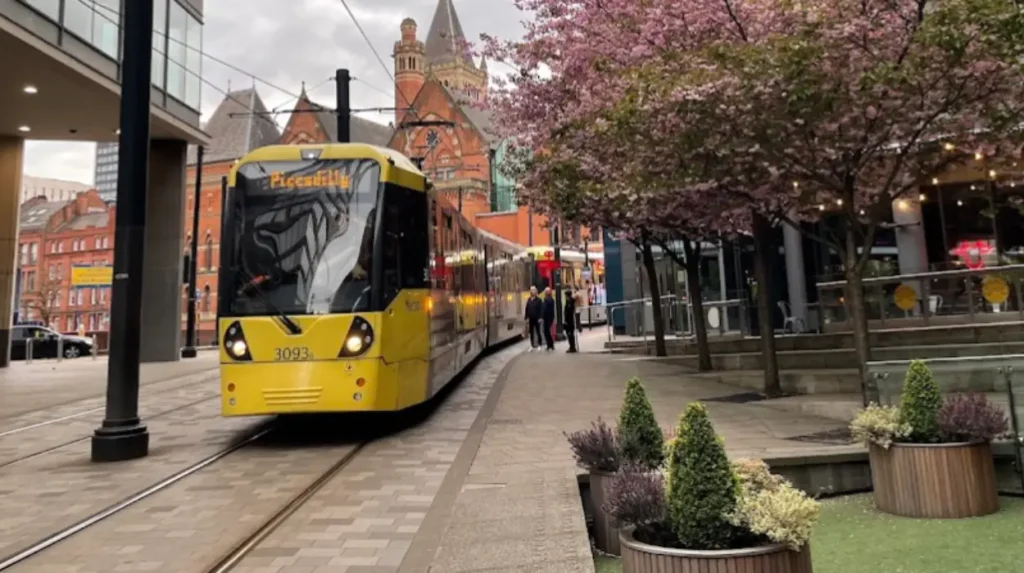
Bus fleet modernization forms the plan’s backbone, with operators like Transport for Greater Manchester (TfGM) procuring vehicles that slash emissions by 90% compared to older diesels. Trials of hydrogen buses complement electrics, testing scalability for the Bee Network’s franchised services launching in 2024.
Taxi incentives offer grants for electric conversions, targeting 2,500 vehicles by 2026. Partnerships with Hackney carriage associations ensure uptake, with early data showing 15% fleet improvement in 2025. Traffic measures employ AI sensors to prioritize buses and cycles, reducing congestion hotspots by up to 20% in pilots.
Complementary efforts include green infrastructure: tree planting along the River Irwell and permeable pavements to filter runoff. Schools receive funding for air quality audits, promoting walk-to-school schemes that cut short car trips.
Health Impacts and Community Benefits
Reducing NO2 directly lowers hospital admissions for respiratory issues, with Manchester University NHS data projecting 1,000 fewer cases yearly post-compliance. Children in polluted areas show improved lung function in studies from similar UK schemes, while elderly residents benefit from fewer cardiovascular events.
Economically, cleaner air boosts productivity; absent days from pollution-related illness cost the region £200 million annually. Enhanced liveability attracts tourism to areas like the Northern Quarter, where clearer skies highlight street art and events. Equity focuses on deprived wards like Moss Side, where pollution correlates with higher poverty and health disparities.
Residents report better quality of life, with community groups like Friends of the Earth Manchester advocating for sustained monitoring to prevent backsliding.
Progress and Monitoring Efforts
As of July 2025 updates, NO2 levels dropped 12% in priority zones, on track for legal limits. TfGM’s dashboard provides hourly readings, empowering citizens to track improvements. Independent audits by Defra confirm the plan’s efficacy, faster than CAZ alternatives elsewhere.
Challenges persist: modeling predicts weather variability could delay outer borough compliance to 2027. Responsive tweaks, like expanded cycle lanes under the £1.5 billion Bee Network, accelerate gains. Public engagement via town halls ensures transparency.
Future Goals Beyond 2026
Post-compliance, the plan evolves into a net-zero roadmap, aligning with the UK’s 2050 target. Expansion targets PM2.5, with wood-burning restrictions and green hydrogen hubs. Integration with Manchester’s City Centre Masterplan promotes 15-minute neighborhoods, minimizing car dependency.
Collaboration with national policies, like the Environment Act 2021’s ambient targets, strengthens resilience. Research from the University of Manchester explores bio-filters and drone monitoring for proactive control.
Innovation thrives: startups develop air-purifying pavements, piloted in Ancoats. Long-term, the plan positions Manchester as a clean air leader, inspiring cities like Leeds.
Challenges in Implementation
Supply chain delays for electric buses posed early hurdles, mitigated by diversified suppliers. Public skepticism lingered from CAZ fears, addressed through campaigns highlighting no-charge benefits. Funding ringfencing prevents diversion to other needs.
Enforcement remains light-touch, relying on incentives over fines, though non-compliant taxis face phase-outs. Climate change adds uncertainty, with hotter summers potentially increasing ozone precursors.
Stakeholder buy-in varies; businesses welcome retrofits, but rural fringe areas push for equitable support. Adaptive governance, via annual reviews, navigates these dynamics.
Role of Residents and Businesses
Individuals contribute by choosing electric vehicles, supported by home charging grants. Cycling surges via protected lanes, with usage up 25% since 2023. Apps like TfGM’s track cleanest routes.
Businesses retrofit vans for last-mile deliveries, accessing £10 million in loans. Retailers in the Arndale promote low-emission deliveries, enhancing footfall. Schools and workplaces adopt no-idle zones, fostering cultural shifts.
Community activism amplifies impact: Clean Air Manchester campaigns for school streets, closing roads during peak hours.
Comparing with Other UK Cities
Manchester’s no-charge model contrasts Birmingham’s CAZ, which cut NO2 25% but sparked protests. London’s Ultra Low Emission Zone achieves faster drops via fees, yet burdens low-income drivers more. Leeds mirrors Manchester’s investment path, blending buses and cycles.
Bradford’s partial CAZ highlights flexibility, while Scotland’s workplace parking levies offer lessons. Manchester excels in scale, covering 2.8 million people collaboratively.
Data tables reveal nuances:
| City | Approach | NO2 Reduction (2025) | Cost to Public |
|---|---|---|---|
| Manchester | Investment-led | 12% | None |
| Birmingham | CAZ Charging | 25% | £8/day |
| London | ULEZ | 30% | £12.50/day |
| Leeds | Hybrid | 15% | Minimal |
Scientific Backing and Research
Academic papers from the University of Manchester quantify benefits: epidemiological models link 1µg/m³ NO2 drop to 0.7% fewer asthma attacks. Ricardian analysis values cleaner air at £2 billion regionally.
Government diffusion tubes validate trends, with peer-reviewed studies in Atmospheric Environment confirming bus retrofits’ efficacy. Long-term cohorts track child health, underscoring sustained investment.
Manchester’s Clean Air Plan transforms pollution control into a blueprint for sustainable urban living. By prioritizing investment over punishment, it safeguards health, economy, and environment for generations, solidifying the city’s green credentials.
