Key Points
- There have been discussions on a platform called Sharing Student Projects, which will enable access to short summaries of student research by students, faculty members, partners, and general individuals.
- So far, there have been over 150 completed research projects from undergraduates, postgraduates, and full-time/part-time students.
- It was introduced in 2022 and was greatly redesigned from 2024, following the design process led by Taslima Ivy, and numerous stakeholder inputs.
- Dr. Sarah MacQuarrie, who works as a Senior Lecturer at the Manchester Institute of Education, is the leader of the initiative.
- The aim of this project is making student research more accessible and engaging, promoting open and inclusive research, and fostering dialogue between the University and communities.
- Students can share project summaries, research experience, and career stories while future researchers can benefit from the content of the materials as a source of inspiration for their research.
- In turn, staff will be able to use summary materials as teaching aids and include public engagement within their teaching processes.
- For community partners, there will be an opportunity to explore student research and engage in cooperation with them.
- Moorlands Junior School mentioned that collaboration provided them with an opportunity to develop a user-friendly website, sparking discussions among various stakeholders of the school community.
- Participation in the program is voluntary and based on the consent, eligibility, and academic verification to guarantee accurate summarization of the research.
- Currently, there are participating programs such as MEd Psychology of Education, MA Leadership in Learning, MA Digital Technologies, Communication, and Education, MA Education for a Sustainable Environment, BSc Education, MA International Education, MA Educational Leadership, and PGCE Primary and Secondary.
Manchester (Manchester Mirror) November 16, 2026 — The University of Manchester has promoted Sharing Student Projects, an open-access platform that brings student research beyond the classroom and makes it available to students, staff, community partners and the wider public. The University says the initiative connects learning with community impact by publishing excerpts and summaries of research completed by Manchester students.
- Key Points
- What Can Students, Staff and Partners Do?
- What Has Dr Sarah MacQuarrie Said?
- How Has a School Benefited From Collaboration?
- How Can University Programmes Take Part?
- Why Does the Platform Matter for Research Transparency?
- Background of the Development
- Prediction: How This Can Affect Students and Communities
The platform gathers work completed by undergraduate and postgraduate students, as well as full-time and part-time learners, as part of their qualifications. According to the University, it now contains more than 150 research projects, giving visitors access to a range of completed work, research journeys and career stories.
Sharing Student Projects was originally launched in 2022. Since 2024, it has undergone substantial redevelopment intended to reflect students’ voices, aspirations and experiences through a participatory design process led by Taslima Ivy.
The initiative is led by Dr Sarah MacQuarrie, Senior Lecturer in the Manchester Institute of Education. The University states that its purpose is to encourage interaction and engagement between higher education institutions and the communities involved with, or connected to, student work.
What Can Students, Staff and Partners Do?
The University describes the platform as a resource for three main groups: students, staff and external partners. Students can explore previous projects, learn about other people’s research journeys and share their own work after completing a project.
For students, publishing a summary offers a way to demonstrate achievements beyond graduation. The University says it can also help them present research and communication skills to potential employers.
Future researchers can use the platform to see examples of completed projects and learn from the experiences of others. Alongside project summaries, the site includes research journeys and career stories that provide insight into the work behind the research.
Staff can use the material as accessible teaching resources. The University says the summaries offer a practical way to embed open research and public engagement within student learning.
For the wider community, the platform provides a route into Manchester’s student research. It allows people to discover ideas that may be relevant to their interests, communities or professional work.
What Has Dr Sarah MacQuarrie Said?
As reported by The University of Manchester, Dr Sarah MacQuarrie said:
“A diverse collection of completed projects and research journeys helps make the research process more transparent and demonstrates that there are multiple legitimate routes through research.”
Her statement frames the platform as more than a repository of completed dissertations or assignments. The University presents it as a way to show different pathways through research and to make the process more understandable to people outside academic settings.
The initiative also forms part of a wider University project, Developing and disseminating student projects with lay audiences, for which Dr MacQuarrie is the principal investigator. Taslima Ivy and Felix Kwihangana are listed as co-investigators.
The University’s Research IT service previously reported that the website was developed by Research Software Engineers Qinhan (Annie) Zheng and Theresa Teng. It said the bespoke site streamlined the time needed to upload and manage summaries of student research outcomes, while making it easier for other schools and faculties to join the project.
How Has a School Benefited From Collaboration?
The University highlights Moorlands Junior School as an example of how student projects can benefit external partners through collaboration. As reported by The University of Manchester, James Gilmartin, Assistant Headteacher for Curriculum at the school, said: “Working with the Sharing Student Summaries Project has been invaluable in helping us create a website that truly works for all our key stakeholders.”
Gilmartin added:
“The collaboration also sparked meaningful conversations across our school community, allowing us to better understand different perspectives and make decisions that genuinely reflect everyone’s needs.”
The University presents this example as evidence that student research can have practical value beyond academic assessment. It says the platform highlights how projects can benefit partners through collaboration.
How Can University Programmes Take Part?
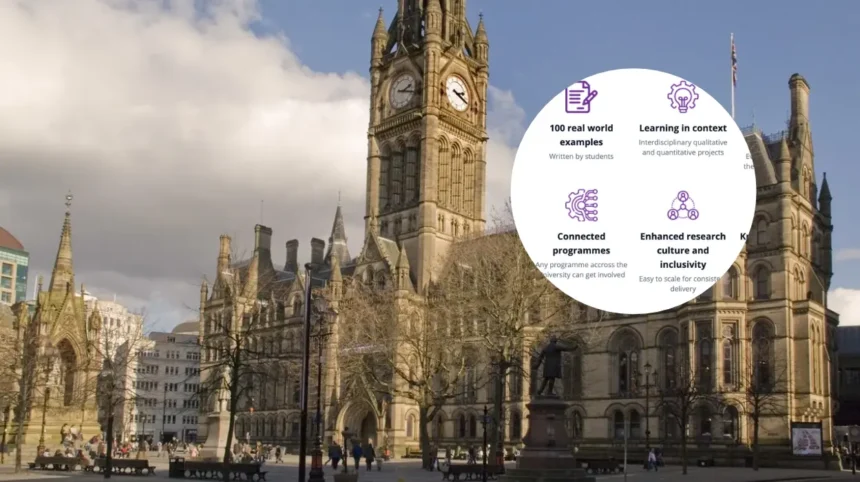
Any University programme can choose to become a connected programme. The project team provides templates, guidance and adaptable teaching resources for participating departments.
Publication on the platform is voluntary. The University says it is subject to consent, programme eligibility requirements and academic checks that confirm a summary accurately reflects the underlying research.
The current participating programmes listed by the University are:
- MEd Psychology of Education
- MA Leadership in Learning
- MA Digital Technologies, Communication, and Education
- MA Education for a Sustainable Environment
- BSc Education
- MA International Education
- MA Educational Leadership
- PGCE Primary and PGCE Secondary
The platform’s own “Get Involved” page describes the material as plain-English summaries written by students about projects completed while studying at the University of Manchester. It also notes that students should consider permissions, ethics and copyright requirements before publishing a full project or dissertation.
Why Does the Platform Matter for Research Transparency?
The University positions the platform as a way to recognise the contribution students make to research and society. It says the site allows visitors to discover fresh voices, learn from others’ experiences and see how student work can connect with real-world issues.
The initiative’s project description says the website enhances the student experience by focusing on knowledge generated through dissertations and student projects. It also says the platform gives staff and students a focus for discussion, helps create allyship across learners and provides a common starting point for future researchers.
The University’s Research Explorer describes the work as supporting knowledge equity by recognising student voices as part of the research process. It says the platform aims to democratise the research experience and support inclusion by helping students share examples of their research projects and engage with those examples while developing research plans.
The project’s own history page says the initiative was conceptualised by Sarah MacQuarrie and Ann Lendrum in 2018, arising from their interest in teacher engagement. It states that Taslima Ivy joined the project team in 2023, bringing expertise in student voice and collaboration.
Background of the Development
Sharing Student Projects began as an effort to make the outcomes of student dissertations and research projects more visible beyond the University. The official website was launched in December 2022, according to the University’s Research IT service, which reported that the site was developed to simplify the publication and management of student research summaries.
The project was designed to help higher education institutions engage with communities by sharing student research while embedding dissemination and openness principles in education studies. Research IT said the site also allows experienced and emerging researchers to engage with the material and provides a resource for wider non-academic communities.
The latest announcement marks a renewed emphasis on the platform after its redevelopment from 2024. The University says the revised version reflects student voices and experiences, while continuing to connect academic work with employers, educators, community organisations and other external audiences.
Prediction: How This Can Affect Students and Communities
For students, the platform may make research feel more visible and useful beyond a final assessment. By publishing plain-English summaries, students can create a public record of their work that may support future job applications, further study or professional networking, although the University does not claim any guaranteed employment outcome.
For future students, access to completed projects and research journeys may provide practical examples of how others framed questions, carried out research and communicated findings. This could help reduce uncertainty for those preparing dissertations or research projects, particularly where they can see multiple legitimate routes through research.
For University staff, the platform may encourage more programmes to include open research and public engagement in teaching. The availability of templates, guidance and adaptable resources could make participation more straightforward for departments considering whether to join.
For community partners, the platform may create a clearer route to student research and potential collaboration. The Moorlands Junior School example suggests that such partnerships can help organisations consider different perspectives and make decisions informed by a wider range of stakeholders.