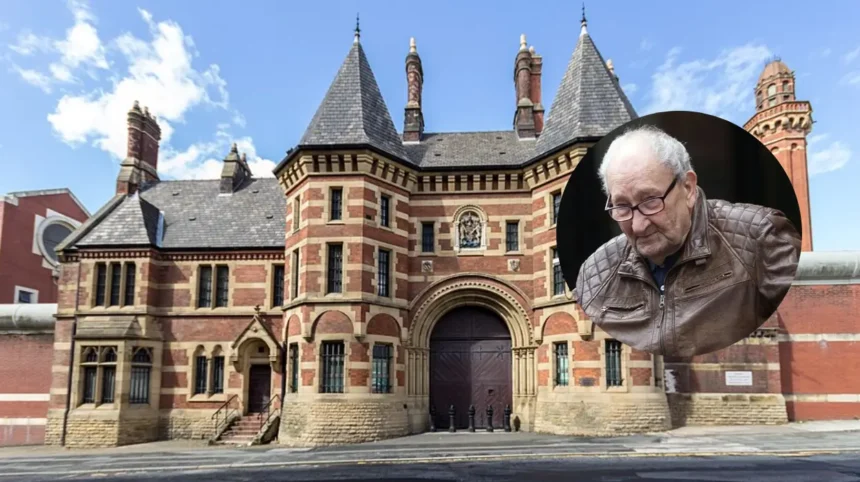
Key Points
- James Glendenning, a retired policeman from Reddish, Stockport, passed away following the collapse in a prison cell in HM Prison Manchester, otherwise referred to as Strangeways.
- According to an inquest, the 88-year-old prisoner suffered from vascular dementia, heart disease, and a pacemaker.
- He was found to be unresponsive on 29 October 2023 and subsequently passed away at Salford Royal Hospital.
- The post mortem showed that he suffered from a non-survivable brain bleed related to cerebral amyloid angiopathy.
- Greater Manchester Police did not find any signs of foul play in the course of their special procedure investigation into the circumstances.
- The coroner concluded that the cause of the man’s death was natural causes.
- In 2018, Glendenning was jailed for raping and assaulting indecently two girls.
- The judge called his crimes “utterly depraved and utterly wicked”.
- The first case of abuse was reported back in the 1980s; however, the matter was not investigated at that point.
- A second report was made in 2015.
Manchester (Manchester Mirror) October 01, 2026 — James Glendenning died after suffering a fatal brain haemorrhage in a cell at HMP Manchester, according to an inquest reported by the Manchester Evening News.
- Key Points
- What did the medical evidence show?
- Did police find evidence of foul play?
- Why was James Glendenning in prison?
- How were the historical allegations investigated?
- What did the judge say after the conviction?
- What is known about the prison death?
- What does the inquest conclusion mean?
- Background: Who was James Glendenning?
- Prediction: How could this affect victims and the public?
Glendenning, a former police officer who was convicted of sexually abusing two girls while serving as a police officer in the 1970s, was found unresponsive in his cell at Strangeways on Sunday, 29 October 2023.
He was 88 when he became seriously ill in prison. The inquest heard that he was already in a fragile state of health and had a medical history that included heart problems, a pacemaker and vascular dementia.
Prison staff initially believed that Glendenning may have fallen from his bed. He was taken to Salford Royal Hospital, where he died later the same day. His age at death was reported as 93 in the inquest account.
The hearing examined whether his death had been caused by a fall or by an underlying medical condition. A post-mortem examination was carried out by neuropathologist Dr Daniel Du Plessis.
According to the evidence reported by the Manchester Evening News, Dr Du Plessis concluded that Glendenning died from a spontaneous intracerebral haemorrhage. The bleeding was attributed to amyloid-related cerebral amyloid angiopathy, a condition associated with changes in the brain and linked in the evidence to vascular dementia.
What did the medical evidence show?
The inquest heard that Glendenning had experienced cognitive impairment because of his vascular dementia. Dr Du Plessis said the haemorrhage could have followed a fall, but the more likely explanation was that the bleeding happened spontaneously and may have caused him to fall.
The medical evidence therefore pointed away from an external attack or other criminal act. Instead, it indicated that a serious internal bleed had occurred, leaving Glendenning with injuries that could not be survived.
The coroner, Andrew Bridgman, recorded the cause of death as natural causes. He concluded that Glendenning had suffered a “non-survivable bleed on the brain likely of spontaneous origin”.
The inquest was described as a documentary hearing. No live witnesses gave evidence, and the coroner considered written statements and other documents relating to the death.
Coroner Bridgman expressed his sympathies to Glendenning’s family. No family members were present during the hearing, according to the report.
Did police find evidence of foul play?
Greater Manchester Police investigated Glendenning’s death under a special procedure investigation. Detective Sergeant Kirsty Roe led the investigation.
The Manchester Evening News reported that the investigation found no indication of foul play. The police findings were consistent with the medical evidence presented to the coroner.
The conclusion meant that no criminal circumstances were identified in connection with the death. The coroner’s decision that Glendenning died from natural causes brought the inquest to an end.
The death occurred while Glendenning was serving a lengthy prison sentence imposed after his conviction for historical sexual offences against children.
Why was James Glendenning in prison?
Glendenning was sentenced in November 2018 after being convicted of offences committed while he was a police officer during the 1970s.
The charges included one count of rape and ten counts of indecent assault. The report also referred to four further indecent assault charges. Glendenning denied the allegations, but a jury found him guilty following a trial.
He was sentenced to 23 years in prison. During sentencing, the judge condemned the crimes in strong terms and described them as “utterly depraved and utterly wicked”.
The case involved two young girls. Evidence presented at the trial described the abuse suffered by the victims and the fear surrounding their attempts to speak about it.
One victim was reportedly threatened with a cane if she disclosed what had happened. The court also heard that another girl screamed in pain and pleaded with Glendenning to stop.
The sentencing remarks criticised Glendenning for betraying the trust placed in him. The judge described the offences as degrading and emphasised that the victims had been children when the abuse occurred.
How were the historical allegations investigated?
The case involved allegations that had remained unresolved for many years.
The court heard that one victim reported the abuse to police during the 1980s. However, her allegations were dismissed at that time.
A new complaint was made in 2015. Following that complaint, the investigation was reopened and further inquiries were conducted.
The renewed investigation eventually led to Glendenning being prosecuted. The jury heard evidence from the two complainants and considered the allegations alongside the historical circumstances in which they had first been reported.
The judge said Glendenning had lied to police during the 1980s and during later interviews. The sentencing remarks also referred to what the judge described as lies given during the trial.
The two complainants’ accounts were accepted by the jury, despite Glendenning’s denials. He was convicted on all the counts brought against him.
What did the judge say after the conviction?
During sentencing, the judge said Glendenning had committed the offences when the victims were young girls. The remarks focused on the abuse of trust and the lasting seriousness of crimes committed against children.
As reported by the Manchester Evening News, the judge said Glendenning’s conduct was “utterly depraved and utterly wicked”. The judge also said that the victims’ trust had been betrayed and described the offences as “utterly degrading”.
The sentencing comments reflected the seriousness of the convictions rather than the circumstances of Glendenning’s later death in custody.
The inquest dealt with the medical and investigative questions surrounding his death. It did not reopen the criminal trial or reconsider the jury’s verdicts.
What is known about the prison death?
Glendenning was being held at HMP Manchester, commonly known as Strangeways, when he became unresponsive.
Prison staff believed he may have fallen from his bed. Emergency action was taken, and he was transferred to Salford Royal Hospital. He died later that day.
The post-mortem examination identified bleeding inside the brain. The evidence suggested that the bleed was spontaneous and associated with cerebral amyloid angiopathy, rather than being caused by an assault.
The coroner accepted the medical conclusion and recorded the death as natural causes. Greater Manchester Police also found no evidence of foul play.
The inquest did not identify any criminal involvement in the circumstances of the death. Its findings were limited to the available evidence concerning Glendenning’s medical condition, the events in his cell and the police investigation.
What does the inquest conclusion mean?
The conclusion means that the coroner considered Glendenning’s death to have resulted from a medical event rather than an unlawful act or accident.
The phrase “natural causes” refers to death caused by disease or an internal medical condition. In this case, the identified condition was a serious brain haemorrhage likely to have occurred spontaneously.
The evidence did not establish that a fall caused the haemorrhage. Instead, the medical opinion reported at the hearing was that the haemorrhage may have caused the fall.
This distinction was important because Glendenning had been discovered in circumstances that initially raised the possibility of a fall. The medical examination provided the basis for the coroner’s final conclusion.
The police investigation and the inquest therefore reached consistent findings: no evidence of foul play was identified, and the death was attributed to natural causes.
Background: Who was James Glendenning?
James Glendenning was a former police officer from Reddish in Stockport. He was convicted in 2018 of historical sexual offences against two girls, committed while he was serving as a police officer in the 1970s.
The prosecution followed a renewed investigation after a complaint made in 2015. One of the victims had previously approached police in the 1980s, but her allegations were dismissed at the time.
After the later investigation, Glendenning faced trial and denied the charges. The jury convicted him of rape and multiple indecent assaults. He received a 23-year prison sentence in November 2018.
The trial and sentencing highlighted the serious abuse of authority and trust involved in the offences. The later inquest was separate from those proceedings and focused only on the circumstances and medical cause of his death in custody.
Prediction: How could this affect victims and the public?
For survivors of historical abuse, the case may reinforce the importance of preserving and reviewing old complaints when new evidence or renewed reports emerge. It also demonstrates that allegations made decades earlier can remain relevant to later investigations, although each case must be assessed on its own evidence.
For the public, the inquest provides reassurance that a death in custody was investigated and that the coroner considered medical, prison and police evidence before reaching a conclusion. The finding of natural causes may also help prevent speculation about the circumstances of the death.
The wider impact is likely to remain focused on accountability for historical abuse, the treatment of victims whose earlier complaints were not accepted and the need for appropriate scrutiny when serious allegations involve people in positions of authority.