Key Points
- Bruntwood SciTech has developed the £60m Greenheys labs at Manchester Science Park, providing 131,000 sq ft of specialised Containment Level 2 (CL2) lab and write-up facilities, which were built on schedule and on budget.
- The centre will be home to the new headquarters of UK Biobank, which will move 11 million biological specimens and about 50% of its 400-person team from Stockport to the Oxford Road Corridor knowledge quarter in autumn 2026.
- Jonathan Breeze, Bruntwood’s executive vice-president of academic markets, has described Greenheys as a “lightning rod” that will help elevate Manchester’s international reputation for science and drive growth in the life sciences industry of the north-west region.
- UK Research and Innovation (UKRI) infrastructure funding and construction work by Willmott Dixon, together with other partners in design and technical matters such as BDP and Deloitte, helped deliver the project.
- According to Bruntwood, there will be about 750 job positions and £53.2m of local economic output through the use of the facilities at Greenheys, along with the advantages of collocation with UK Biobank and Manchester Science Park.
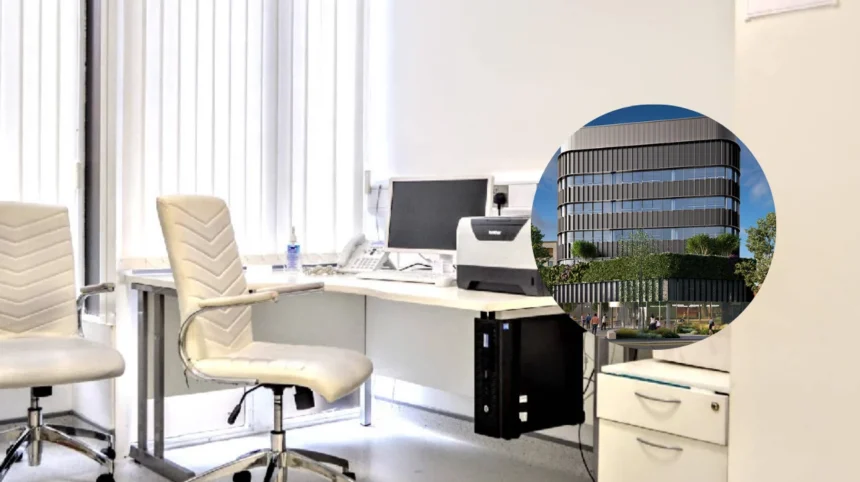
Manchester (Manchester Mirror) August 20, 2026 – The completion of the Greenheys laboratory building at Manchester Science Park marks a significant step in efforts to strengthen the city’s life sciences and technology sectors, with developers and stakeholders positioning the facility as a potential catalyst for regional growth. The £60m, 131,000 sq ft development, delivered by Bruntwood SciTech and construction partner Willmott Dixon, provides flexible Containment Level 2 (CL2) laboratory and write-up space designed for research-intensive organisations working in life sciences, biotechnology and advanced diagnostics.
- Key Points
- How will UK Biobank’s relocation reshape research capacity in the city?
- What are the economic and employment implications of Greenheys for Greater Manchester?
- Which businesses and sectors are expected to occupy Greenheys?
- How does Greenheys fit into wider plans for the Oxford Road Corridor and devolution agenda?
- Background of the Greenheys development and UK Biobank relocation
- Prediction: How could Greenheys affect Manchester’s life sciences sector and local workforce?
As reported by Willmott Dixon in its completion announcement, the building has been handed over to Bruntwood SciTech on time and on budget, and sits within Manchester’s Oxford Road Corridor knowledge quarter, close to the University of Manchester and Manchester Metropolitan University. The facility is fully electric and designed to achieve BREEAM Excellent, reflecting an emphasis on sustainability alongside scientific capability.
Jonathan Breeze, Bruntwood’s executive vice-president of academic markets, told Research Professional News that the north-west’s life sciences ecosystem remains “in its infancy” compared with the so-called “golden triangle” of London, Cambridge and Oxford, but expressed hope that Greenheys would act as a “lightning rod” to put Manchester on a more global stage. He added that the development would complement the existing mix of institutions and businesses along the Oxford Road Corridor.
How will UK Biobank’s relocation reshape research capacity in the city?
A central element of the Greenheys development is its role as the new headquarters for UK Biobank, the organisation that maintains one of the world’s most comprehensive collections of biological, health and lifestyle data. UK Biobank is preparing to relocate 11 million biological samples from its ultra-low temperature automated storage facility in Stockport to Greenheys, alongside around half of its nearly 400-strong team, in a move supported by infrastructure funding from UK Research and Innovation (UKRI).
According to UK Biobank’s own communications, the new £75m, 131,000 sq ft Greenheys facility will include a latest-generation robotic freezer system capable of storing and retrieving up to 20 million samples, an upgrade from the current 16 million donated by 500,000 participants. Dr Mark Effingham, Deputy CEO at UK Biobank, has described the move as the start of a “next chapter” that will strengthen collaboration across Greater Manchester’s life sciences ecosystem and support research with potential to improve health worldwide.
Breeze said the relocation would allow UK Biobank to handle samples “far quicker” than in the Stockport facility and would make the organisation more accessible to researchers and talent based around the University of Manchester and the wider corridor. He added that while UK Biobank was already part of Manchester’s ecosystem, its presence at Greenheys “aligns Manchester more closely to some of the leading global innovation cities”.
What are the economic and employment implications of Greenheys for Greater Manchester?
Beyond its scientific function, Greenheys is being framed as an economic asset for the city region. Bruntwood has estimated that the building will host around 750 jobs and generate an estimated £53.2m in value for the local area. The development is part of a broader strategy by Bruntwood SciTech—a joint venture between Bruntwood, Legal & General (L&G) and the Greater Manchester Pension Fund—to expand high-specification science and innovation space across its national portfolio.
As reported by BioUK, customers at Greenheys will benefit from co-location and collaboration opportunities with UK Biobank and other industry leaders, not only within the new building but across Manchester Science Park and the wider Bruntwood SciTech network. The site also offers on-campus amenities including a cafe, gym and access to local venues such as The Abbey pub, intended to support a mixed-use environment for researchers and staff.
Breeze highlighted the public–private partnership with UKRI as a model worth celebrating, particularly against a backdrop of heightened scrutiny of science infrastructure in the North, including recent controversy over funding cuts to the Jodrell Bank astronomy facility south of Manchester. He said the fact that Greenheys was delivered on time and on budget demonstrated the viability of such collaborations.
Which businesses and sectors are expected to occupy Greenheys?
While much of the laboratory space at Greenheys remains to be taken, Bruntwood has stated an ambition to fill the building within 18 months. The facility is designed to attract fast-growth life science and technology businesses working in areas such as diagnostics, genomics, biotech and precision medicine, alongside UK Biobank’s headquarters occupying three floors of the building.
According to Bruntwood SciTech’s announcement, the development offers dedicated fume extraction units, high-spec local exhaust ventilation (LEV) capacity and advanced air handling systems to facilitate sophisticated analytical and research work. These specifications are intended to make the building suitable for organisations requiring laboratory-grade infrastructure rather than standard office space.
The Northern Powerhouse Partnership has described the completion of Greenheys as an “important addition to the North West’s science and innovation infrastructure”, signalling broader regional support for the project. Industry observers, including laboratory specialists promoting the site, have pointed to its high-specification imaging and DNA sequencing capabilities as factors likely to attract research-intensive tenants.
How does Greenheys fit into wider plans for the Oxford Road Corridor and devolution agenda?
The positioning of Greenheys within the Oxford Road Corridor knowledge quarter aligns with long-standing plans to concentrate research, education and innovation assets along this stretch of central Manchester. The corridor already hosts the city’s two universities, major NHS trusts and a range of research institutes, and Greenheys is intended to add further density to this cluster by providing modern laboratory space adjacent to existing institutions.
The project’s completion also coincides with renewed political attention on devolution and regional economic development, with prime minister Andy Burnham, formerly mayor of Manchester, seeking to revitalise the UK’s devolution agenda. While Greenheys itself is a property and infrastructure development, stakeholders have linked its potential impact to broader ambitions to rebalance scientific and economic activity away from the south-east.
Breeze said the development would “add to the already unique mix in the Oxford Road Corridor” and help position Manchester more prominently within global innovation networks. He emphasised that the goal was not only to accommodate existing organisations such as UK Biobank but to attract new businesses and talent that might otherwise locate in the golden triangle.
Background of the Greenheys development and UK Biobank relocation
The Greenheys project emerged from a partnership between Bruntwood SciTech, UKRI and construction firm Willmott Dixon, with design and technical input from firms including BDP, Deloitte, DW Consulting, Silcock Leedham and I Want Plants. UK Biobank announced in May 2023 its intention to move to a larger, faster and more efficient purpose-built facility at Manchester Science Park, following £127.6m in funding from the UKRI Infrastructure Fund. The new building, valued at around £60m for the wider development and £75m for UK Biobank’s fit-out and associated works, was scheduled to become operational in 2026, with the practical completion achieved in summer 2026.
UK Biobank’s relocation involves transferring 11 million biological samples from Stockport to Greenheys, alongside approximately half of its workforce, in a phased move beginning in autumn 2026. The organisation’s leadership has framed the move as a strategic step to improve efficiency, enhance collaboration with academic and clinical partners in Manchester, and support data-driven research into conditions such as cancer, dementia, heart disease and metabolic disorders.
Prediction: How could Greenheys affect Manchester’s life sciences sector and local workforce?
If Greenheys succeeds in attracting a critical mass of life science and technology businesses within the planned 18-month timeframe, the development could materially strengthen Manchester’s position as a regional hub for biomedical research and innovation. The co-location of UK Biobank with other research-intensive tenants may encourage new collaborations between academia, industry and the NHS, potentially accelerating translational research and attracting further investment into the Oxford Road Corridor.
For the local workforce, the projected 750 jobs associated with the building could create opportunities for scientists, technicians and support staff, while also stimulating demand for related services in the city. However, the extent of these benefits will depend on the ability of local training pipelines and recruitment strategies to match the skill requirements of incoming businesses, and on whether Greenheys can compete effectively with established clusters in London, Cambridge and Oxford for talent and capital.