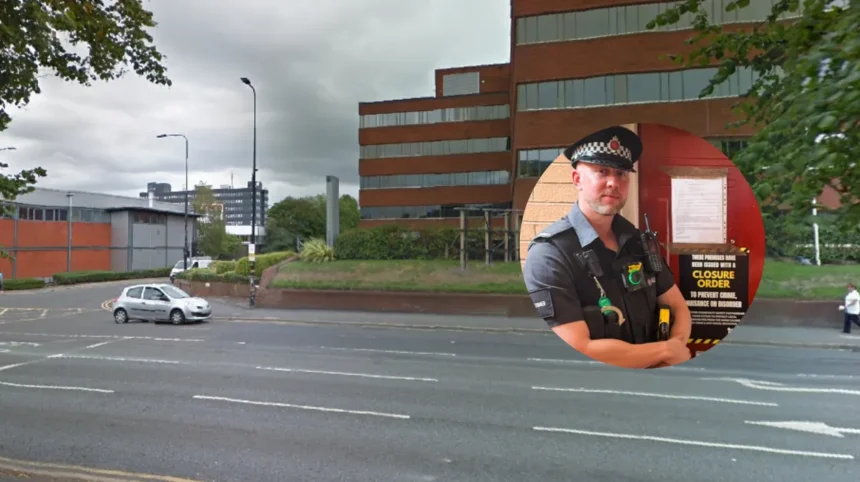
Key Points
- A house at Aintree Avenue in Sale has been put under closure for three months.
- This closure has been ordered by the court due to significant “anti-social behaviour and disorder” involving misuse of drugs and violence.
- According to the order, no one else except for the owner and professionals working officially may enter the house; otherwise, they can be arrested.
- The order will be assessed before its expiration regarding further extension.
- According to GMP, Irwell Valley Housing and Trafford Council, this step has been taken to protect vulnerable communities as well as to improve the quality of life of the locals.
Sale (Manchester Mirror) August 11, 2026 – A residential property on Aintree Avenue in Sale has been closed for three months following months of reported drug misuse, violence and anti-social behaviour, according to Greater Manchester Police (GMP) and local reporting by the Messenger Newspapers.
- Key Points
- What led to the three-month closure order in Sale?
- Who can enter the property during the closure period?
- How long will the Sale property remain closed?
- What powers allow police and councils to close properties?
- What have partners said about the Sale closure?
- Background: Context of property closures in Trafford and Greater Manchester
- Prediction: How this development may affect Sale residents and local communities
The closure order, granted by Manchester Magistrates’ Court, prohibits members of the public from entering the address for the next three months as part of efforts to crack down on criminal and disorderly activity linked to the premises. Only the occupant and professionals acting in an official capacity are permitted to enter, with police warning that anyone else found entering the property could face arrest.
What led to the three-month closure order in Sale?
According to GMP, the Aintree Avenue address had become a source of “community concerns” over recent months due to drug misuse and violent behaviour, with police saying the activities at the property had “a considerable impact on local residents” and caused “distress”.
The Messenger Newspapers reported that GMP described the situation as “significant anti-social behaviour and disorder”, prompting action to close the property under legal powers designed to tackle premises linked to persistent nuisance and criminality.
As reported by journalists at Messenger Newspapers, GMP stated:
“This result demonstrates the ongoing commitment of Greater Manchester Police, Trafford Council and Irwell Valley Housing to tackling anti-social behaviour, protecting vulnerable communities, and improving the quality of life for local residents”.
The force added:
“We understand the distress this has caused to residents, and we are pleased that positive action has now been taken to address these issues”.
Who can enter the property during the closure period?
Under the terms of the closure order, access to the Aintree Avenue property is strictly limited. Only the occupant and professionals acting in an official capacity – such as police officers, council officials, housing officers or emergency services – are allowed to enter.
Anyone else found entering the address during the three-month period could be arrested, GMP warned. The order is intended to prevent the continuation or reoccurrence of disorder, anti-social behaviour and criminal activity associated with the premises.
How long will the Sale property remain closed?
The closure order is currently in place for three months, GMP confirmed. Before the order expires, it will be reviewed to consider whether an extension is necessary, depending on whether the risks associated with the property persist.
Under the Anti-Social Behaviour, Crime and Policing Act 2014, magistrates’ courts can issue closure orders for up to three months, with the possibility of a further three-month extension if concerns about crime, nuisance and disorder remain.
What powers allow police and councils to close properties?
Closure orders are a legal tool available to police and local authorities under the Anti-Social Behaviour, Crime and Policing Act 2014. A magistrates’ court may grant an order if satisfied that:
- A person has engaged in anti-social behaviour on the premises;
- The use of the premises is associated with significant and persistent disorder or serious nuisance to members of the public; and
- The order is necessary to prevent the occurrence or reoccurrence of such disorder or nuisance.
Once granted, a closure order prohibits any person from accessing the premises, including those with rights of abode or ownership, for the duration of the order. Extensions of up to a further three months can be applied for if risks remain.
What have partners said about the Sale closure?
GMP highlighted the multi-agency nature of the operation, noting collaboration with Trafford Council and Irwell Valley Housing. The force said the action reflected a shared commitment to tackling anti-social behaviour and protecting vulnerable communities in Sale and across Trafford.
Trafford Council has previously secured closure orders on other properties in the borough linked to serious criminal activity, including weapons and Class A drugs, demonstrating an ongoing enforcement approach to nuisance properties.
Background: Context of property closures in Trafford and Greater Manchester
The closure of the Aintree Avenue property follows a pattern of similar enforcement action across Trafford and Greater Manchester. In April 2026, Manchester Magistrates’ Court granted a full closure order on another house on Aintree Avenue in Sale after police discovered a supply quantity of Class A drugs, a significant sum of cash, and a large number of prohibited and offensive weapons, including machetes, knuckle dusters and a very large sword.
In May 2026, a one-bedroom flat on Hurst Avenue in Sale was closed following repeated police call-outs involving drug offences and disorder, with Trafford Council taking legal action supported by GMP. More recently, in August 2026, closure orders were secured for properties in Stockport and Oldham linked to drug-related activity, anti-social behaviour and brothels.
Wigan Council and GMP have also reported securing dozens of closure orders over the past year, most commonly for drug-related activities, with orders typically lasting three months and extendable for a further three months if concerns persist.
Prediction: How this development may affect Sale residents and local communities
The three-month closure of the Aintree Avenue property is likely to have several effects on Sale residents and the wider community. In the short term, neighbours may experience reduced noise, disturbance and visible signs of disorder, potentially improving perceived safety and quality of life on the street.
Over the medium term, if the closure is successful in disrupting drug supply and violent activity linked to the address, it could deter similar behaviour at nearby properties and reinforce the message that persistent anti-social behaviour will be met with enforcement action. However, if underlying issues such as drug demand, housing vulnerability or lack of support services are not addressed, there is a risk that criminal activity could shift to other addresses in the area.
For local residents, the most immediate impact will be the removal of a known source of distress and disorder. For authorities, the case reinforces the use of closure orders as part of a broader strategy to tackle nuisance properties, with future extensions or further orders likely if similar patterns emerge elsewhere in Sale and Trafford.