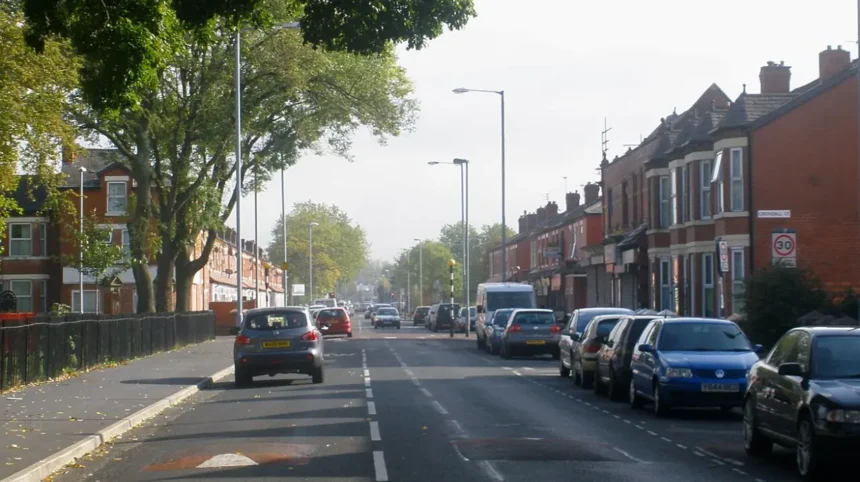
Moss Side is an inner-city ward in Manchester, England, located south of the city centre along the A5103 Princess Road corridor. From the mid-20th century, the district accumulated severe levels of social deprivation, physical housing decay, unemployment, and gang-related crime, creating conditions that demanded structured urban intervention.
- How Did Urban Renewal Programmes Begin Transforming Moss Side in the 1990s?
- What Major Housing Developments Have Shaped the Moss Side Regeneration Landscape?
- How Is the Former Reno Nightclub Site Being Redeveloped as Part of Moss Side Regeneration?
- What Role Does Community Consultation Play in the Moss Side Regeneration Scheme?
- How Has Moss Side Regeneration Addressed Social Deprivation and Housing Overcrowding?
- What Is the Long-Term Future of Moss Side Under Current Regeneration Plans?
- FAQs About Moss Side Regeneration Reshaping Manchester’s
Moss Side began as a rural settlement incorporated into Manchester during the rapid industrial expansion of the late 19th century. By the early 20th century, it housed wealthy Victorian villas and a stable working-class community. The transformation into a deprived urban area began in the 1960s when Manchester City Council demolished large sections of Victorian terraced housing and replaced them with high-density council estates and flatted developments. These interventions concentrated poverty and created environments poorly suited to long-term community wellbeing.
By 1994, The Independent newspaper identified Moss Side as one of the most deprived areas in Britain, citing high unemployment, substandard housing stock, and elevated crime rates. The area gained national notoriety during the 1981 riots, part of a wider pattern of urban unrest across British inner cities including Brixton, Toxteth, and Handsworth. Analysts attributed the unrest to structural social deprivation, discriminatory policing, and economic exclusion disproportionately affecting Afro-Caribbean communities settled in the area since the 1950s and 1960s.
The Index of Multiple Deprivation consistently ranked Moss Side among the worst-performing wards in Greater Manchester across indicators including income, employment, education, health, and housing quality. Population density in Moss Side is among the highest in the city, with a 17.4% increase recorded between 2001 and 2007 alone. This combination of spatial concentration and social disadvantage created the statistical and policy basis for sustained regeneration programmes from the 1990s onward.
How Did Urban Renewal Programmes Begin Transforming Moss Side in the 1990s?
The Moss Side regeneration process formally accelerated in the 1990s through Manchester City Council-led housing investment, demolition of failed estate blocks, and government-backed programmes. The nearby Hulme City Challenge, launched in April 1992 with 37.5 million pounds in central government funding, set the structural template for area-based regeneration that Moss Side subsequently followed.
Manchester City Council secured 7 million pounds in central government funding during this period to demolish high-rise residential blocks across south Manchester, including parts of Moss Side. These towers, constructed during the 1960s and 1970s as a solution to housing shortages, had become sites of concentrated social dysfunction, crime, and physical deterioration. The demolition programme cleared land for lower-density housing and better-planned residential environments suited to long-term community stability.
The Alexandra Park Estate, a major social housing site within Moss Side, received substantial renovation investment beginning in the late 1990s. Rather than demolition, the estate underwent physical improvement of existing stock, environmental enhancements, and tenure diversification. This approach reflected a policy shift from clearance-only solutions toward mixed strategies that preserved community continuity while improving physical conditions. Renovation of existing terrace housing across Moss Side ran concurrently with the Alexandra Park work throughout the early 2000s.
The regeneration model adopted combined physical renewal with economic and social programmes. Investment in community facilities, local employment initiatives, and public space improvements accompanied the housing work. This multi-dimensional approach recognised that physical redevelopment alone does not resolve social deprivation, and that sustainable neighbourhood improvement requires parallel investment in human capital and community infrastructure. These principles shaped subsequent regeneration phases well into the 2010s and 2020s.
What Major Housing Developments Have Shaped the Moss Side Regeneration Landscape?
Between 1997 and the present, Moss Side hosted multiple discrete housing development schemes that collectively account for hundreds of new and refurbished homes. Significant projects include the Infusion Homes development on Bowes Street, the Maine Place redevelopment of the former Manchester City FC stadium site, and the Great Western Street mixed-tenure scheme delivered by Moss Care Housing.
The Bowes Street area adjacent to Princess Road received a 17-million-pound investment that renovated and new-built 155 properties across five streets. The scheme, completed under the Infusion Homes branding and launched on 26 February 2011, delivered 2, 3, and 4-bedroom homes incorporating eco-friendly technologies including solar panels, thermal insulation, water butts, and sun pipes. The development won the UK’s Best Affordable Housing Scheme award at a national competition in May 2011, and within days of its market launch, 60% of properties were sold, demonstrating strong residential demand for quality housing in the regenerated area.

The Maine Road site, formerly home to Manchester City Football Club until the club relocated to the City of Manchester Stadium in 2003, was redeveloped between 2011 and 2018. Marketed as Maine Place, the scheme delivered primarily 2, 3, and 4-bedroom homes for sale and shared ownership, alongside the new Divine Mercy primary school. The 35-acre former football ground represented one of the most significant brownfield land releases in south Manchester’s regeneration history, converting a single-use sports facility into a functioning residential neighbourhood.
Moss Care Housing developed a large site on Great Western Street providing mixed-tenure properties including rental, shared ownership, and outright sale options across 2, 3, and 4-bedroom home types. This tenure diversification aimed to attract a broader socioeconomic mix to the ward, addressing previous patterns of concentrated social housing that had reinforced deprivation cycles. Diversifying the housing offer is a central principle in UK urban regeneration policy, supported by research showing that mixed-tenure neighbourhoods produce better long-term social outcomes.
How Is the Former Reno Nightclub Site Being Redeveloped as Part of Moss Side Regeneration?
The former Reno nightclub site on Princess Road, derelict since the venue’s demolition in 1987, received planning approval in November 2025 for a 212-home development delivered by Mosscare St Vincent’s (MSV) and Manchester City Council. The scheme provides 100 homes at social rent, 28 for older persons at social rent, and 84 at rent-to-buy rates, funded in part by Homes England.
The Reno nightclub held major cultural significance as a late-night venue at the junction of Princess Road and Moss Lane East. It served as the primary social hub for Manchester’s West Indian community from the 1960s through the 1980s and played a documented role in the development of Black British culture in the city. The venue and the Nile club above it were known nationally within Afro-Caribbean communities. This heritage significance directly influenced the planning and design process for the new development, requiring cultural integration into the built environment.
Manchester City Council’s Planning Committee granted approval for the scheme in November 2025. The buildings range from three to ten storeys in height and include 1 to 5-bedroom homes designed for accessibility and multigenerational living. The scheme incorporates private gardens for all traditional homes, rooftop terraces on flatted blocks, and publicly accessible green space across the site. MSV committed to incorporating community art and cultural design elements reflecting the site’s history and Moss Side’s diverse identity as a condition of the development process.
Homes England provided funding support for the scheme. MSV, which has operated in Moss Side for over 60 years and owns more than 1,100 homes in the area, partnered with Manchester City Council under a formal development agreement. Charlie Norman, Chief Executive of MSV Housing Group, confirmed that the resident consultation process directly shaped design outcomes, specifically producing the inclusion of roof gardens, accessible units, and the commitment to a Local Lettings Policy prioritising existing Moss Side residents.
What Role Does Community Consultation Play in the Moss Side Regeneration Scheme?
Community consultation is a statutory and operational requirement embedded in all current Moss Side regeneration planning. MSV and Manchester City Council established a resident steering group representing community organisations across the ward before any design was finalised. Feedback from residents directly altered site selection, home type distribution, parking provision, and green space planning within the approved scheme.
MSV’s consultation approach included open community sessions, door-to-door engagement, and online feedback mechanisms. The developer committed to a Local Lettings Policy as a direct response to resident concerns about who would benefit from the new homes. The policy prioritises existing Moss Side residents and those on the Manchester social housing waiting list. Moss Side has more residents on the city’s priority social housing list than any other ward in Manchester, which gives the local lettings approach particular operational importance in this scheme.
Resident feedback preserved the Greenheys Adult Learning Centre from conversion to residential use. Initial proposals included the Greenheys site within the development footprint, but community opposition led MSV to remove it from housing plans and retain adult learning services on site. This outcome demonstrates the material effect of consultation on development decisions. MSV also committed to a Memorandum of Understanding with the West Indian Sports and Social Club, supporting improvement of that facility through social value contributions from scheme contractors.
The consultation process engaged residents on green space quality, health infrastructure capacity, heritage integration, and transport access. MSV partnered with Sow the City, an environmental organisation, to map existing green spaces and develop a neighbourhood greening plan extending beyond the immediate development site. Manchester City Council and NHS partners assessed health service capacity impacts of the proposed population increase, committing to match residential growth with healthcare infrastructure investment rather than allowing services to be diluted by new demand.
How Has Moss Side Regeneration Addressed Social Deprivation and Housing Overcrowding?
Moss Side regeneration programmes directly target overcrowding and under-occupation simultaneously, a dual housing crisis specific to the ward. The population grew by more than 20% in the decade to 2023, creating acute demand for additional social rent homes. MSV’s current scheme addresses both problems through its 1 to 5-bedroom offer combined with an integrated right-sizing programme enabling existing residents to move into better-matched properties.
Right-sizing refers to a housing management strategy enabling residents in larger homes than they currently need to move into smaller new-build properties, releasing their original homes for larger families on the waiting list. MSV integrated this mechanism into the Reno site scheme, allowing existing Moss Side tenants in under-occupied properties to transfer into new purpose-built units. The approach reduces pressure on family-sized housing without demolition of existing stock, preserving community continuity while releasing larger homes where they are most needed across the ward.
Manchester City Council’s ward data identifies Moss Side as the area with the highest proportion of residents on the priority housing waiting list across all Manchester wards. The demand profile combines young families, multigenerational households, and an ageing population with distinct accessibility requirements. MSV’s scheme responds to all three groups with designated older person social rent properties, wheelchair accessible units, and homes ranging from one to five bedrooms within a single connected development on a single regenerated site.
Energy efficiency investment forms a structural component of regeneration financial planning. MSV committed to an energy efficiency programme across its existing 1,100 Moss Side properties running alongside new construction activity. The Infusion Homes scheme of 2011 demonstrated that eco-specification homes with solar panels, thermal insulation, and sun pipes generate lower running costs for social housing residents, addressing fuel poverty within the deprived ward. This integration of sustainability into regeneration planning reflects Homes England’s national funding criteria and the net zero commitments embedded in current housing policy.
What Is the Long-Term Future of Moss Side Under Current Regeneration Plans?
The current regeneration trajectory positions Moss Side for sustained physical, social, and economic improvement through 2030 and beyond. The MSV and Manchester City Council partnership covers four development sites with a total capacity of approximately 350 homes across Princess Road, Barnhill Street, Westwood Street, and Raby Street. A potential MSV merger with Great Places Housing Group was projected to unlock millions of pounds in additional investment capital for Moss Side and surrounding communities.
The potential merger between MSV Housing Group and Great Places Housing Group was projected to unlock significant additional borrowing and grant capacity. MSV Chief Executive Charlie Norman stated in 2023 that the merged entity’s North of England investment programme would treat Moss Side as a continued priority. A larger housing association carries greater financial resilience, enabling accelerated delivery of new homes and stock improvement across the existing 1,100 MSV properties throughout the ward’s residential streets.
Demographic projections indicate that Moss Side’s population will continue growing faster than the Manchester city average. The ward’s age structure, with a documented concentration in the under-10 and 25-35 age groups identified in Manchester City Council’s ward profile, signals sustained demand for family-sized social housing over the medium term. The ethnic composition of the ward includes growing Afro-Caribbean, South Asian, Somali, and Eastern European communities, requiring culturally responsive housing design and community facility planning that accounts for distinct household structures and social needs.
The heritage of the Reno site represents a specific long-term cultural investment within the regeneration framework. MSV’s commitment to incorporating community art, cultural design elements, and public memory of the Reno nightclub into the physical built environment creates a permanent record of Moss Side’s African and Caribbean cultural history. This approach reflects evolving best practice in urban regeneration, where heritage integration reduces community displacement anxiety and sustains neighbourhood identity through physical change. Moss Side regeneration, across three decades of sustained intervention, demonstrates the scale of long-term partnership investment required to reverse structural urban deprivation in British inner-city areas.
FAQs About Moss Side Regeneration Reshaping Manchester’s
What is Moss Side regeneration and why is it happening?
Moss Side regeneration is a long-term urban renewal programme in Manchester aimed at replacing derelict housing, building new affordable homes, and reducing social deprivation in one of the city’s most disadvantaged wards. The programme is driven by a 20% population surge over the past decade, severe overcrowding, and a priority social housing waiting list larger than any other Manchester ward. Manchester City Council and MSV Housing are the two lead partners delivering the scheme.
Who is paying for the Moss Side regeneration project?
The Moss Side regeneration is funded through a combination of Manchester City Council investment, Homes England government grants, and private finance raised by MSV Housing Group. The Reno nightclub site development alone involves 212 homes backed by Homes England funding. MSV’s potential merger with Great Places Housing Group was projected to unlock millions of pounds in additional capital for further investment across the ward.
Will existing Moss Side residents be able to live in the new homes?
Yes. MSV committed to a Local Lettings Policy specifically in response to community concerns raised during consultation. This policy gives priority to existing Moss Side residents and those already on Manchester’s social housing waiting list. The scheme also includes a right-sizing programme allowing current tenants in under-occupied larger homes to move into new smaller units, freeing family-sized properties for those who need them.
What happened to the Reno nightclub and what is being built there now?
The Reno nightclub, a legendary venue on Princess Road that served as Manchester’s primary Afro-Caribbean social hub from the 1960s, was demolished in 1987 and the site sat derelict for nearly four decades. Manchester City Council’s Planning Committee approved a 212-home development on the site in November 2025, delivered by MSV Housing. The new scheme includes social rent homes, older person housing, rent-to-buy units, roof gardens, and cultural design elements honouring the Reno’s heritage.
Is Moss Side a safe and improving area to live in now?
Moss Side has undergone substantial physical and social improvement since the mid-1990s, with hundreds of new and refurbished homes, eco-friendly housing schemes, and significant investment in public spaces. The area’s reputation for gang-related crime, which peaked in the late 1980s and earned Manchester the nickname Gunchester, has reduced considerably alongside the regeneration programmes. While deprivation indicators remain above the Manchester average, the ward is in active, funded transformation with major development projects now approved and underway.