Manchester’s Hulme district, nestled just south of the city center, embodies the raw evolution of urban Britain. Once a bustling industrial hub, it grappled with profound challenges that reshaped its identity. These urban issues in Manchester Hulme, from overcrowding to failed modernist experiments, offer timeless lessons in city planning and community resilience.
- Historical Roots of Hulme’s Urban Challenges
- Post-War Slum Clearance and the Rise of Hulme Crescents
- Design Flaws and Construction Nightmares
- Social Decay: Crime, Poverty, and Isolation
- Economic Decline and the Loss of Industry
- Environmental Degradation in Hulme
- The Demolition and Path to Regeneration
- Modern Housing and Gentrification Tensions
- Current Social and Community Dynamics
- Transportation and Connectivity Challenges
- Environmental and Sustainability Initiatives
- Health and Wellbeing in a Revived Hulme
- Lessons from Hulme for Future Urban Planning
- Cultural Legacy and Artistic Renaissance
Hulme’s story transcends its geography, reflecting broader 20th-century struggles with industrialization, post-war reconstruction, and social inequality. As Manchester boomed during the Industrial Revolution, Hulme swelled with workers drawn to cotton mills and canals, leading to dense, unsanitary housing. This set the stage for enduring urban issues that persisted despite ambitious interventions.
Today, understanding Hulme’s urban issues provides insight into sustainable development, making it a compelling evergreen topic for residents, historians, and urban enthusiasts alike.
This archival photo captures the towering Hulme Crescents in their prime, symbolizing bold ambition amid Manchester’s urban renewal efforts.
Historical Roots of Hulme’s Urban Challenges
Hulme’s urban woes trace back to the 19th century when Manchester emerged as the world’s first industrial city. Canals like the Bridgewater brought prosperity but also pollution and population booms, cramming families into back-to-back terraces without sanitation. By 1900, Hulme housed around 80,000 people in conditions decried as slums, fostering disease and poverty.
The interwar years exacerbated these problems as economic depression hit textile workers hard. Unemployment soared, and substandard housing worsened health crises like tuberculosis. Local authorities viewed Hulme’s endless rows of grimy terraces as irredeemable, lacking gardens, parks, or community spaces—a description etched into Manchester Corporation’s 1945 development plan.
This historical backdrop of industrial exploitation laid the foundation for Hulme’s urban issues, where rapid growth outpaced infrastructure, creating a cycle of decay that demanded radical solutions.
Post-War Slum Clearance and the Rise of Hulme Crescents
After World War II, Manchester Corporation targeted Hulme for comprehensive redevelopment. The 1945 plan labeled it a hopeless expanse, prompting slum clearance that demolished thousands of Victorian homes. In their place rose the Hulme Crescents, Europe’s largest public housing project, completed in the early 1970s by architects Wilson & Womersley.
Inspired by French architect Le Corbusier’s “streets in the sky,” the Crescents featured four 13-story deck-access blocks housing over 3,000 families. Elevators and walkways promised car-free living and community vibes above ground level. Initially hailed as innovative, they aimed to address Manchester Hulme urban issues like overcrowding with high-density, modern design.
Yet, this utopian vision quickly unraveled, marking a pivotal chapter in Hulme’s troubled urban narrative.
Design Flaws and Construction Nightmares
The Hulme Crescents’ downfall stemmed from fundamental design and construction shortcomings. Industrialized building techniques used large pre-cast concrete panels that failed to weather Manchester’s damp climate, leading to pervasive leaks and dampness. Roofs ponded water, and joints cracked, turning homes into moldy traps within years.
Walkway “streets” became wind tunnels and no-go zones, deterring the community interaction planners envisioned. Lifts broke frequently, isolating upper floors, while poor natural surveillance invited crime. These flaws amplified Manchester Hulme urban issues, transforming a housing solution into a symbol of planning hubris.
Academic analyses later critiqued the project for ignoring human-scale urbanism, prioritizing density over livability—a lesson echoed in studies of Brutalist failures across Britain.
Social Decay: Crime, Poverty, and Isolation
By the late 1970s, social pathologies gripped the Crescents. High unemployment, fueled by deindustrialization, trapped residents in poverty cycles. Crime rates exploded, with muggings and drug dealing rampant on decks, earning Hulme notoriety as a no-man’s-land.
Isolation plagued families, as the elevated design severed street-level ties. Children played in derelict spaces, and anti-social behavior thrived unchecked. Reports documented rodent infestations and vandalism, eroding any sense of pride or safety. These Manchester Hulme urban issues highlighted how physical decay mirrored social breakdown.
Government studies linked such estates to concentrated disadvantage, where welfare dependency and family instability compounded urban decline.
Economic Decline and the Loss of Industry
Hulme’s urban issues intertwined with Manchester’s industrial fade. Once powered by mills and engineering works, the area saw factories shutter as global competition and automation hit. The 1980s recession under Thatcherism accelerated job losses, leaving Hulme’s workforce adrift.
Vacant lots and polluted canals scarred the landscape, deterring investment. The Crescents’ stigma repelled businesses, creating a vicious cycle of economic stagnation. Poverty rates soared above city averages, with child deprivation metrics painting a grim picture into the 1990s.
This economic void intensified other Hulme urban challenges, underscoring the need for holistic regeneration beyond housing.
Aerial view of Hulme’s demolished Crescents in the 1990s, illustrating the rubble-strewn aftermath of a failed urban experiment.
Environmental Degradation in Hulme
Pollution plagued Hulme from its industrial heyday. Canal silt choked waterways, and air thick with mill smoke bred respiratory ills. Post-clearance, the Crescents’ concrete sprawl offered scant green space, exacerbating urban heat and flood risks in Manchester’s rainy climate.
Asbestos in buildings posed health hazards during decay, while illegal dumping marred open areas. These environmental urban issues in Manchester Hulme persisted until regeneration efforts introduced parks and remediation, but legacy contamination lingers in soil and memory.
Urban planning research emphasizes how such neglect fuels health disparities, a persistent theme in Hulme’s story.
The Demolition and Path to Regeneration
By 1994, the inevitable arrived: total demolition of the Crescents. Manchester City Council, via Hulme Regeneration Ltd and City Challenge funding, razed the blocks, displacing 13,000 residents. The £265 million initiative prioritized low-rise, traditional housing to recapture street-level community.
The Hulme Development Guide set principles for coherent urban form, emphasizing permeability and mixed-use. New homes, shops, and parks emerged, fostering a “bohemian” vibe with artists and students. This marked a turning point, addressing core Manchester Hulme urban issues through grounded design.
Regeneration succeeded where modernism failed, blending public and private investment.
Modern Housing and Gentrification Tensions
Today’s Hulme boasts diverse housing, from terraced homes to flats, but affordability remains contentious. Post-regeneration influx of students and young professionals via nearby universities spiked demand, pushing rents up and displacing legacy families.
Gentrification debates rage: luxury developments contrast with pockets of deprivation. Council estates persist alongside trendy cafes, creating a patchwork of wealth. These evolving urban issues in Hulme mirror wider Manchester trends, balancing growth with equity.
Planning policies now stress inclusive housing, yet tensions endure.
Current Social and Community Dynamics
Hulme’s social fabric has knitted anew, with community hubs like the Matthew Goodfellow Centre anchoring efforts. Crime has plummeted since the 1990s, thanks to better design and policing. Diverse populations, including Pakistani and African communities, enrich the area.
Yet, child poverty hovers at 30%, and youth services strain under cuts. Community plans, like the Hulme Ward Plan, engage residents in governance, drawing on extensive consultations. This participatory model sustains resilience against ongoing Manchester Hulme urban issues.
Vibrant events and murals celebrate Hulme’s creative spirit, a far cry from its dark past.
Transportation and Connectivity Challenges
Historically severed by ring roads and canals, Hulme now benefits from improved links like the A56 and Metrolink expansions. Cycling paths and bus corridors enhance access to Manchester center. However, congestion and poor pedestrian routes persist in denser zones.
Future plans integrate Hulme into city-wide networks, addressing isolation—a holdover from Crescents-era design. Enhanced connectivity bolsters economic vitality, mitigating some urban issues.
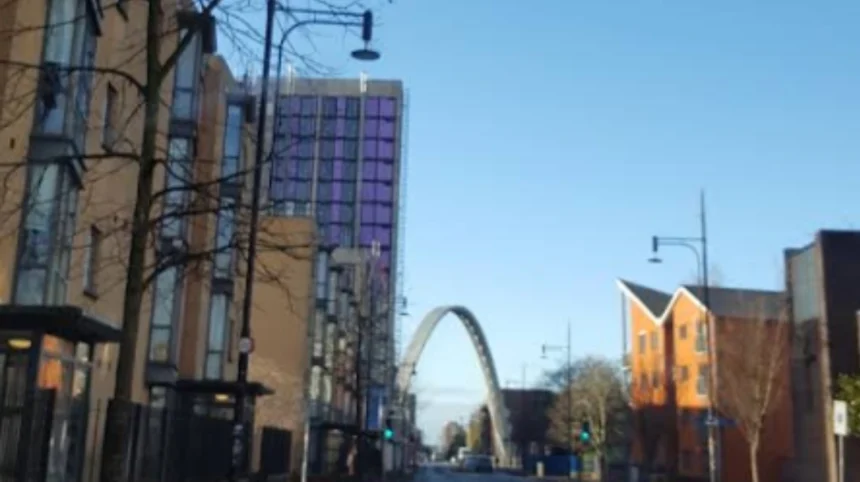
Contemporary street scene in regenerated Hulme, showcasing low-rise homes and green spaces that replaced the infamous high-rises.
Environmental and Sustainability Initiatives
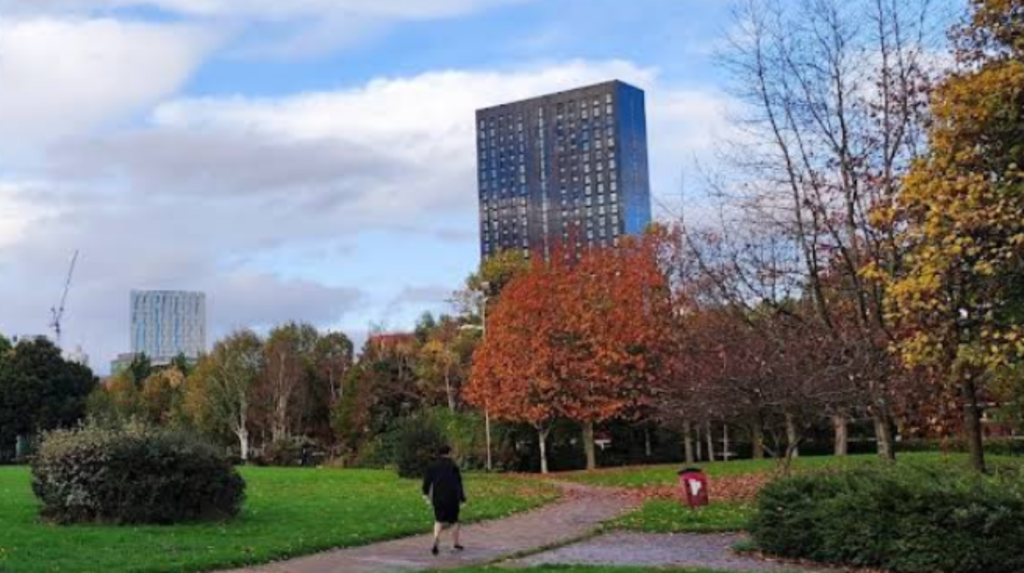
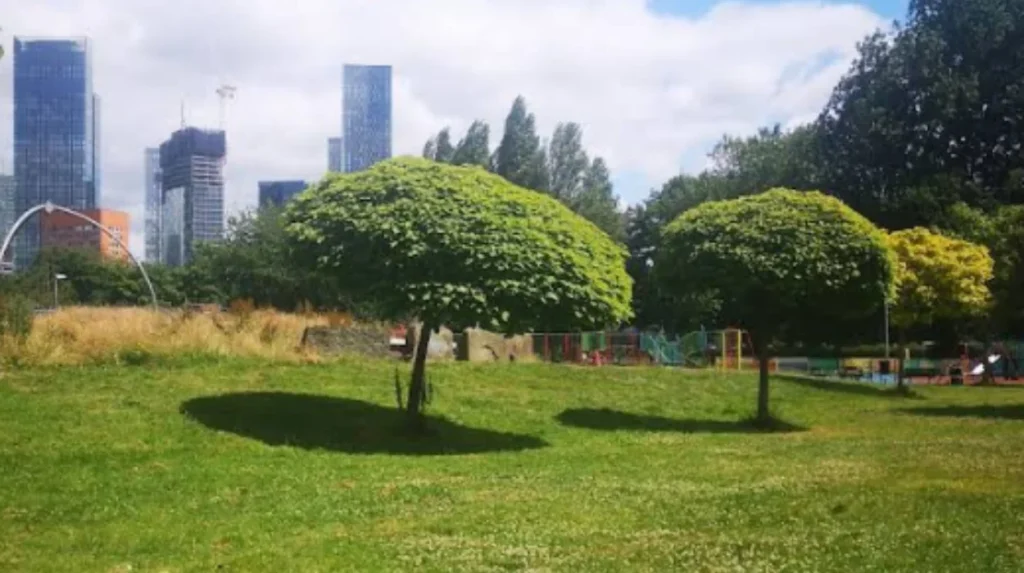
Regeneration introduced sustainable features: permeable paving reduces flooding, and tree-lined streets combat pollution. Hulme Park, with its meadows and play areas, restores green lungs absent for decades. Community gardens promote biodiversity and food security.
Renewable energy in new builds and canal cleanups tackle legacy issues. Academic papers praise Hulme as a model for brownfield reclamation, aligning with UK net-zero goals. These efforts position Hulme as a leader in urban sustainability.
Health and Wellbeing in a Revived Hulme
Improved housing slashed damp-related illnesses, and active travel boosts fitness. GP surgeries and mental health outreach address disparities. Yet, obesity and deprivation-linked conditions linger, prompting holistic programs.
The pandemic highlighted vulnerabilities, spurring vaccination drives and green recovery. Hulme’s trajectory shows how resolving physical urban issues enhances public health.
Lessons from Hulme for Future Urban Planning
Hulme’s saga—from slums to Crescents to revival—teaches that top-down modernism often fails without community input. Low-rise, human-scale design triumphs, as proven by post-1990s success. Economists and planners cite Hulme in debates on mixed-tenure models.
For Manchester and beyond, it underscores integrating social, economic, and environmental fixes. Ongoing monitoring ensures adaptability, making Hulme’s urban issues a blueprint for resilient cities.
Cultural Legacy and Artistic Renaissance
Hulme birthed cultural icons: The Smiths’ early gigs echoed its grit, and Madchester raves pulsed in warehouses. Street art and festivals now honor this heritage, drawing tourists. Literature like Alan Bleasdale’s works immortalize its struggles.
This renaissance transforms scars into strengths, embedding Hulme in Manchester’s cultural narrative.
What are the biggest challenges facing Manchester?
Manchester faces challenges like housing shortages, rising living costs, traffic congestion, and inequality between neighborhoods. Areas like Hulme also deal with urban regeneration pressures and social integration.
What is the safest area to live in Manchester?
Safer areas in Manchester include Didsbury, Chorlton, and parts of Sale, known for low crime rates and strong community environments compared to inner-city zones.
What is the bad side of Manchester?
Some parts of Manchester struggle with crime, unemployment, and poor housing conditions. Inner-city areas, including parts of Hulme, may experience anti-social behavior and economic disparities.
Does Manchester have a homeless problem?
Yes, Manchester has a visible homelessness issue, especially in the city centre. Efforts are ongoing to address rough sleeping, but rising housing costs continue to make the problem challenging.
What is Gen Z’s biggest issue?
Gen Z faces issues like high living costs, job insecurity, mental health concerns, and limited affordable housing—problems that are particularly noticeable in urban areas like Manchester.